Fennel Oil and Anti-Aging Claims: Antioxidant Assays vs Real Skin
Pages that call fennel oil anti-aging usually rest on one kind of evidence: a test-tube antioxidant assay. This page opens two of those papers, shows how much the numbers swing between fennel oils of the same species, and sets them against what dermatologists and the FDA say actually matters for aging skin. Our position is simple: the assay result is real, and it does not tell you what the oil does on a face. Dilution and patch-test basics are in our skin basics guide.
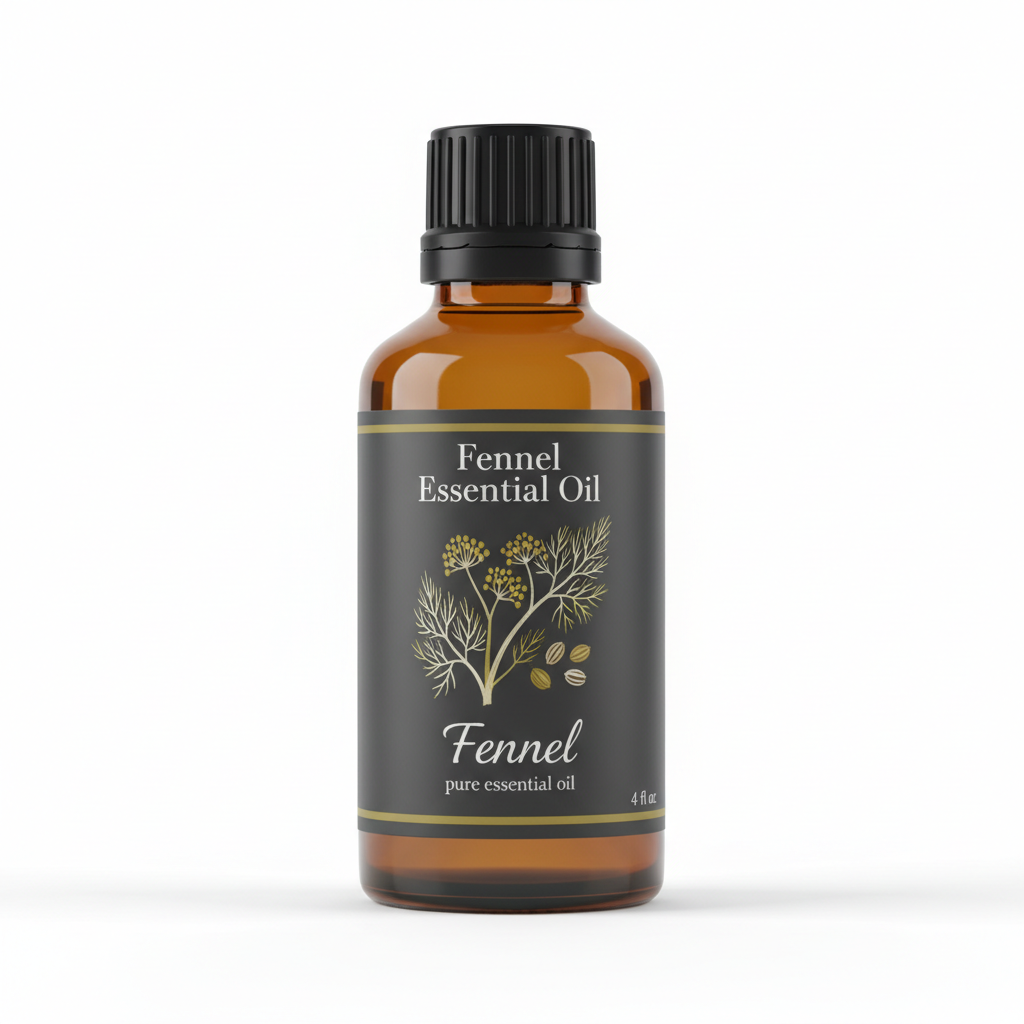
Fennel Essential Oil
Our own Fennel Essential Oil, in sizes from 0.5 oz to bulk.
From $13.99
Shop Now →What an antioxidant assay actually measures
The assay most often quoted is DPPH. It mixes a plant sample with a stable coloured chemical radical and records how much sample is needed to fade the colour by half (the IC50). A lower number means a stronger reaction in the tube. It involves no skin, no ultraviolet light, no collagen and no person.
A 2025 study of seed oil from Meknes, Morocco, reported a DPPH IC50 of 51.45 µg/mL for the oil, which was 24.72% fenchone, 22.22% trans-anethole and 20.48% limonene. The authors state that the work is in vitro and in silico and that "further experimental validations" are needed to confirm effects "in real biological systems," along with clinical studies (El Moumen et al., 2025). That is the paper's own limit, stated by the people who ran it.
Same species, a 37-fold spread
A 2011 study distilled the fruit of three organically grown Egyptian fennel cultivars and ran the same DPPH test. The sweet fennel oil (var. dulce, 46.26% trans-anethole) had an IC50 of 0.41 mg/mL, close to the 0.40 mg/mL the authors report for ascorbic acid in the same test. The azoricum cultivar (61.11% trans-anethole) came in at 0.35 mg/mL. The bitter var. vulgare oil, which was mostly estragole at 57.94% with only 4.99% trans-anethole, scored 15.33 mg/mL, about 37 times weaker than the sweet oil (Shahat et al., 2011). The paper has a flaw worth knowing: its methods list DPPH concentrations in µg/mL while it reports IC50 values in mg/mL, so read the absolute figures with care and the ranking with more confidence.
Three things follow, and they are reasoning from those two papers, not claims the papers make. First, "fennel oil is a strong antioxidant" is not one statement: it depends on variety, and two labs running two protocols give numbers you cannot fairly line up (51.45 µg/mL is 0.05 mg/mL, but a different test day and a different oil). Second, a bottle's label seldom tells you which of these profiles you have, which is why we publish anethole and estragole per lot and send both figures on request through the contact page. Third, even the best tube number is a number about a tube.
There is also a concentration trap. A 1% blend contains 10 mg of fennel oil per mL of carrier, many times the 0.41 mg/mL that halved the colour in the tube, so concentration is not what limits the claim. What limits it is the step from the tube to the skin: whether the oil gets to living cells, stays there, and does anything useful when it arrives. That step is the one nobody has measured for fennel oil, and it is the step the marketing quietly skips. The arithmetic is simple; the biology is what is missing.
What nobody has shown on skin
On 25 October 2026 we searched Europe PMC for fennel together with photoaging, collagen, skin aging and wrinkle. The first twenty results were reviews, plant-extract papers and formulation work. None was a human trial of fennel essential oil on wrinkles. A search limit is not proof of absence, but it is the best we can honestly say: we found no trial that measured fennel oil on aging human skin.
That leaves the claims people make in between: that antioxidants "fight free radicals" and so slow aging, that anethole "boosts collagen." The first jumps from a tube to a tissue. The second we could not source at all, so we do not repeat it.
A related claim says fennel's "phytoestrogen" action firms skin. The EMA's 2008 report does describe oestrogen-like activity of trans-anethole: oral doses of 80 mg/kg for three days raised uterine weight in immature female rats, and a yeast-cell assay showed activity at high concentrations (EMA, 2008). Those were a uterus and a receptor assay, not skin. It is the same pattern as the DPPH result, a real finding in a system that is not a face, and it is also why we say anyone with an oestrogen-sensitive condition should leave fennel oil alone.
What the dermatology and FDA sources put first
The American Academy of Dermatology's guidance on anti-aging products says dermatologists agree that sunscreen and moisturizer are the two most effective anti-aging products you can buy. It recommends broad-spectrum, water-resistant sunscreen with an SPF of at least 30, reapplied every two hours outdoors, and it adds that no single product addresses every sign of aging and "you cannot get the results of a facelift from a cream" (AAD, how to select anti-aging skin care products). The FDA's consumer page makes the regulatory point: only broad-spectrum sunscreens with an SPF of at least 15 have been shown to reduce the risk of skin cancer and early skin aging, and products below that carry a warning saying they have been shown only to help prevent sunburn (FDA, page current as of October 2026). The two bodies differ on the number, SPF 30 for the AAD and SPF 15 as the FDA floor, which is a difference between a recommendation and a minimum.
| Claim | Evidence behind it | Our grade |
|---|---|---|
| Fennel oil is a strong antioxidant | DPPH tube assays; spread of 0.41 to 15.33 mg/mL across fennel oils in one study | Lab only, and variety-dependent |
| It reverses wrinkles or boosts collagen | No human trial found; collagen claim unsourced | Unsupported |
| Sunscreen slows skin aging | AAD and FDA guidance | The established step |
| A cream rivals a facelift | AAD says it cannot | Myth |
A caution that belongs in an anti-aging conversation
The EMA's 2008 assessment report on fennel notes that fennel contains small amounts of bergapten, a linear furocoumarin that "might be responsible for phototoxicity." That sentence is about the plant, not about distilled oil, and we could not find a source that says whether the compound carries into steam-distilled oil in meaningful amounts (EMA, 2008, superseded). We therefore do not say fennel oil is phototoxic, and we do not say it is safe in sun. Anyone chasing smoother skin who is also using an ingredient with an unresolved phototoxicity note should be wearing sunscreen anyway, which is the point of the section above.
The same report lists rare allergic skin reactions and rare contact dermatitis to anethole-containing preparations. If you try a diluted blend, follow the 24-hour patch test and our 0.5% to 2% range in the skin basics guide.
Where fennel oil honestly fits, and who should skip it
If you enjoy the scent of an after-bath body oil, the DIY fennel body oil is a formulation we reasoned out from published dilution guidance. It is a fragrance choice. Do not use it as a substitute for sunscreen, and do not expect it to change fine lines.
- Skip it entirely if you are pregnant or breastfeeding, and keep it away from children; that is our published position.
- Skip it with an oestrogen-sensitive condition or epilepsy.
- Skip it if you have reacted to celery, aniseed, caraway, coriander, dill or anethole.
We sell one product, sweet fennel essential oil bottled undiluted, with no skincare products and no claim that it affects aging. If wrinkles, sun damage or dark patches worry you, a dermatologist can discuss sunscreen, prescription retinoids and other options with your actual skin in front of them. Our skin basics guide covers the safe-use basics, and for a different cosmetic myth about the same oil, read fennel oil and cellulite.
Fennel Essential Oil
Fennel Essential Oil from our own shop, in sizes from 0.5 oz to bulk.
From $13.99
Shop Now →Sources & Further Reading
- El Moumen B et al., 2025. Unveiling the chemical composition, antioxidant, and antimicrobial potentials of Foeniculum vulgare Mill: a combined in vitro and in silico approach. Int J Mol Sci 26(10):4499. pmc.ncbi.nlm.nih.gov
- Shahat AA et al., 2011. Chemical composition, antimicrobial and antioxidant activities of essential oils from organically cultivated fennel cultivars. Molecules 16(2):1366-1377. pmc.ncbi.nlm.nih.gov
- American Academy of Dermatology. How to select anti-aging skin care products. aad.org
- U.S. Food and Drug Administration. Sunscreen: how to help protect your skin from the sun. fda.gov
- European Medicines Agency, 2008. Assessment report on Foeniculum vulgare Miller (superseded). ema.europa.eu