Best Carrier Oils for Fennel Essential Oil
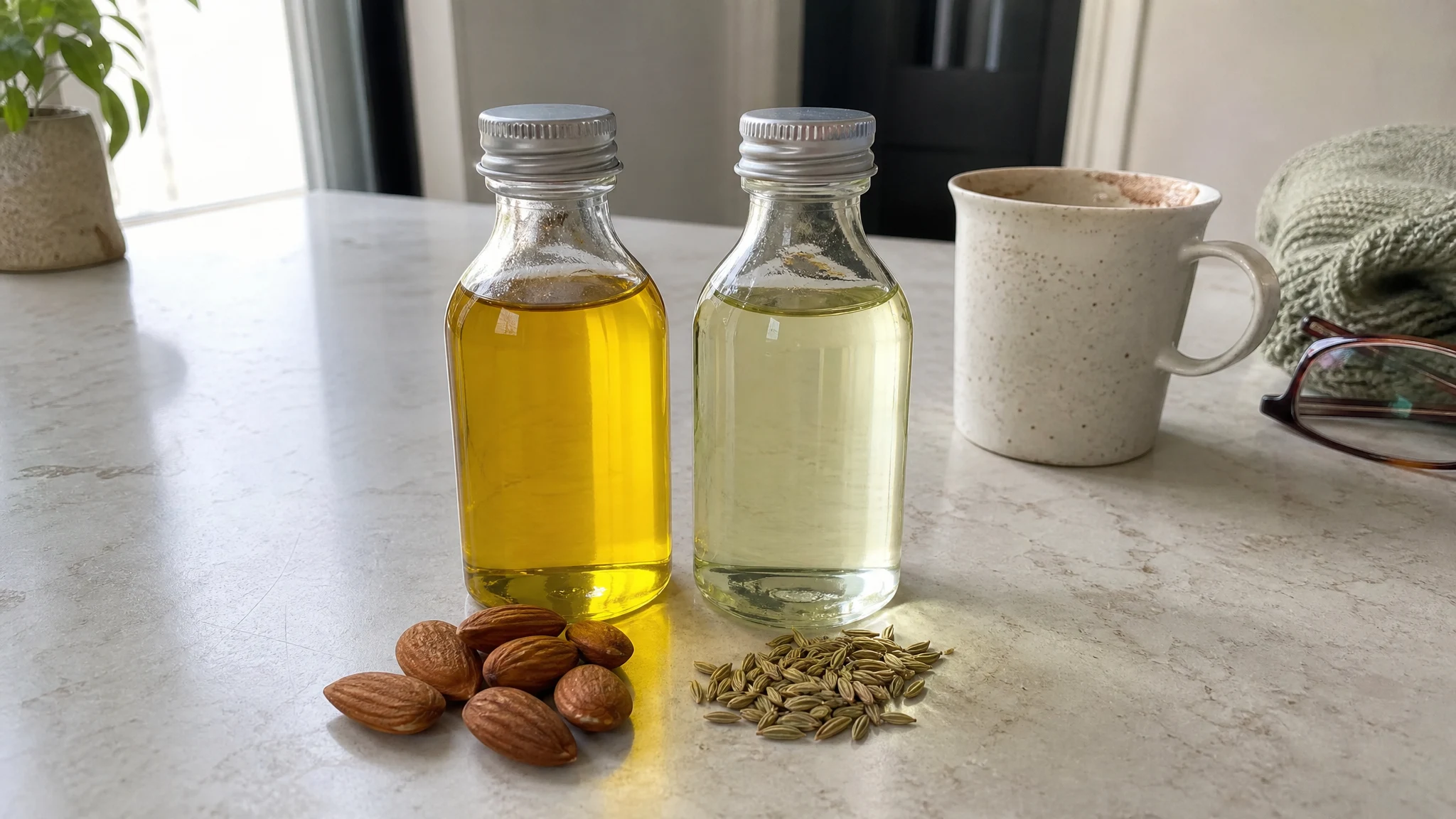
There is no single best carrier for fennel oil, and no carrier makes it safer than the dilution does. What a carrier does change is how long your blend keeps, whether it suits oily or breakout-prone skin, and whether it is a problem for anyone with a nut allergy. We sell sweet fennel essential oil only, with no carrier oils, so this page is a comparison from published sources, with the trade-offs stated and nothing to sell you.
Fennel Essential Oil
Our own Fennel Essential Oil, in sizes from 0.5 oz to bulk.
From $13.99
Shop Now →Start with the dilution, because the carrier does not change it
Our published range for skin is 0.5% to 2% fennel oil in a carrier, roughly 3 to 12 drops per ounce, with a 24-hour patch test first. The arithmetic: an ounce is about 30 ml, which at the common planning figure of 20 drops per ml is about 600 drops, so 0.5% is 3 drops and 2% is 12. In a 10 ml bottle, 1% is 0.1 ml, about 2 drops. Drop size varies with the bottle opening, so this is a guide, not a lab measurement. Any carrier in this article is used at that same dilution. The reasons for caution are in our skin basics guide: the EMA lists allergic skin reactions to fennel as rare, with rare contact dermatitis to anethole preparations (EMA, 2008, superseded), and no carrier changes that.
| Batch size | At 0.5% | At 1% | At 2% |
|---|---|---|---|
| 10 ml bottle | 1 drop | 2 drops | 4 drops |
| 30 ml (1 oz) | 3 drops | 6 drops | 12 drops |
| 100 ml | 10 drops | 20 drops | 40 drops |
Those figures use 20 drops per ml and are our arithmetic from the published range. Mixing two carriers is fine for the same reason: the percentage is of the total volume, so count all the carrier you pour in.
What the sources say about each carrier
The figures below come from published papers, and fatty-acid percentages differ by crop, region and processing, so read them as typical ranges, not specifications for the oil in your bottle.
| Carrier | Composition, as published | Stability | Watch for |
|---|---|---|---|
| Jojoba | More than 98% waxes (Abdalla et al., 2024) | Longest induction period of four oils tested in a 2026 oxidation study | Listed as noncomedogenic in a review; not a trial |
| Sweet almond | Oleic acid 53 to 78%, linoleic 13 to 26% (Poljšak and Kočevar Glavač, 2022) | Middle: mostly monounsaturated | Nut allergy; ask whether refined |
| Apricot kernel | 68.61% oleic acid in one 2025 analysis (Akbaş et al., 2025) | Similar to almond by composition (our inference) | One analysis; origin varies |
| Grapeseed | 66.62% linoleic acid in the same 2025 analysis | Lower: high in polyunsaturates | Shortest shelf life of this list (our inference) |
| Fractionated coconut | Medium-chain fraction, mainly C8 and C10 (Heidt et al., 2026) | High: coconut oil is described as very resistant to rancidity | Not the same as virgin coconut oil |
| Virgin coconut | Lauric acid 46 to 48% (Abdalla et al., 2024) | High | Listed as highly comedogenic |
| Olive | Oleic 73 to 78%, linoleic 7 to 9% (Poljšak and Kočevar Glavač, 2022) | Described as susceptible to oxidation | Scent varies by grade; smell before buying |
The stability column has one direct measurement and the rest is inference. In a 2026 study that pushed rosehip, sunflower, olive and jojoba oils to oxidise, jojoba had the longest induction period and the ranking tracked each oil's polyunsaturated fatty acid content (Fagoaga et al., 2026). Grapeseed was not in that test. Our reasoning, from its 66.62% linoleic acid and the pattern in that study, is that grapeseed should oxidise sooner than jojoba, which is why a grapeseed blend should be made in small batches. That is an inference, not a measurement.
Matching the carrier to the job
Face, or skin that breaks out. Avoid virgin coconut oil: the same review lists it as highly comedogenic. Comedogenicity ratings are weaker evidence than they look, because early testing used animal models on raw ingredients, and a small human study of finished products found that products containing comedogenic ingredients are not necessarily comedogenic (Draelos and DiNardo, 2006). Jojoba is the usual pick on that basis, with the caveat that its rating is a review's statement. Our fennel oil and acne article goes into why we would be cautious with fennel on a face at all.
Body oil you will keep for months. Choose a stable carrier and mix a small batch. Jojoba or fractionated coconut fit best on the sourced stability data. Our DIY fennel body oil is a formulation reasoned from published dilution guidance, and it uses carriers from this list. Fennel oil is typically stable for 2 to 3 years sealed, per our own guidance. Polyunsaturated carriers may spoil sooner than that (our inference from the stability data), so label the batch date; see how to store fennel essential oil.
Massage over large areas. How a carrier feels, how fast it absorbs and how greasy it leaves the skin are real differences, but none of the sources we opened ranks carriers on feel, so we make no claim. Try a small amount of any carrier alone before blending a large batch, and remember a larger area means more total oil on skin, which is a reason to stay at the low end of the dilution range.
Our short answer, reasoned from the table and not from any test of ours: jojoba is the most defensible all-round pick for a face or a blend you will keep, because of its stability data and its review-level noncomedogenic listing. Fractionated coconut is the stable, light alternative. Sweet almond is a reasonable body carrier if nobody using it has a nut allergy and you buy it fresh. Grapeseed suits a batch you will use up quickly. Virgin coconut and olive are the ones we would steer away from for facial use, for the reasons the sources give.
The nut allergy question
If anyone using the blend has a tree nut allergy, sweet almond and apricot kernel oils need a decision, not an assumption. The American Academy of Allergy, Asthma and Immunology's allergist answer, reviewed October 2026, explains that refined oils are extracted with chemical agents or high heat and generally do not contain proteins, while unrefined cold-pressed nut oils do. It says the topic "has not been well studied," and advises asking the manufacturer whether a nut oil is refined (AAAAI, Pongracic). Choosing jojoba avoids the almond-protein question, but we are not allergists, and whether coconut-derived oils suit a person with a known nut allergy is a question for an allergist.
What to read on a carrier bottle
- The plant and the word refined or cold-pressed (or unrefined). It decides the nut-allergy answer and the scent.
- A harvest, pressing or best-before date, because oxidation is the carrier's main failure.
- Dark glass and a tight cap, kept away from heat and light, as for the fennel oil itself.
- A plain carrier. Skip blends already scented, or you lose control of the total essential oil percentage.
A rancid smell is the practical signal that a carrier has oxidised, and a rancid carrier should not go on skin. That is a rule of thumb, not a study result.
Who should not make this blend, and where we stop
- Anyone pregnant or breastfeeding, and children. Our published position is to avoid fennel oil entirely.
- Anyone with an oestrogen-sensitive condition or epilepsy.
- Anyone allergic to celery, aniseed, caraway, coriander, dill or anethole.
We make and sell one oil, sweet fennel, and we do not sell carriers, so buy yours from a supplier that states refined or cold-pressed and a date. A pharmacist can answer questions about interactions, and an allergist can answer nut-oil questions. The place to begin remains the skin basics guide. If you are comparing a carrier called fennel seed oil with the essential oil, fennel seed oil vs fennel essential oil explains why they are different products.
Fennel Essential Oil
Fennel Essential Oil from our own shop, in sizes from 0.5 oz to bulk.
From $13.99
Shop Now →Sources & Further Reading
- Abdalla S, Aroua MK, Gew LT, 2024. A comprehensive review of plant-based cosmetic oils. ACS Omega 9(44):44019-44032. pmc.ncbi.nlm.nih.gov
- Poljšak N, Kočevar Glavač N, 2022. Vegetable butters and oils as therapeutically and cosmetically active ingredients for dermal use: a review of clinical studies. Front Pharmacol 13:868461. pmc.ncbi.nlm.nih.gov
- Akbaş Ş, Osório NM, Ferreira-Dias S, 2025. Batch and continuous lipase-catalyzed production of dietetic structured lipids from milk thistle, grapeseed, and apricot kernel oils. Molecules 30(9):1943. pmc.ncbi.nlm.nih.gov
- Heidt C et al., 2026. Medium-chain triglycerides: scientific and regulatory perspectives from Germany and Japan with a US context. Nutrients 18(7):1027. pmc.ncbi.nlm.nih.gov
- Fagoaga C, Moreno A, Fernández-Julián N, Castellano G, 2026. Oxidative stability and kinetics of oxidation of rosehip, sunflower, olive and jojoba oils. Antioxidants (Basel) 15(5):646. pubmed.ncbi.nlm.nih.gov
- Draelos ZD, DiNardo JC, 2006. A re-evaluation of the comedogenicity concept. J Am Acad Dermatol 54(3):507-512. pubmed.ncbi.nlm.nih.gov
- American Academy of Allergy, Asthma and Immunology. Food allergy: nut oils in topical products (Pongracic JA). aaaai.org
- European Medicines Agency, 2008. Assessment report on Foeniculum vulgare Miller (superseded). ema.europa.eu