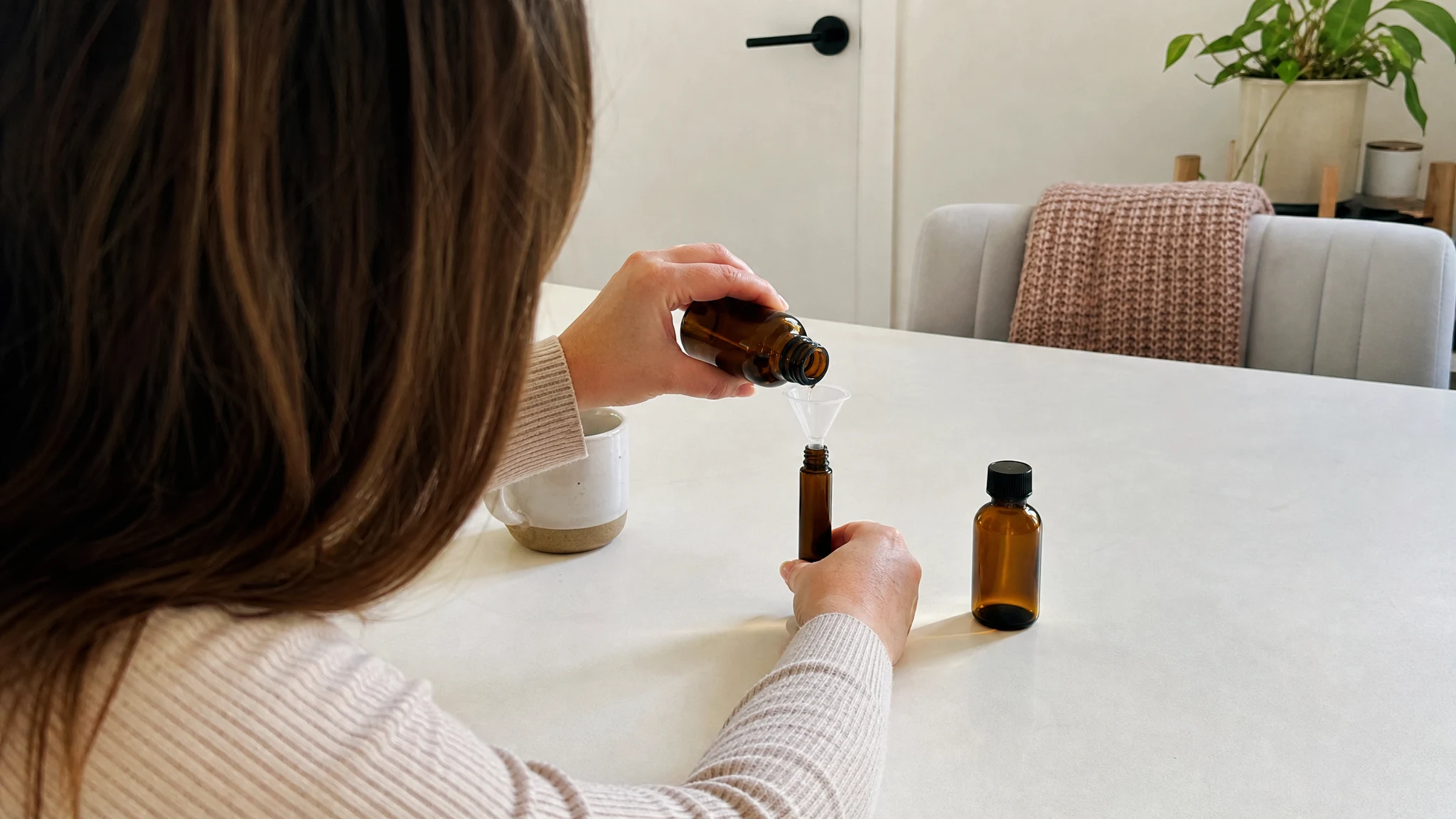
Fennel Roller Blend Recipes With the Dilution Math Done
A 10 ml roller bottle is too small for the way most recipes count: drops. At the 0.5% to 2% range that we publish for fennel oil, you are choosing between one and four drops, and the size of a "drop" varies by 50% or more between droppers. So this page does the arithmetic first, shows where it gets uncomfortable for an anethole-rich oil, and only then gives three formulations. They are reasoned from published dilution guidance, not tested batches, and we say so each time. Roller blends sit in the craft end of what fennel oil is used for; our 18 everyday ideas for home is the wider list.
Fennel Essential Oil
Our own Fennel Essential Oil, in sizes from 0.5 oz to bulk.
From $13.99
Shop Now →Step one: how big is a drop
The Tisserand Institute summarises three published measurements of essential oil drop size (1999, 2000 and 2016, covering 1, 25 and 23 oils across 3 to 7 types of dispenser). The average weight of 20 drops was 0.66 g in all three, and drops per ml ranged from about 20 to 40. The Institute's own dilution chart assumes 30 drops per ml, and its author's conclusion is that "a drop is never a precise measure" but that the average is fine outside a clinical setting (Tisserand Institute, "How big is a drop?").
Our oil can be checked against that. The certificate of analysis for our published batch lists a specific gravity of 0.975 at 20 °C (certificate). An average drop of 33 mg (0.66 g divided by 20) is therefore about 0.034 ml, or roughly 30 drops per ml. That is arithmetic from two published figures, not a measurement of our bottle, and your dropper will differ. Our own shop guidance (about 3 to 12 drops per ounce of carrier) is consistent with the older 20-drops-per-ml convention, so both are shown below.
The roller table
For a 10 ml roller, with essential oil measured by volume:
| Dilution | Fennel oil needed | Drops at 20 per ml | Drops at 30 per ml |
|---|---|---|---|
| 0.5% | 0.05 ml | 1 | 1.5 |
| 1% | 0.10 ml | 2 | 3 |
| 1.5% | 0.15 ml | 3 | 4.5 |
| 2% | 0.20 ml | 4 | 6 |
Read across the rows. Two drops is 1% on one convention and 0.67% on the other, and one drop is either 0.5% or 0.33%. A one-drop error in a 10 ml bottle moves you by 0.33 to 0.5 percentage points. At low targets that is the whole range you were aiming for.
Two ways to reduce the error, both pure arithmetic. First, make a larger batch: 30 ml at 0.5% needs 3 drops (20 per ml), so one drop is a smaller slice of the total. Second, dilute once and measure the dilution by volume. A 10% stock is 1 ml of fennel oil in 9 ml of carrier oil. Then 1 ml of stock in 9 ml more carrier gives a 1% roller, and 0.5 ml of stock in 9.5 ml gives 0.5%. A 1 ml syringe or pipette replaces drop counting. Label the stock clearly and keep it away from children.
Where fennel is not like other oils
Here is the part that most roller recipes skip. Fennel oil is mostly anethole, and sweet fennel oil also contains estragole. The fragrance industry's estragole standard publishes a limit for each of 12 product categories, from 0.0021% to 1.5% of the finished product, and lists an indicative estragole level of 3% for sweet fennel oil. It adds that an analysed value should replace the indicative one when you have it (IFRA, Amendment 49, 2020, hosted copy; later amendments exist and may differ, so check ifrafragrance.org). Multiply it out. The fennel-oil percentage that would reach each estragole limit, assuming 3%:
| Estragole limit in the finished product | Fennel oil that reaches it (limit divided by 0.03) |
|---|---|
| 0.0021% (the strictest, shared by several categories) | about 0.07% |
| 0.012% (several categories) | about 0.4% |
| 0.075% | about 2.5% |
| 0.42% | about 14% |
A 1% roller therefore contains about 0.03% estragole at the indicative figure, which is above some category limits and below others. We did not open the standard's category definitions, so we are not assigning a roller to one, and the limits assume typical amounts of product used, which a small roller applied to one patch of skin does not match exactly. Use the table to see how quickly the allowed level shrinks, not as a pass or fail. It is why we do not tell you any roller percentage is safe for every part of the body, and why we start recipes at 0.5%. If you want a tighter number for your oil, ask us for the estragole figure for your lot (contact page) and replace the 3%.
For scale, the one human trial we found that used fennel seed oil on skin applied 1.6% in sweet almond oil in massage, one session every 15 days for two months, to 20 people against 20 receiving massage alone; it was described by its authors as exploratory, and it measured anxiety, sleep and well-being questionnaires (Félix and colleagues, 2026). It is not a roller study and it is not a safety ruling. A concentration used in a trial is not a recommendation.
Three formulations
These are reasoned from the arithmetic above and from our published 0.5% to 2% range. We have not run batches of them, and nothing here is a tested recipe. Drop counts use 20 drops per ml. Fill the rest of the bottle with a carrier oil; the carrier oil guide compares options.
- Single-oil scent roller, 0.5%. 10 ml roller. Either 1 drop of fennel oil (20 per ml), or 0.5 ml of a 10% stock plus 9.5 ml carrier, which is the more reliable route.
- Fennel and lavender evening roller, 1% total. 10 ml roller. 1 drop fennel (0.5%) and 1 drop lavender (0.5%), the rest carrier. We hold to a combined total of 1% so the fennel share stays at 0.5%. For why lavender pairs with fennel, see what blends well with fennel oil.
- Three-roller batch, 0.5% fennel and 0.5% lavender. 30 ml of carrier in total, with 3 drops of each oil, poured into three 10 ml bottles. Each drop is a smaller slice of the whole, so a miscount costs less.
A blend with any oil other than lavender needs that oil's own limits, from its supplier, not ours. We sell only fennel and cannot give you those numbers.
What commonly goes wrong
The usual failure is not a bad recipe but an unrecorded one. Someone adds "a couple of drops", tops up a half-used bottle with more carrier, and a month later cannot say what percentage is on their skin. Write the percentage, the date and the ingredients on the label when you make it, and note which dropper you used, since the table above shows the dropper changes the result. Do not top up an old blend with new oil; make a fresh bottle. Keep the roller away from children, who may mistake a small scented bottle for something harmless (that last point is common sense rather than a published finding).
Use and limits
- Patch test first. Apply the finished blend to a small patch of skin and wait 24 hours. Our skin basics guide walks through it.
- Who should skip it. Our published guidance is to avoid fennel oil entirely in pregnancy and while breastfeeding, not to use it with children, and to leave it alone with an oestrogen-sensitive condition or epilepsy. Keep it away from eyes and pets. A pharmacist or your own doctor can tell you what applies to you.
- Where not to roll it. Not on the face or on broken skin, in our view. That follows from the estragole arithmetic above and is a precaution, not a measured hazard.
- Storage. Keep the stock and the roller capped, away from heat and light. We have no tested shelf life for diluted blends, so write the date on the label and discard the roller if the scent changes.
The honest summary is that a 10 ml roller is the least forgiving place to use fennel oil. Do the math in volume, keep the fennel share small, and use our uses guide for lower-stakes ways to enjoy it.
Fennel Essential Oil
Fennel Essential Oil from our own shop, in sizes from 0.5 oz to bulk.
From $13.99
Shop Now →Sources & Further Reading
- Tisserand Institute. How big is a drop? tisserandinstitute.org
- IFRA, 2020. IFRA Standard: Estragole (Amendment 49). perfumersworld.com (hosted copy)
- Félix BP, Rodrigues A, Sousa MJ, Pereira OR, 2026. Effect of aromatherapy massage with Foeniculum vulgare Mill. seed essential oil compared to massage on anxiety, well-being, and sleep quality: an exploratory randomized study. Health Sci Rep. pubmed.ncbi.nlm.nih.gov/42147465