
Can You Swallow Fennel Essential Oil? Flavouring vs the Bottle
We do not recommend swallowing fennel essential oil, and our bottle is not meant for internal use. The usual counterargument is that fennel oil is "approved for food". That is true of a flavouring used in a food, and it says little about a drop of the oil in a glass of water. This page explains the gap, with the numbers; the wider picture is in is fennel essential oil safe.
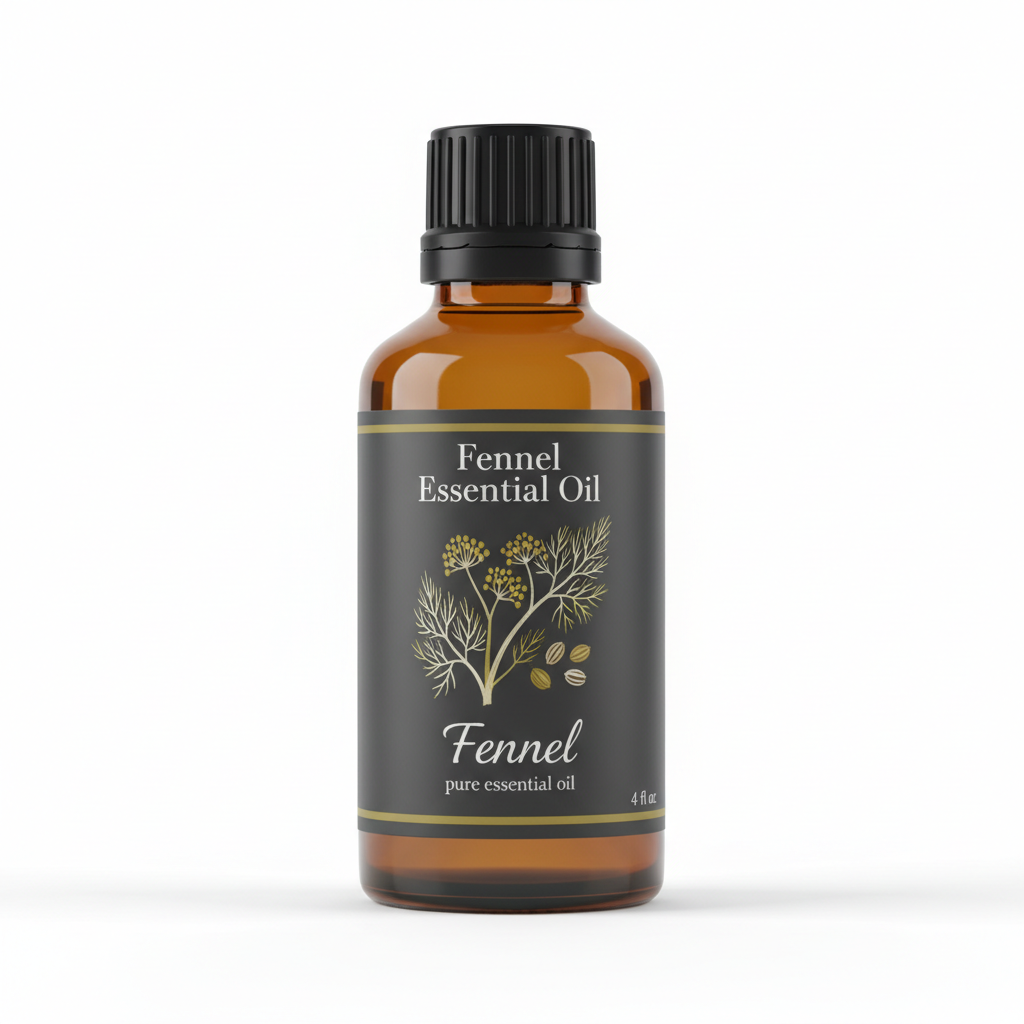
Fennel Essential Oil
Our own Fennel Essential Oil, in sizes from 0.5 oz to bulk.
From $13.99
Shop Now →What the food listing covers and what it does not
In the United States, 21 CFR 182.20 lists the essential oils, oleoresins and natural extractives that are "generally recognized as safe for their intended use". "Fennel, sweet" (Foeniculum vulgare Mill.) is on it (eCFR, 21 CFR 182.20). The operative words are "for their intended use", and the regulation sits in the part of the code that deals with food substances. The intended use is flavouring: a small amount of oil spread through a whole portion of food, made by a manufacturer who controls the amount.
The listing does not say a consumer can measure drops of undiluted oil into a drink. It also does not define "food grade". On a bottle, that phrase is a seller's description unless it names a standard, so ask which one.
Flavouring against the bottle, side by side
| Question | Flavouring in a food | The bottle |
|---|---|---|
| How much reaches you at once | A trace, distributed through the portion; the whole diet is estimated at roughly 1 mg of estragole a day from all foods combined (Council of Europe estimate, cited by the EMA) | One drop is about 0.05 mL, roughly 48 mg of oil, which at the 3.76% mean estragole in EFSA's sweet fennel oil batches is about 1.8 mg of estragole |
| Who controls the amount | The manufacturer, to a formula | You, by eye, from a bottle |
| What the law is describing | A flavouring use | Nothing: our guidance is that the bottle is not for internal use |
| Where EU regulators landed on oral oil as a medicine | Not applicable | In 2024 the EMA committee concluded a monograph for oral bitter fennel oil could not be supported |
| If you misjudge | Little room to misjudge | Concentrated exposure, with aspiration a recognised risk |
The arithmetic rows are ours: a 0.05 mL drop, an oil density of about 0.96 g/mL (the figure implied by the EMA's own dose calculation), and one published mean for someone else's batches. Your lot will differ. Read it as scale, not as a measurement of your bottle.
What the EU did with the oral medicine
This is the history most "can I ingest it" pages skip. In 2007 the European Medicines Agency's herbal committee published a monograph that allowed a traditional product of bitter fennel fruit oil for cough, at 200 microlitres a day for up to two weeks, and contraindicated it under 18 years of age (EMA monograph, 2007). On 29 May 2024 the same committee adopted a public statement reversing that. It said new data on estragole's genotoxicity and carcinogenicity, together with the high estragole intake at the traditional dose, mean a monograph "cannot be supported anymore," and it proposed withdrawing the 2007 text. The committee added that carcinogenicity studies have not been done with fennel oil itself (EMA public statement, 2024).
Three limits on how far to read that. It concerns bitter fennel oil, which the European Pharmacopoeia caps at 6.0% estragole, and the EMA's own table puts sweet fennel oil lower, at 1.5% to 5.0%. Its assessment report found "no evidence of use of sweet fennel fruit oil" in European medicinal products. And it is a benefit-risk judgement about a cough product with other options available, not a ruling that one swallow harms anyone. For the estragole science behind it, see estragole in fennel oil.
Doing the dose arithmetic once
The EMA's estragole statement sets guidance values for medicines: 0.05 mg a day for adults, pregnant and breastfeeding women, and 1.0 microgram per kg of body weight a day for children up to 11 (EMA estragole statement, 2023). Compared with one drop at 1.8 mg of estragole, that is about 36 times the adult figure and, for a 20 kg child whose figure is 20 micrograms, about 90 times.
Two honest cautions on that comparison. These are daily intakes over time, not a one-off, so a single drop is not the same as 36 days of exceeding a limit. And the EMA itself says an exact limit cannot be defined and describes the figure as a "helpful tool." What it shows is scale: a drop of the bottle sits well outside the range regulators designed their numbers around.
Trans-anethole, the main compound, has its own number. The EMA assessment report cites an acceptable daily intake of about 0 to 2 mg per kg from the JECFA committee in 1999 and notes that the traditional oral dose of bitter fennel oil exceeds it, which the agency set aside as no specific concern because use was short (not more than one week in its calculation) (EMA assessment report, 2024).
Fennel tea is not fennel oil
A reader who has had fennel tea may assume the oil is the same thing, more concentrated. The two differ enormously in how much estragole you take in. The EMA's estragole statement cites a study of 37 fennel preparations in which only less than 0.1% to 2.5% of the estragole reached the infusion, with 0.4 to 133.4 micrograms in an infusion made from 1 g of material. A swallowed oil delivers all of it. The tea has its own limits, set out in the EMA fennel fruit monograph, 2024, but those are limits on a herbal tea and do not transfer to the oil.
Why a plain-capped bottle makes the dose worse
Everything above assumes you know how much oil you took. With a bottle there is no way to. Ours has a plain cap, so pouring is uncontrolled, and any drop count is an estimate: the 0.05 mL we use for arithmetic is an average that shifts with the opening and the oil's viscosity. A manufacturer working to a formula can fix the amount of oil per batch of food. A person tipping a bottle over a glass has no such control, and the EMA's own cautious oral dose was 200 microlitres, about four of those drops, under medical-product conditions and for a defined short course.
That leaves a simple rule for any "safe to ingest" claim you meet, ours or anyone's. Ask who stands behind the dose, which named standard the oil meets, and what the estragole content is for the lot in your hand. If the seller cannot answer all three, the claim is a label, not a safety assessment.
What goes wrong when the oil is swallowed
America's Poison Centers says that some essential oils are poisonous if swallowed and that aspirating one into the lungs during choking can cause pneumonia (poison.org). For fennel oil specifically, a 2011 case report describes a woman with well-controlled epilepsy who had a tonic-clonic seizure after eating cakes made with an unknown amount of the oil (Skalli and Soulaymani Bencheikh, 2011). Note the route: this was food, not the bottle, and she had epilepsy, so it is also a case for caution with flavourings in that group.
If someone has swallowed the oil, call poison control (US: 1-800-222-1222) and have the bottle in your hand. Call rather than waiting to see whether symptoms appear.
Who to ask, and what to ask
If your question is really "can I take fennel for digestion", the person to ask is a pharmacist or a physician, who can point to a product made for oral use by a manufacturer that states its estragole content. Our bottle is not that product. The pharmacist can also point you to the right product type, which is not a bottle of essential oil. If you are pregnant, breastfeeding, taking medicines, or have epilepsy or a hormone-sensitive condition, the answer is already in is fennel essential oil safe and contraindications and interactions. If you are weighing whether a "fennel seed oil" is a different thing, see fennel seed oil vs fennel essential oil.
We will tell you what is in our oil: an independent laboratory quantifies anethole and estragole for every lot, and we send both figures on request via the contact page. We will not tell you to swallow it. Our overview of the whole question is is fennel essential oil safe.
Fennel Essential Oil
Fennel Essential Oil from our own shop, in sizes from 0.5 oz to bulk.
From $13.99
Shop Now →Sources & Further Reading
- U.S. Code of Federal Regulations, Title 21, section 182.20. Essential oils, oleoresins (solvent-free), and natural extractives (including distillates). ecfr.gov
- European Medicines Agency, 2024. Public statement on Foeniculum vulgare Miller subsp. vulgare var. vulgare, aetheroleum, EMA/HMPC/522456/2021. ema.europa.eu (public statement PDF)
- European Medicines Agency, 2024. Assessment report on Foeniculum vulgare, aetheroleum, final revision 1. ema.europa.eu (assessment report PDF)
- European Medicines Agency, 2024. European Union herbal monograph on Foeniculum vulgare, fructus, final revision 1. ema.europa.eu (monograph PDF)
- European Medicines Agency, 2007. Community herbal monograph on Foeniculum vulgare, aetheroleum, copy hosted by e-lactancia. e-lactancia.org (monograph PDF)
- European Medicines Agency, 2023. Public statement on the use of herbal medicinal products containing estragole, revision 1. ema.europa.eu (statement PDF)
- EFSA FEEDAP Panel, 2023. Safety and efficacy of feed additives consisting of essential oils from the fruit and stems of Foeniculum vulgare. EFSA Journal 21(10):e08348. pmc.ncbi.nlm.nih.gov/articles/PMC10613937
- Skalli S, Soulaymani Bencheikh R, 2011. Epileptic seizure induced by fennel essential oil. Epileptic Disord 13(3):345-347. pubmed.ncbi.nlm.nih.gov/21865126
- America's Poison Centers. Essential oils. poison.org