Is Fennel Essential Oil Safe? Who Should Skip It and Why
For a healthy adult using a small, patch-tested, diluted amount on skin, the documented risk is mainly irritation or sensitisation. For pregnancy, breastfeeding, children, epilepsy, hormone-sensitive conditions and allergy to the carrot family, regulators and we advise leaving it out. Swallowing the oil is a separate question with a firmer answer: don't.
Fennel Essential Oil
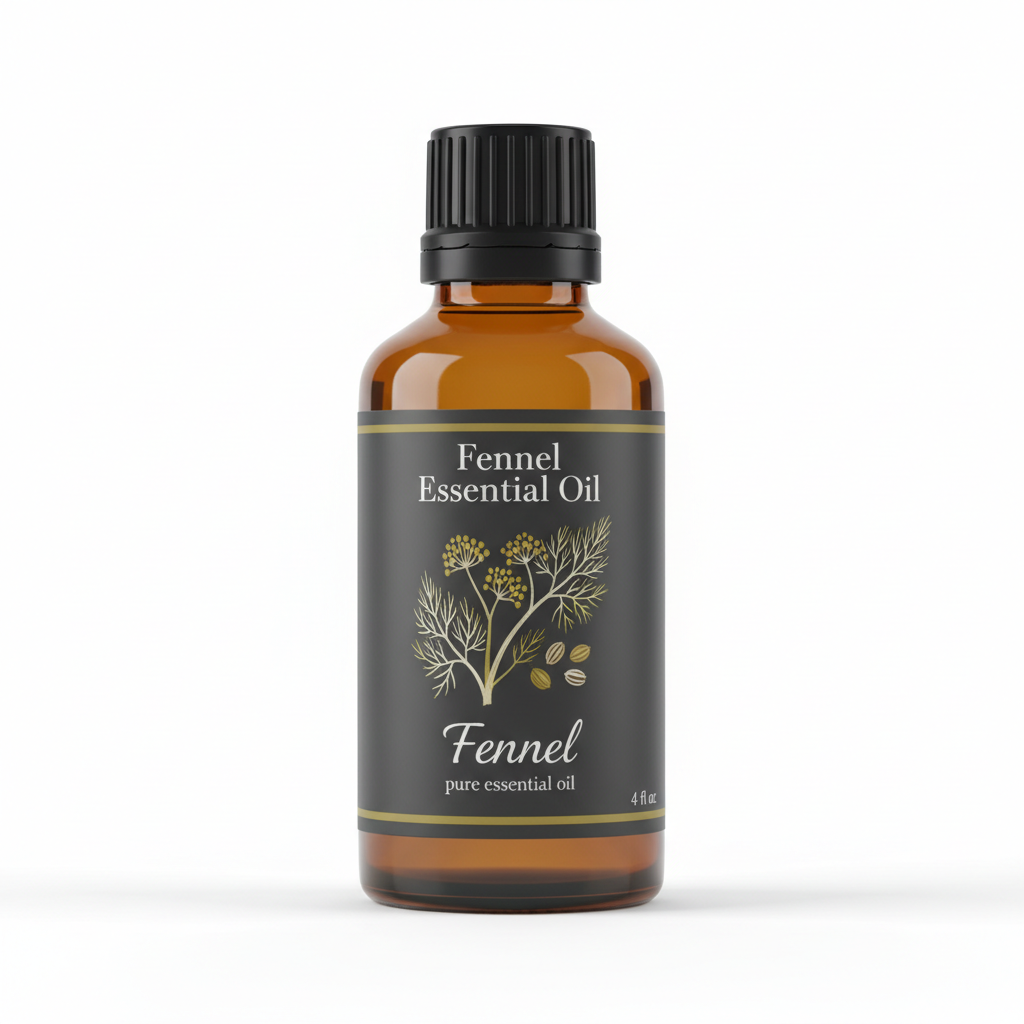
Our own Fennel Essential Oil, in sizes from 0.5 oz to bulk.
From $13.99
Shop Now →The question has three parts: who, how, and which fennel
A generic answer ignores those differences. The regulators who have reviewed fennel oil did not. The European Medicines Agency (EMA) committee that reviews herbal medicines wrote different rules for adults, for children, for pregnancy and for each route, and its oil documents are about bitter fennel oil, not sweet. Its 2024 assessment report notes "no evidence of use of sweet fennel fruit oil" in European medicinal products (EMA assessment report, 2024).
That matters because we sell sweet fennel, and any advice about "fennel oil" that never names the variety is incomplete. Sweet oil is higher in trans-anethole and lower in fenchone than bitter; see sweet vs bitter fennel oil for the difference. Where the evidence below is about bitter oil, anethole or estragole in general, we say so, and applying it to sweet oil is an extrapolation.
Why fennel gets more caution than most oils
Four separate findings sit behind the caution. They are different in kind, so it helps to keep them apart.
- Estrogen-like activity. The EMA report summarises a rat experiment in which oral trans-anethole at 80 mg/kg for three days raised uterine weight in immature females, and a yeast assay in which anethole activated the human estrogen receptor at high concentrations. Both are laboratory findings at doses far above a drop on skin. The agency's 2007 monograph still warned that excessive doses of fennel oil may affect hormone therapy and the contraceptive pill (EMA monograph, 2007).
- Estragole. A minor component of fennel oil that is a genotoxic carcinogen in rodents. The EMA's position and what it does and does not mean are in estragole in fennel oil.
- Seizures. A 1999 paper in the Journal of Neurology reviewed the literature and listed fennel among 11 plant oils reported as convulsants, and in 2011 a case report described a 38-year-old woman with well-controlled epilepsy who had a tonic-clonic seizure after eating cakes made with an unknown amount of fennel oil (Burkhard et al., 1999; Skalli and Soulaymani Bencheikh, 2011). The case report concerns swallowed oil; the 1999 abstract does not specify the route for its own three patients.
- Skin and airway sensitisation. In 2023 the European Food Safety Authority's feed-additive panel assessed sweet fennel oil and described it as an irritant to skin and eyes and a dermal and respiratory sensitiser (EFSA FEEDAP Panel, 2023).
Who should skip it: one table
This is the part that is easy to lose in running text, so it is one table. Each row gives the reason, what we advise, and where the reason comes from. "Our guidance" is the position we publish; the regulator column is what the cited agency actually wrote, which is sometimes narrower.
| Group | Reason | Guidance | Source |
|---|---|---|---|
| Pregnancy and breastfeeding (detail) | Safety not established; no adequate reproductive studies of fennel oil; estragole guidance value of 0.05 mg per person per day | Our guidance: avoid entirely. EMA: not recommended | EMA assessment report, 2024; EMA estragole statement, 2023 |
| Under 1 year | Lack of data and presence of estragole | EMA: contraindicated for the oral oil. Ours: not appropriate for children | EMA assessment report, 2024 |
| 1 to 11 years (detail) | Estragole guidance value of 1.0 microgram per kg per day | EMA: oral oil not recommended. Ours: not appropriate for children | EMA assessment report, 2024; EMA estragole statement, 2023 |
| Epilepsy | Convulsions reported after swallowing fennel oil; anethole in excess linked to convulsions in the EMA's literature review | Our guidance: leave it alone. EMA lists no formal contraindication | Skalli, 2011; Burkhard, 1999 |
| Estrogen-sensitive conditions, hormone therapy, contraceptive pill (detail) | Estrogenic activity of anethole in rat and yeast assays; no human data on the oil | Our guidance: leave it alone. EMA: excessive doses may affect hormone therapy | EMA monograph, 2007; EMA assessment report, 2024 |
| Allergy to celery, aniseed, caraway, coriander, dill or mugwort pollen | Cross-reactivity within the carrot family and with mugwort | EMA: contraindicated | EMA monograph, 2024 |
| Dogs and cats (detail) | The ASPCA lists the plant as non-toxic but says to avoid concentrated oil; it is the only pet guidance we could open | Keep the bottle and diffuser away from pets; ask a veterinarian | ASPCA plant entry |
On skin: dilute, patch test, and keep it modest
Our published guidance is 0.5% to 2% in a carrier oil, with a 24-hour patch test first, and the method is in fennel oil skin basics. Given the sensitiser classification above, the patch test is the one step worth not skipping.
There is a gap here that most pages leave out. The EMA's estragole statement says that no data exist on how much estragole crosses the skin, and for medicines it applies the same daily limits to skin products as to oral ones unless lower absorption is shown, restricting use to intact skin for a maximum of two weeks. That is a rule for licensed medicines, not for cosmetics, and nobody has measured our case. But the arithmetic is worth seeing. Using the EFSA panel's mean of 3.76% estragole in five batches of sweet fennel oil, a 0.05 mL drop, and an oil density of about 0.96 g/mL (implied by the EMA's own dose arithmetic), one millilitre of a 1% blend carries about 0.36 mg of estragole, against a guidance value of 0.05 mg for a day. Whether any meaningful share is absorbed is the unknown. We read that as a reason to stay at the low end of the range, not to use it daily over large areas, and to skip it altogether in the groups in the table. That is reasoning, not a finding.
In the air: the least studied route
We found no study that measured what a person absorbs from a diffused fennel oil, and none on safety outcomes of diffusing it. The only relevant classification is EFSA's respiratory sensitiser label, written for people handling the feed additive. Reasoning from that: short sessions, an open door, and no diffusing around infants, pets, or anyone with asthma or a history of reacting to the oil. If a room smells strongly of anise, it is already more than needed.
By mouth: a different answer
For a swallowed bottle, the evidence is firmer and the advice is plain. America's Poison Centers says that aspirating an essential oil, which can happen when oil enters the lungs during choking, can cause pneumonia, and that anyone who swallows one should call 1-800-222-1222 in the US (poison.org). In 2024 the EMA concluded that a monograph for oral bitter fennel oil as a medicine could no longer be supported. The reasoning is in can you swallow fennel essential oil. Our bottle is not meant for internal use.
Side effects, and the quality variable
What actual reactions look like, and when they are an emergency, are in fennel oil side effects.
Quality is a safety variable here for a specific reason: estragole content differs between oils. The EMA table gives 1.5% to 5.0% of sweet fennel oil and 3.5% to 12% of bitter, and a European Pharmacopoeia ceiling of 6.0% for bitter oil. For each lot we sell, an independent laboratory quantifies both anethole and estragole, and we will send both figures on request through the contact page.
When we are not the answer
We distil and sell one oil and we are not clinicians. If you take prescription medicines, have a hormone-sensitive condition or epilepsy, are pregnant, or are deciding about a child, the person to ask is a pharmacist or physician, or an obstetrician-gynecologist or midwife for pregnancy, a pediatrician for a child, a veterinarian for a pet. In the US, poison control is 1-800-222-1222, for swallowed oil or an allergic reaction.
If the table above describes you, the best-supported position is to leave the bottle closed. If it does not, dilute it, patch test it, and read the rest of the cluster: contraindications and interactions and the estragole question.
Fennel Essential Oil
Fennel Essential Oil from our own shop, in sizes from 0.5 oz to bulk.
From $13.99
Shop Now →Sources & Further Reading
- European Medicines Agency, 2024. Assessment report on Foeniculum vulgare Miller subsp. vulgare var. vulgare, aetheroleum, final revision 1. ema.europa.eu (assessment report PDF)
- European Medicines Agency, 2024. European Union herbal monograph on Foeniculum vulgare, fructus, final revision 1. ema.europa.eu (monograph PDF)
- European Medicines Agency, 2007. Community herbal monograph on Foeniculum vulgare, aetheroleum (since superseded), copy hosted by e-lactancia. e-lactancia.org (monograph PDF)
- European Medicines Agency, 2023. Public statement on the use of herbal medicinal products containing estragole, revision 1. ema.europa.eu (statement PDF)
- EFSA FEEDAP Panel, 2023. Safety and efficacy of feed additives consisting of essential oils from the fruit and stems of Foeniculum vulgare. EFSA Journal 21(10):e08348. pmc.ncbi.nlm.nih.gov/articles/PMC10613937
- Burkhard PR, Burkhardt K, Haenggeli CA, Landis T, 1999. Plant-induced seizures: reappearance of an old problem. J Neurol 246:667-670. pubmed.ncbi.nlm.nih.gov/10460442
- Skalli S, Soulaymani Bencheikh R, 2011. Epileptic seizure induced by fennel essential oil. Epileptic Disord 13(3):345-347. pubmed.ncbi.nlm.nih.gov/21865126
- America's Poison Centers. Essential oils. poison.org
- ASPCA. Toxic and non-toxic plants: fennel. aspca.org