
Fennel Oil in Pregnancy and Breastfeeding: Why We Say Leave It Out
Leave concentrated fennel essential oil out of pregnancy and breastfeeding. We do not say that because someone has shown it harms a pregnancy; nobody has tested the oil in pregnant or nursing women at all. We say it because the regulators who have looked at fennel and its main marker compound, estragole, set a very low ceiling for these two groups, and one drop of undiluted oil sits well above that ceiling if swallowed. This page lays out what was measured, what was only inferred, and where the evidence people usually cite is about something else. It sits inside our wider guide, is fennel essential oil safe.
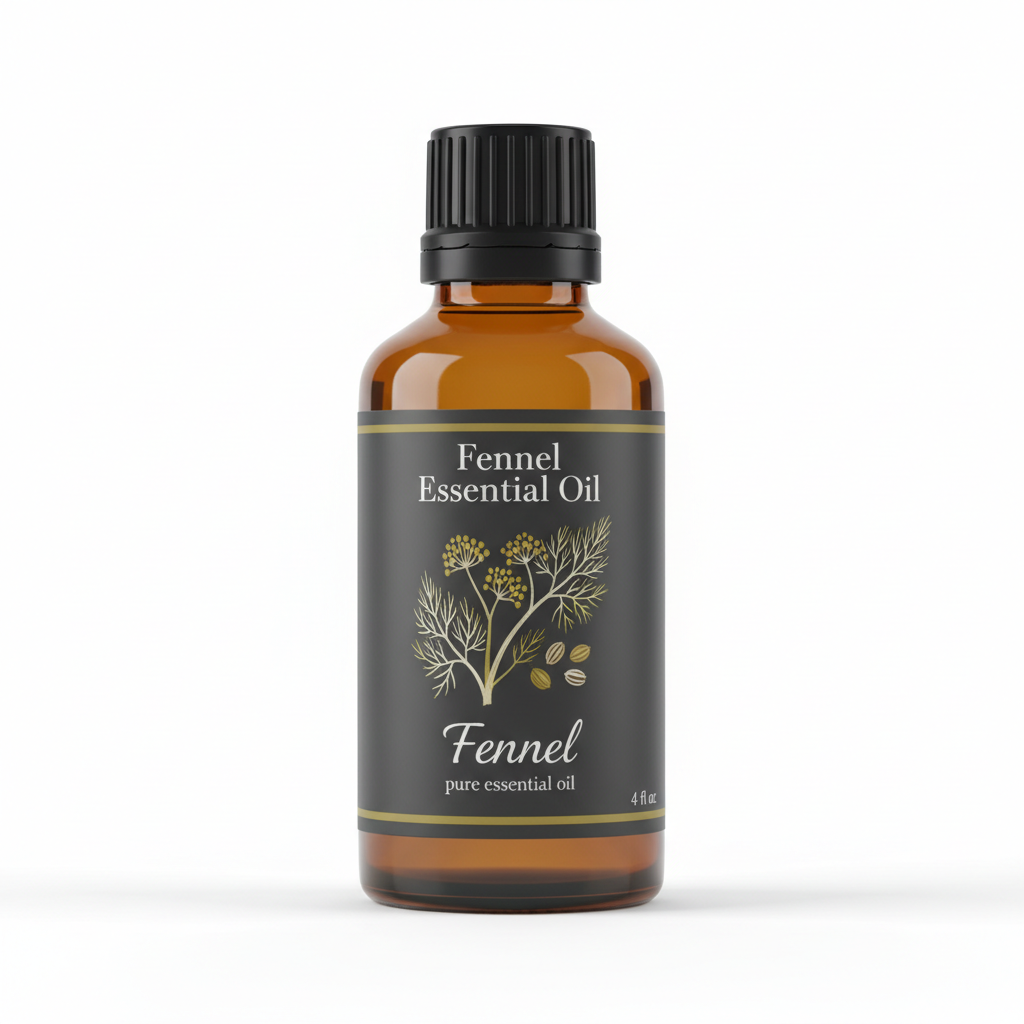
Fennel Essential Oil
Our own Fennel Essential Oil, in sizes from 0.5 oz to bulk.
From $13.99
Shop Now →The trials everyone cites are about tea and seed, not the oil
Most fennel and lactation material points to galactagogue research: studies of whether fennel raises breast milk supply. A Cochrane review of 41 randomised trials of oral galactagogues (3,005 mothers) counted fennel among the natural agents tested and rated the certainty of evidence low to very low. Of fennel specifically, it said "we are very uncertain" whether it improves infant weight (Foong and colleagues, Cochrane, 2020). Those trials gave fennel by mouth as seed, tea or extract. None gave essential oil, and none was designed to ask whether fennel is safe.
A safety trial did exist for a mixed tea. Sixty fully breastfeeding women were randomised to a tea containing bitter fennel fruit, anise, coriander and fenugreek or to a lemon verbena placebo. No adverse effects attributable to the tea were reported through the infants' first year (Wagner and colleagues, 2019). That is reassuring about a tea steeped from the fruit. It is not evidence about an oil that concentrates the volatile fraction of the seed, because the dose arrives in a very different form.
So the first correction to common advice: "fennel is fine while nursing" and "fennel oil is dangerous while nursing" are both extrapolations. The tea has a small amount of human data, and the oil has none.
What the regulators wrote down
The European Medicines Agency's herbal committee revised its fennel fruit monograph on 31 January 2024. Under fertility, pregnancy and lactation it says that safety "has not been established", that "in the absence of sufficient data, the use during pregnancy and lactation is not recommended", that there is evidence trans-anethole is excreted in human breast milk, and that no fertility data are available (EMA monograph, 2024). That monograph covers the dried bitter fennel fruit taken as a tea. A 2008 EMA assessment report that also covered fennel oil goes further, noting that "the use of fennel oil and alcoholic extracts is not recommended during pregnancy and lactation" as a precaution (EMA assessment report, 2008). That report carries a "Superseded" stamp on EMA's site, so read it as the committee's reasoning at the time, not its current position.
The number that matters sits in the committee's estragole statement, last corrected 12 May 2023. For pregnant and breastfeeding women, herbal medicines are "not recommended" if the daily estragole intake exceeds 0.05 mg per person, unless a risk assessment based on adequate safety data justifies it. The same statement says no data exist on estragole absorption through the skin, so the same limits apply to skin use unless a lower absorption rate has been shown for the product (EMA HMPC public statement on estragole, 2023).
One drop against 0.05 mg: the arithmetic
Take a drop as about 0.05 ml (the usual 20-drops-per-ml planning figure; drop size varies with the bottle opening). The published certificate of analysis for our oil lists a specific gravity of 0.975, so a drop weighs roughly 49 mg. The EMA's table of estragole in sweet fennel oil gives 1.5 to 5.0% (same 2023 statement). That puts the estragole in one drop at about 0.7 to 2.4 mg, which is 15 to 50 times the 0.05 mg ceiling. We do not publish a figure for each lot on the page; we send the estragole and anethole numbers for a lot on request through the contact page.
Read that as orientation, not alarm. It is arithmetic, not a measured exposure. The comparison assumes the whole drop is swallowed, and nobody has measured how much estragole reaches the blood from a diluted skin application or from a room scented with a diffuser. It also helps to know where 0.05 mg comes from: the statement's own worked example divides a rodent carcinogenicity potency (51.8 mg/kg per day) by 50,000 and multiplies by 50 kg, giving 0.052 mg per person per day. That is a conservative cancer-risk calculation, which the statement then applies to pregnant and breastfeeding women as a precaution. Exceeding it once is not a measured hazard; it does mean the oil leaves no room under the ceiling.
What animals and cells showed
The 2008 assessment report summarises the reproductive findings that made the committee cautious. In female rats, oral trans-anethole at 50, 70 and 80 mg/kg on days 1 to 10 of pregnancy inhibited implantation by 33, 67 and 100% respectively, with no gross malformations in the offspring that did go to term (the report cites Dhar, 1995; the original abstract confirms the dose-dependent anti-implantation activity and a significant estrogenic effect). In the same report, rat embryo limb-bud cells exposed to fennel essential oil at 0.0186 to 9.3 mg/ml for five days showed cell loss, which the authors read as toxicity to foetal cells with no evidence of teratogenicity. The 2024 monograph adds that an aqueous fennel seed extract given to pregnant mice on days 6 to 15 produced dose-dependent embryotoxic effects, and that "adequate tests on reproductive toxicity have not been performed."
All of this is oral dosing in rodents or cells in a dish, at doses a scented room does not approach. It is why the committee called the question open, not why we call it closed. The honest summary is that the signal is estrogen-like activity plus a missing dataset.
What to do with that, by situation
This is reasoning from the sources above, not a clinical recommendation.
- Swallowing the oil. This is where the 15-to-50-times arithmetic applies, and swallowing is not something we recommend for anyone (see can you swallow fennel essential oil).
- On skin. Our own shop guidance is 0.5% to 2% in a carrier with a patch test first, and our published caution is to avoid fennel oil entirely in pregnancy and while breastfeeding. Because the EMA says skin absorption data are missing, we do not read a low dilution as an exemption. While nursing, keep any oil off the chest and off skin the baby's mouth touches.
- In the air. Nothing has measured fennel levels in milk or blood after diffusing. We would still leave it out, because the same compound is the issue and an unmeasured exposure is not a reason to add one.
If you already used the oil before reading this, the statement's ceilings are daily intakes built with large safety factors, not cliffs. Mention it at your next appointment and move on. The people who can weigh it against your own history are an obstetrician-gynecologist or midwife for pregnancy, and an IBCLC (lactation consultant) or your pediatrician for a nursing baby. If a large amount was swallowed, call Poison Control at 1-800-222-1222 (poison.org).
Where we are not the answer
We sell only fennel oil, so we have nothing to offer here except a plain no. If the real question is low milk supply, that is a conversation for an IBCLC, and the Cochrane review above is a useful reminder of how thin the evidence is for any herb. If it is nausea, indigestion or sleep during pregnancy, those belong with your obstetric provider. An oil that we distil from crushed seed is not a substitute for that conversation.
For the full list of who should skip fennel oil and why, see is fennel essential oil safe, and for the same question about infants, fennel oil around babies and children. The interaction side is in fennel oil contraindications and interactions.
Fennel Essential Oil
Fennel Essential Oil from our own shop, in sizes from 0.5 oz to bulk.
From $13.99
Shop Now →Sources & Further Reading
- European Medicines Agency (HMPC), 2024. European Union herbal monograph on Foeniculum vulgare Miller subsp. vulgare var. vulgare, fructus, final revision 1. ema.europa.eu
- European Medicines Agency (HMPC), 2023. Public statement on the use of herbal medicinal products containing estragole, EMA/HMPC/137212/2005 Rev 1 Corr 1. ema.europa.eu
- European Medicines Agency (HMPC), 2008. Assessment report on Foeniculum vulgare Miller (marked superseded). ema.europa.eu
- Foong, Tan, Foong and colleagues, 2020. Oral galactagogues (natural therapies or drugs) for increasing breast milk production in mothers of non-hospitalised term infants. Cochrane Database Syst Rev. pubmed.ncbi.nlm.nih.gov
- Wagner, Boan, Marzolf and colleagues, 2019. The safety of Mother's Milk Tea: results of a randomized double-blind, controlled study in fully breastfeeding mothers and their infants. J Hum Lact. pubmed.ncbi.nlm.nih.gov
- Dhar, 1995. Anti-fertility activity and hormonal profile of trans-anethole in rats. Indian J Physiol Pharmacol. pubmed.ncbi.nlm.nih.gov
- Fennelessentialoil.com, certificate of analysis (specific gravity). fennelessentialoil.com