
Fennel Oil Around Babies and Children: Where the Line Sits
Keep concentrated fennel essential oil away from babies and children: not on their skin, not in their mouths, not in the room where an infant sleeps. The European regulators' lines for fennel in children are drawn at age 4 and age 12, they were drawn for dried fruit steeped as a tea, and every one of them is stricter than most online advice about the oil. Below is where each line sits, who drew it and why, plus the one infant colic trial that gets quoted against it. The broader picture of who should skip fennel is in is fennel essential oil safe.
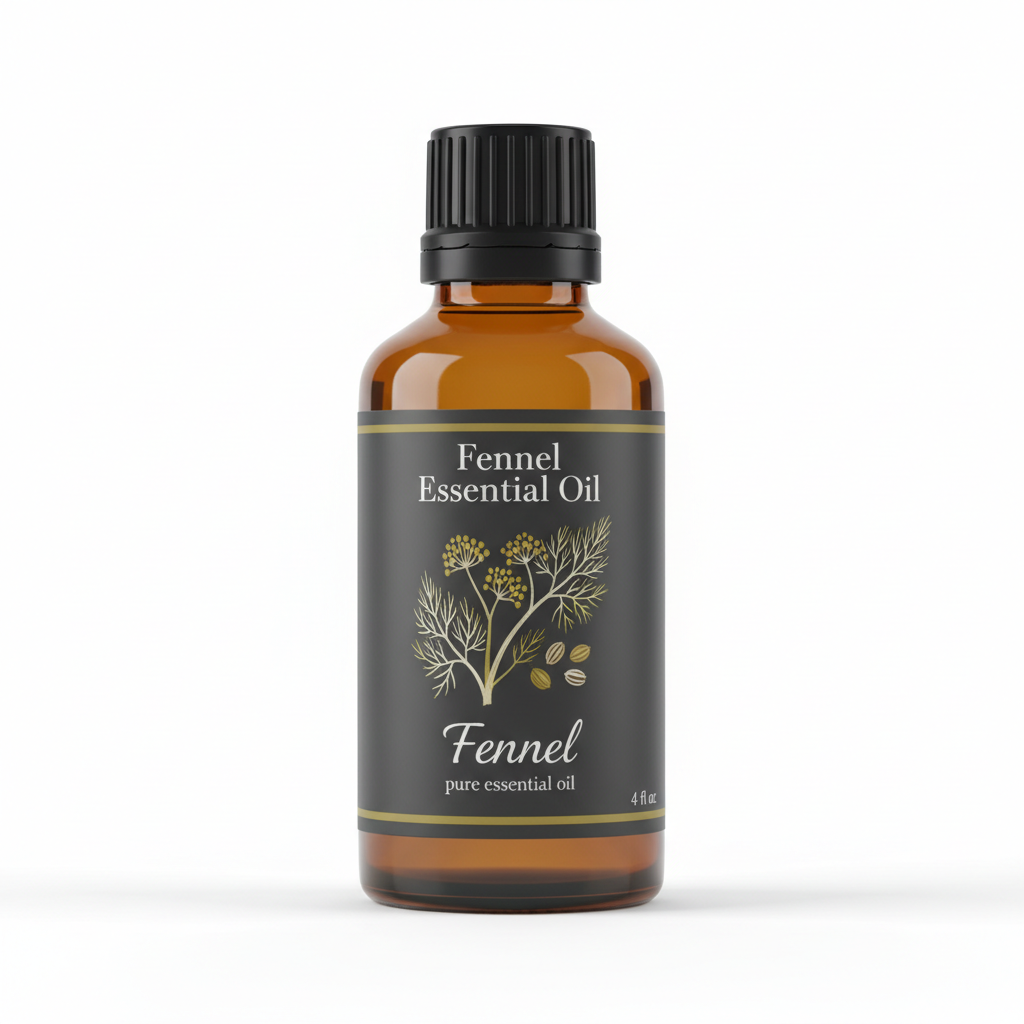
Fennel Essential Oil
Our own Fennel Essential Oil, in sizes from 0.5 oz to bulk.
From $13.99
Shop Now →The age lines, with the source for each
| Age | What the regulator wrote | Source and date |
|---|---|---|
| Under 4 years | Fennel fruit tea "not recommended" because of "lack of adequate data" | EMA herbal monograph, 31 January 2024 |
| 4 to 12 years | Tea only, for mild short-lived symptoms (under one week); not recommended if estragole intake exceeds 1.0 micrograms per kg of body weight per day, unless a risk assessment justifies it | EMA herbal monograph, 2024 |
| Children up to 11 | Same estragole guidance value of 1.0 micrograms per kg per day for any herbal medicine containing estragole | EMA estragole statement, corrected 12 May 2023 |
| Under 18 (fennel oil) | "Contraindicated" because of lack of data and estragole | EMA assessment report, 2008 (marked superseded) |
Two of those rows need a flag. The 2024 monograph covers the dried bitter fennel fruit as a tea, not essential oil, so it tells you about a far more dilute preparation than a bottle of oil. The only EMA document in this set that speaks to the oil, the 2008 report, carries a "Superseded" stamp on EMA's site. The 2008 text also said tea in children under 4 should be "restricted to the paediatrician," while the 2024 text says "not recommended"; the committee moved from a prescriber-only position to a plain not-recommended one. Sources: EMA monograph, 2024; EMA estragole statement, 2023; EMA assessment report, 2008.
The colic trial that gets quoted, and what it does not settle
The study people cite for fennel and infants is a randomised, placebo-controlled trial in Russia of 125 infants aged 2 to 12 weeks with colic. Infants given a fennel seed oil emulsion for a week had colic eliminated by the study's definition (crying under 9 hours a week) in 65% (40 of 62), against 23.7% (14 of 59) on placebo. The authors reported no side effects in either group (Alexandrovich and colleagues, 2003). The EMA report describes the preparation as a 0.1% emulsion in water, equal to about 12 mg of oil per kg of body weight per day.
That looks like an argument for the oil. Three things keep it from being one. It is a single trial, and a systematic review of complementary treatments for colic judged that "some encouraging results exist for fennel extract" while stressing "all trials have major limitations" and that independent replications were missing for most treatments (Perry and colleagues, Pediatrics, 2011). The EMA committee reviewed the same trial and still wrote that the available data "cannot be accepted for supporting the use in children for safety reasons." And the dose, set against the later estragole guidance, is large. The trial abstract does not give the estragole content of its oil, so this is a reasoned estimate: if the oil held 1.5% estragole, the low end of the range the EMA lists for sweet fennel oil, 12 mg/kg would deliver about 180 micrograms of estragole per kg per day, roughly 180 times the 1.0 microgram guidance value. That is arithmetic, not a trial result, and the trial predates the guidance. It does explain why the committee did not take a positive colic result as clearing the oil for children.
A toddler against one drop
For the same reasoning applied to a bottle at home, take a drop as about 0.05 ml, which at the specific gravity of 0.975 on our published certificate of analysis weighs about 49 mg. At 1.5 to 5.0% estragole, one drop holds about 0.7 to 2.4 mg of it. For a 10 kg toddler the 1.0 microgram guidance value is 10 micrograms a day (0.01 mg), so a swallowed drop is roughly 70 to 240 times the figure. Orientation only: the guidance value is a conservative cancer-risk number for repeated intake, not a toxic dose. The more immediate danger from swallowing a concentrated oil is different, and it is not about estragole.
Swallowing: the risk that arrives within hours
Poison centres see this pattern with essential oils generally. In the NSW Poisons Information Centre's four years of data (July 2014 to June 2018), there were 4,412 essential oil exposures; 63% involved people under 15, toddlers aged 1 to 4 made up 49.4%, 80% were accidental, and 31% of callers had symptoms when they rang. The authors note that as little as 5 ml can cause life-threatening toxicity in a child and recommend keeping essential oils apart from oral medicines. Eucalyptus and tea tree dominated that data; fennel is not mentioned in it (Lee and colleagues, Medical Journal of Australia, 2020). We cite it for the route, not the oil.
For fennel, one older literature survey of plant oils and seizures listed fennel among 11 essential oils reported as convulsants; its three new cases, one of them a child, involved several of those oils taken for therapeutic purposes, and the child's course was the less favourable (Burkhard and colleagues, 1999). Our own published caution already tells anyone with epilepsy to leave fennel oil alone; this is the reason it matters for a child who may have a seizure tendency nobody has found yet. If a child swallows or gets the oil in the mouth or eyes, call Poison Control at 1-800-222-1222 (poison.org) and keep the bottle to hand.
Skin, and air in a child's room
Nobody has measured how much estragole or anethole a child absorbs through skin, and the EMA's estragole statement says no data on estragole absorption through the skin exist. Its default is that the same limits apply to cutaneous use. We therefore read our own 0.5% to 2% guidance as written for adults and say plainly that it is not a children's range; our published position is that fennel oil is not appropriate for children.
The air is less clear, which is itself the point. No study has measured a child's exposure from a diffuser running fennel oil. What is documented is hazard: the EFSA panel's 2023 opinion on fennel oils treated sweet fennel oil as an irritant to skin and eyes and a dermal and respiratory sensitiser (EFSA FEEDAP Panel, 2023), and the EMA lists allergic reactions affecting skin or the respiratory system. That is reasoning to keep it out of an infant's bedroom and away from a child with asthma or eczema, not a measured outcome. We would add that a child allergic to celery, carrot, dill or aniseed should be treated as higher risk, since the EMA monograph lists hypersensitivity to the Apiaceae family and to anethole as a contraindication.
Colic, coughs and tummy aches: who to ask
Parents usually reach for fennel oil to settle a baby's colic or a child's stomach. This is a pediatrician's question, not a retailer's. A pediatrician can check the things a bottle cannot: whether crying is colic at all, whether there is reflux, a feeding problem or an infection, and whether a fennel tea is even appropriate for that age. We sell one product, undiluted sweet fennel oil, and it is the wrong one for this job.
What we can offer is the process side: if you want the numbers for a lot, we send both the anethole and estragole figures on request through our contact page, which a clinician can use. For the same questions in pregnancy and nursing, see fennel oil in pregnancy and breastfeeding, and for the compound behind these limits, estragole in fennel oil.
The line, then, is simple to state: for children, the regulator's cautious positions are about tea, and we would not extend them to a concentrated oil. Keep the bottle capped, out of reach and away from children's medicines, and take the oil's role in a child's care to a safety-first reading of the evidence and then to a pediatrician.
Fennel Essential Oil
Fennel Essential Oil from our own shop, in sizes from 0.5 oz to bulk.
From $13.99
Shop Now →Sources & Further Reading
- European Medicines Agency (HMPC), 2024. European Union herbal monograph on Foeniculum vulgare Miller subsp. vulgare var. vulgare, fructus, final revision 1. ema.europa.eu
- European Medicines Agency (HMPC), 2023. Public statement on the use of herbal medicinal products containing estragole. ema.europa.eu
- European Medicines Agency (HMPC), 2008. Assessment report on Foeniculum vulgare Miller (marked superseded). ema.europa.eu
- Alexandrovich, Rakovitskaya, Kolmo and colleagues, 2003. The effect of fennel (Foeniculum vulgare) seed oil emulsion in infantile colic: a randomized, placebo-controlled study. Altern Ther Health Med 9(4):58-61. pubmed.ncbi.nlm.nih.gov
- Perry, Hunt, Ernst, 2011. Nutritional supplements and other complementary medicines for infantile colic: a systematic review. Pediatrics. pubmed.ncbi.nlm.nih.gov
- Lee, Harnett, Cairns, 2020. Essential oil exposures in Australia: analysis of cases reported to the NSW Poisons Information Centre. Med J Aust 212(3). mja.com.au
- Burkhard, Burkhardt, Haenggeli and colleagues, 1999. Plant-induced seizures: reappearance of an old problem. J Neurol. pubmed.ncbi.nlm.nih.gov
- EFSA FEEDAP Panel, 2023. Safety and efficacy of feed additives consisting of essential oils from the fruit and stems of Foeniculum vulgare Mill. ssp. vulgare. EFSA Journal 21(10):e08348. pmc.ncbi.nlm.nih.gov
- Fennelessentialoil.com, certificate of analysis (specific gravity). fennelessentialoil.com