
Common Mistakes When Blending With Fennel, and How to Fix Them
Fennel essential oil has a reputation. Ask around in any blending community and you will hear the same warnings whispered like folklore: it overpowers everything, it smells like liquorice candy, it is impossible to balance. Some of those warnings contain a grain of truth. Most of them, though, are built on misunderstandings about how this oil actually behaves in a blend.
This article works through the most common fennel blending mistakes, separates the myths from the evidence, and gives you practical fixes so your next blend comes out exactly the way you intended. If you want a broader foundation before diving in, the ultimate guide to blending and using fennel essential oil is a good place to start.
Myth 1: Fennel Oil Is Always Overpowering, So You Need Very Little of It
The Myth
"Fennel is so strong that even one drop ruins a blend. Use it sparingly or skip it entirely."
The Truth
Fennel oil does have a bold aromatic profile, but the assumption that it always dominates is a generalisation that ignores two important variables: the specific chemotype and the concentration level. Sweet fennel (Foeniculum vulgare var. dulce) from Mediterranean growing regions tends to express a softer, more rounded anise character than its bitter or wild counterparts. Evidence from aromatic composition studies indicates that trans-anethole, the primary constituent in sweet fennel, produces a mellower aromatic impression than the higher fenchone levels found in some other varieties.
The fix here is not to use less fennel automatically. The fix is to understand your oil before blending. Do a simple scent strip test: one drop on a strip, note how it evolves over 30 minutes. You may find it is far more approachable than its reputation suggests.
Why This Myth Exists
Many blenders first encounter fennel as a note in commercial fragrances where it is used at extremely high concentrations for dramatic effect. That experience colours expectations. When working with a well-sourced, properly diluted sweet fennel oil, the experience is quite different.
Practical fix: Start at 2 to 3 percent of your total blend rather than dropping down to trace amounts. Evaluate the result before adjusting further.
Myth 2: Fennel Only Works in "Spa" Blends
The Myth
"Fennel belongs in wellness centre diffusers and nowhere else. It does not fit in anything warm, woody, or citrus-forward."
The Truth
This is one of the more limiting fennel blending mistakes blenders make, and it closes off a genuinely wide aromatic palette. Research into anethole-dominant essential oils suggests that their sweet, slightly herbal character acts as a bridge note, connecting otherwise disparate aromatic families. In practical terms, this means fennel can soften the sharpness of citrus top notes while also adding brightness to heavy resinous bases.
Some of the most satisfying fennel blends pair it with bergamot or blood orange at the top, lemongrass or basil in the middle, and cedarwood or vetiver at the base. The fennel does not disappear into these combinations. It provides a Mediterranean herbal sweetness that gives the blend a distinctive character without pulling everything toward a single direction.
Why This Myth Exists
Fennel is frequently categorised alongside cooling, aquatic, or clinical notes in popular blending guides. Those categorisations are shorthand, not rules. They reflect certain common commercial applications rather than the full versatility of the oil.
Practical fix: Try fennel with one warm note you would not normally pair it with. Sandalwood and sweet fennel, for example, produce a surprisingly rounded, almost culinary warmth that works beautifully in a living room diffuser during cooler months. For inspiration, browse these 10 sweet and herbaceous fennel diffuser blend recipes.
Myth 3: If Your Blend Smells "Too Fennelly," You Have Used Too Much

The Myth
"Fennel oil too strong in a blend always means you overdid the fennel. Pull back next time."
The Truth
This is a diagnostic error. When fennel reads as too strong, it is often not because the fennel percentage is too high. It is because the other notes in the blend are not strong enough, or are not complementary enough, to create balance. Fennel is a middle note with top-note assertiveness in its initial phase. If your blend lacks any competing middle or base notes, fennel will dominate simply because nothing else is holding its ground.
Evidence from professional fragrance evaluation suggests that perceived dominance in a blend is often a matter of contrast rather than volume. A blend with fennel at 5 percent alongside weak or one-dimensional base notes will smell more fennel-heavy than a blend with fennel at 8 percent alongside robust base notes like patchouli or frankincense.
Why This Myth Exists
Percentage arithmetic is the easiest thing to measure in blending, so blenders naturally reach for it as an explanation when something goes wrong. In reality, olfactory perception is far more about the relationship between notes than about raw proportions.
Practical fix: Before reducing your fennel, try adding depth. A small addition of vetiver, labdanum, or cedarwood may rebalance the entire blend without touching the fennel percentage at all.
Myth 4: Fennel and Lavender Are a Classic Combination
The Myth
"Fennel pairs naturally with lavender because they are both herbal."
The Truth
Sharing a broad botanical category does not mean two oils blend harmoniously. Lavender is a floral-herbal note built largely around linalool and linalyl acetate, which give it a soft, powdery character. Sweet fennel is built around trans-anethole, a phenylpropanoid compound with a distinctly anise-like sweetness. These two aromatic directions can clash in a way that reads as confused rather than complex, particularly when neither oil is in a supporting role.
This does not mean the combination is impossible. Some blenders report success using lavender as a minor supporting note under a fennel-and-citrus body. However, considering fennel and lavender as an obvious pairing, and using them in roughly equal proportions, tends to produce blends that are neither cohesive nor pleasant.
Why This Myth Exists
Both oils are frequently listed in the "herbal" category of blending wheels, and beginners often interpret that as a signal that same-category oils work together. Blending wheels are useful starting frameworks, but they are not a substitution for nose-based evaluation.
Practical fix: If you want to use both fennel and lavender, keep lavender below 10 percent of the total blend and give the remaining 90 percent a clear direction, either citrus-led or resin-led, rather than letting lavender and fennel negotiate for dominance.
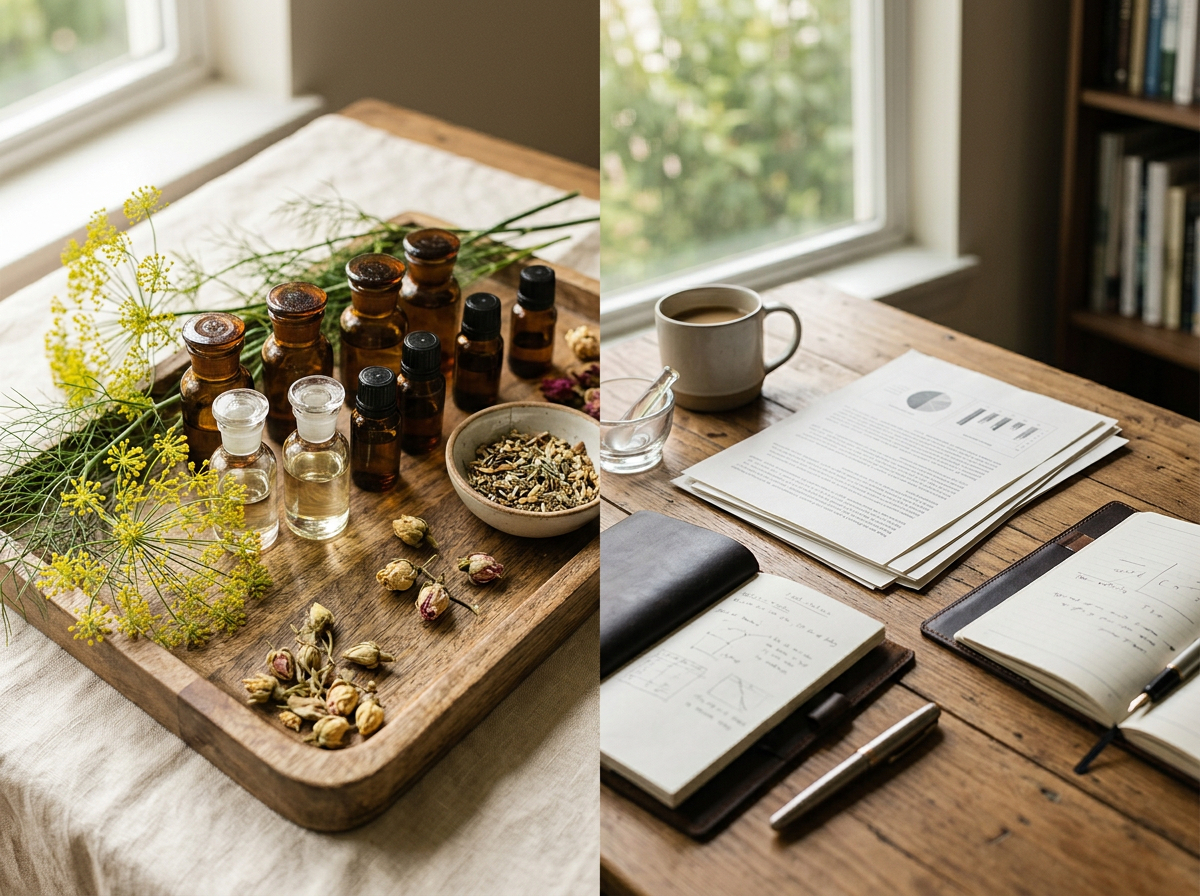
Myth 5: Fennel Essential Oil Blending Tips Always Apply to Body Products and Diffusers Equally
The Myth
"A fennel blend that works in the diffuser will work just as well in a body oil or room spray."
The Truth
Aromatic performance changes significantly depending on the application medium. In a diffuser, volatile top notes disperse quickly and middle notes carry the sustained aromatic impression. On skin, the warmth of body temperature accelerates certain aroma compounds while slowing others, and a carrier oil introduces its own subtle scent character. A blend that smells beautifully balanced diffusing through a room may smell sharp or one-dimensional applied to the wrist.
For body application products specifically, fennel should be diluted appropriately in a carrier oil. A standard safe dilution for most adults in a leave-on product is 1 to 2 percent. Always perform a patch test before applying any new blend to a larger skin area, and note that some individuals may find the oil unsuitable for their skin. Consult a qualified healthcare provider if you have any concerns before topical use, particularly if you are pregnant or nursing.
Room sprays sit in a middle category. The alcohol base behaves differently from both diffusion and carrier oil, influencing how the aroma unfolds in the first few seconds versus the dry-down. For a detailed formulation walkthrough, the DIY fennel and citrus room spray guide covers the ratios and aromatic decisions specific to that format.
Why This Myth Exists
Blending is often taught as a single skill set applied uniformly across applications. In introductory workshops, the distinction between medium-specific performance is frequently glossed over in the interest of keeping things approachable. The result is a gap in practical knowledge that only becomes apparent when results do not transfer.
Practical fix: Consider each application format as its own project. A great diffuser formula is a starting point for a body oil, not a finished recipe. Adjust, test on a strip, then test on skin before committing to a full batch.
Myth 6: More Expensive Fennel Oil Always Smells Better in Blends
The Myth
"Premium-priced fennel essential oil will automatically produce better blends than budget options."
The Truth
Price reflects sourcing, testing, and supply chain transparency, all of which matter. But price alone does not determine aromatic suitability for a specific blend. Some well-priced sweet fennel oils from Italian or French growing regions perform beautifully in blends because their chemical profiles happen to align with what a given formula needs. Conversely, a costly oil from a prestige supplier may have a chemical profile that skews fenchone-heavy, producing a harsher, more medicinal impression that does not suit your intentions.
Evidence from gas chromatography analyses of fennel essential oil across multiple sources indicates significant variation in trans-anethole to fenchone ratios even within the same botanical species. That variation directly affects aromatic character and blending behaviour. Reading a supplier's GC/MS report before purchasing is a more reliable quality indicator than price point.
Why This Myth Exists
In the natural products world, premium pricing is often used as shorthand for quality, and in many categories that correlation holds reasonably well. Essential oils are a category where batch variation, growing region, and extraction method create enough variability that price alone becomes an unreliable proxy.
Practical fix: Request or download the GC/MS report for any fennel oil before purchasing. Look for trans-anethole content in the 60 to 80 percent range as a marker of a classic sweet fennel aromatic profile. Then evaluate with your nose before committing it to a blend.
Putting It Together
Fennel blending mistakes often come from applying generalisations that feel intuitive but do not hold up under closer examination. The oil is bold, yes. It has a distinctive aromatic signature. But those qualities make it interesting, not difficult. Once you understand how its aroma chemistry behaves across different contexts, how it responds to base notes, how it shifts between diffusion and skin application, and how to read a spec sheet rather than relying on price, it becomes one of the more characterful and rewarding oils in your collection.
Work slowly. Test each blend on a strip before scaling. Keep notes on what worked and what did not. The gap between a confusing fennel blend and a genuinely beautiful one is usually smaller than its reputation suggests.