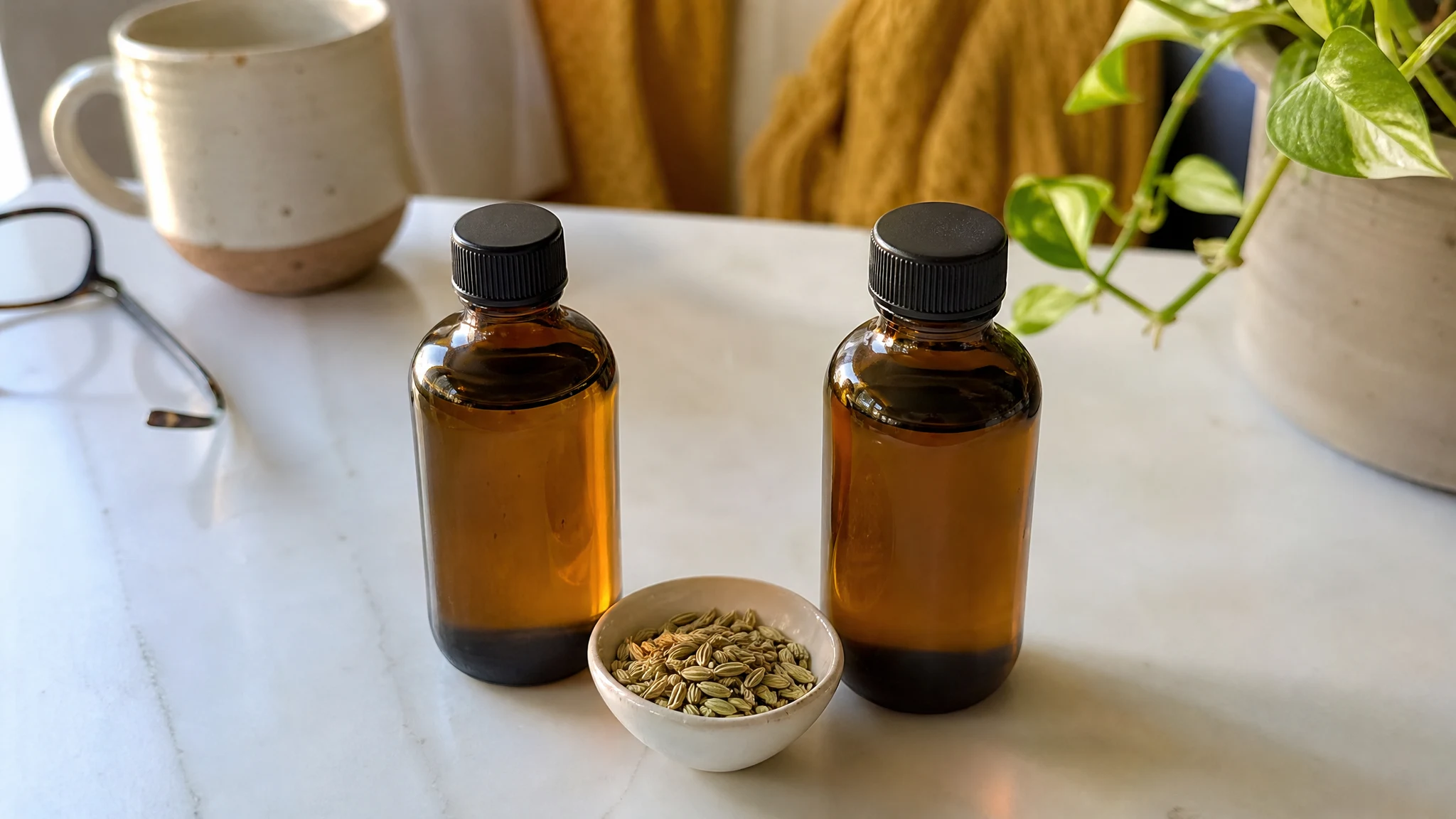
Fennel CO2 Extract vs Fennel Essential Oil
A fennel CO2 extract and a fennel essential oil start from the same seed and end up as different materials, so "which is better" is the wrong question. The useful one is what each process takes out of the seed and what you plan to do with the result. We sell only steam-distilled fennel essential oil, so this page is a comparison for formulators and careful buyers, not a pitch for either side. If you are still deciding what to buy at all, the complete quality guide to buying fennel essential oil comes first.
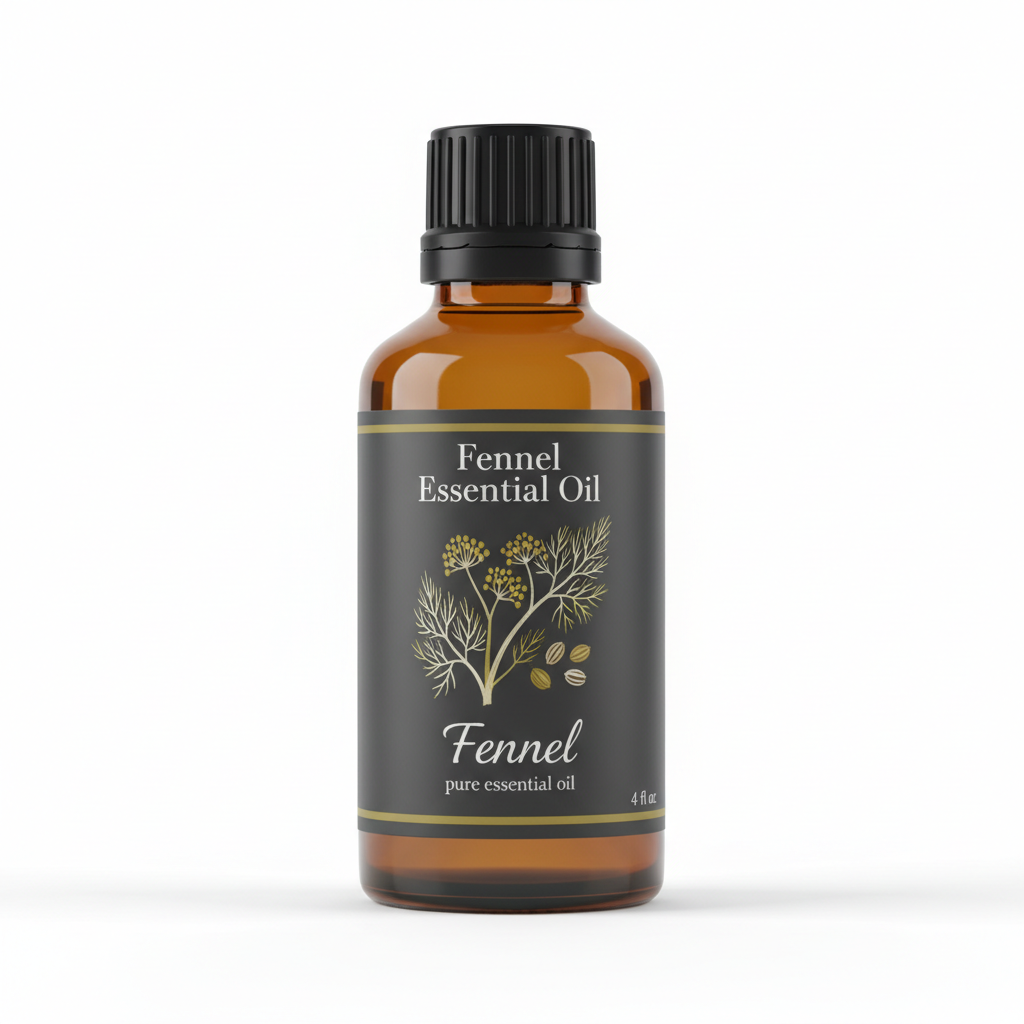
Fennel Essential Oil
Our own Fennel Essential Oil, in sizes from 0.5 oz to bulk.
From $13.99
Shop Now →The seed holds two things, and each process favours one
Fennel fruit is mostly not oil. The European Medicines Agency's 2024 assessment report describes the fruit as containing the essential oil plus triglycerides made mainly of petroselinic, oleic and linoleic acids, wax esters, phospholipids, phytosterols, and tocopherols and tocotrienols (EMA, 2024). The same report gives the European Pharmacopoeia floor for sweet fennel fruit: at least 20 mL of essential oil per kg of fruit, with at least 80% anethole in that oil. That is about 2% of the fruit by volume.
Steam carries over only what evaporates. The fat, wax and sterols stay in the still, and the volatile fraction, mostly anethole in sweet fennel, goes into the oil. Supercritical CO2 is less selective by default. In a 2005 study of fennel seed, the maximum global yield of CO2 extraction was 12.5% on a dry basis, from dry harvested seed at 300 bar and 40 °C, and the extract held anethole and fenchone as its main constituents together with several fatty acids (Moura and colleagues, 2005, Journal of Supercritical Fluids). Set 12.5% against roughly 2% and the CO2 "total" extract is several times as much material per kilogram of seed. The units differ (mass against volume), so read that as a ratio of order, not a precise multiple. Most of the extra weight is not scent.
"Select" and "total" are pressure schedules, not quality grades
Producers sometimes sell a CO2 "select" and a CO2 "total" from the same crop. A 1999 paper from the University of Salerno shows what that means in practice: fennel seed was extracted in two steps, the first at 90 bar and 50 °C to recover the essential oil selectively, the second at 200 bar and 40 °C to recover the vegetable oil (Reverchon and colleagues, 1999, Industrial & Engineering Chemistry Research). So a low-pressure fraction can resemble a distilled oil in composition, while a high-pressure "total" carries the fat as well. Neither word tells you which one you are holding. A supplier's specification sheet should say, and if it cannot say, that is your answer.
Our position, stated plainly: a CO2 extract is not "a stronger essential oil". Something that is mostly lipid by weight is not stronger in the way a buyer usually means. It is a different ingredient, and it should be bought and dosed as one.
What we could not find: aroma and safety data for the CO2 material
The common claim is that CO2 extraction, run at around 40 °C instead of the temperature of steam, gives a "truer" fennel aroma. The temperature difference is real, and it is a reasonable mechanism. We did not find a published sensory panel comparing the two for fennel, so we leave the claim as untested. We also hold no CO2 extract to compare, and nothing here is a smell test of our own.
Safety is the bigger gap. Fennel's regulatory numbers were written for distilled oil and for the fruit. The fragrance industry's estragole standard (IFRA, Amendment 49, 2020) gives an indicative estragole level of 3% for sweet fennel oil, and says that if analysis shows a different level in a natural material, the analysed level should be used instead (IFRA, 2020, copy hosted by Perfumer's World). The table lists the oil, not a CO2 extract. We found no published skin limit for fennel CO2 extract, and we would not borrow the essential oil's numbers for it. Reasoning, not a finding: a material with a different composition needs its own analysis, and the useful number to request is estragole per lot, the same as for any fennel material.
The EMA report is blunt about why that figure matters. Several studies have shown estragole to cause liver tumours in mice and rats through a pathway that also operates in human liver cells in the laboratory, and the committee's public statement says intake from herbal medicinal products should be "as low as possible" (EMA, 2024, quoting its estragole statement). That is a statement about medicinal products at oral doses. It is not a verdict on a diluted skin oil, but it is the reason to ask for the figure.
Who each material suits
| If you want | Steam-distilled essential oil | CO2 total extract |
|---|---|---|
| A volatile, thin liquid for blending and diffusing | Yes, this is what it is | Not as the first choice. It carries non-volatile fat, which does not evaporate (reasoning from the composition above) |
| Fat-soluble co-extracts (sterols, tocopherols) in an anhydrous balm | No, these stay behind in the still | Plausible, but verify the fatty acid and constituent profile on the spec sheet |
| Published guidance on dilution and cautions | Exists: EMA, IFRA, regulator and supplier data | We found none specific to fennel CO2 extract |
| Anethole and estragole numbers per lot | Ask for them; we quantify both for each lot | Ask for them; do not assume they match the oil |
| A recognised pharmacopoeia standard | Ph. Eur. sets anethole and oil-content floors for the fruit (above) | Check what, if anything, the supplier tests against |
For a formulator the practical split is simple. If the formula needs scent and a defined volatile profile, use the distilled oil and test it. If it needs the lipid co-extracts, you are shopping for a different ingredient, and the person to ask is a cosmetic chemist or the extract supplier's technical team. We do not sell CO2 extracts, so we are not the right counter for that purchase and will not pretend to be.
What our oil is, for comparison
We steam-distil crushed seed. The whole seed is bought to a screen size and moisture ceiling, split, damaged and immature seed is rejected, and the seed is cracked coarse on site, typically within the hour before it goes into the still. An independent laboratory analyses each lot, and anethole and estragole are both quantified; we will send both figures for a lot on request through the contact page. Our published certificate of analysis shows appearance, odour, specific gravity (0.975) and refractive index (1.546) for its batch, not a constituent breakdown, so ask for the lot figures if they matter to you. Our steam distillation article explains the process step by step, and the article on reading a label and GC-MS report shows what to look for in the numbers.
Cautions apply to both
Nothing about extraction removes the reasons our own guidance gives for leaving fennel alone: avoid it entirely in pregnancy and while breastfeeding, do not use it with children, and leave it alone if you have an oestrogen-sensitive condition or epilepsy. If any of that applies, a CO2 extract of the same seed is not a loophole, because the same anethole and estragole can be present. A pharmacist or your own doctor can tell you what applies to your situation. For skin we publish 0.5% to 2% in a carrier with a 24-hour patch test, written for our oil, and it should not be transferred to a material we have not analysed.
The short version for the shelf: distilled oil for scent and a known volatile profile, CO2 extract only when you have a reason to want the fat and a spec sheet to back it. Whichever you pick, the buying guide lists the documents to ask for first.
Fennel Essential Oil
Fennel Essential Oil from our own shop, in sizes from 0.5 oz to bulk.
From $13.99
Shop Now →Sources & Further Reading
- European Medicines Agency (HMPC), 2024. Assessment report on Foeniculum vulgare Miller subsp. vulgare var. vulgare, fructus and var. dulce, fructus (EMA/HMPC/240553/2016, 31 January 2024). ema.europa.eu (assessment report PDF)
- Moura LS, Carvalho RN, Stefanini MB, Ming LC, Meireles MAA, 2005. Supercritical fluid extraction from fennel (Foeniculum vulgare): global yield, composition and kinetic data. J Supercrit Fluids 35(3):212-219. acervodigital.unesp.br
- Reverchon E, Marrone C, Poletto M, Daghero J, Mattea M, 1999. Supercritical fractional extraction of fennel seed oil and essential oil: experiments and mathematical modeling. Ind Eng Chem Res 38(8). osti.gov
- IFRA, 2020. IFRA Standard: Estragole (Amendment 49). perfumersworld.com (hosted copy)