Fennel Oil Inhaler Stick: How to Make One and When Not To
A personal inhaler is the lowest-exposure way to use an essential oil: the oil sits on a wick inside a capped tube, never touches your skin, and reaches nobody but the person holding it. For fennel that is a real advantage, because fennel oil is mostly anethole and strongly scented. The catch is that we found no published trial of anyone inhaling fennel oil for any purpose, so make one for the scent, not for a result. This page covers the build, the limits, and the people who should not make one. Inhalers are one of the quieter ways to use the oil; our 18 everyday ideas for home covers the others.
Fennel Essential Oil
Our own Fennel Essential Oil, in sizes from 0.5 oz to bulk.
From $13.99
Shop Now →What the evidence covers, and what it does not
We searched the biomedical literature (Europe PMC) for human trials of inhaled fennel oil and found none. The nearest human trial of fennel seed essential oil in aromatherapy used massage, not inhalation. It randomised 40 people to massage with sweet almond oil alone or with 1.6% fennel seed oil, one session every 15 days for two months, and its authors called it exploratory. Anxiety scores were lower in the fennel group after the last session (32.47 against 41.75 on the State-Trait Anxiety Inventory), but scores did not change significantly over time within either group, and the authors said more studies were needed (Félix and colleagues, 2026). Massage involves touch, time and the oil on skin, so none of it transfers to a sniffed wick.
The only inhalation data in the European Medicines Agency's 2024 fennel assessment report are from rabbits. Anethole and fenchone vapour was added to a steam vaporiser for anaesthetised animals, at doses from 1 to 243 mg/kg, with the amount actually absorbed estimated at no more than 1% of that. Anethole lowered the specific gravity of respiratory tract fluid at 1 to 9 mg/kg, and did not change its volume (EMA, 2024, citing Boyd and Sheppard, 1971). That is an animal experiment on respiratory fluid. It says nothing about nausea, stress or sleep in a person, and we cite it only so you know what exists. Our article on fennel oil and nausea goes through the inhalation studies on that question in more detail.
The risk that does have a source: airway sensitisation
Inhaling an oil is not automatically harmless to the airways. EFSA's 2023 opinion on star anise oil, which is about 89% trans-anethole, classes it as an irritant to skin and eyes and as a dermal and respiratory sensitiser (EFSA FEEDAP Panel, 2023). The EMA monograph on anise oil, another anethole oil, lists allergic reactions affecting the skin or the respiratory system among its undesirable effects, with unknown frequency (EMA, 2013). Neither is about fennel oil in an inhaler. Applying them to fennel is an extrapolation from a shared main compound, and we label it as one. The practical reading: if an inhaler makes you cough, tighten your chest or gives you a headache, stop using it.
Making one
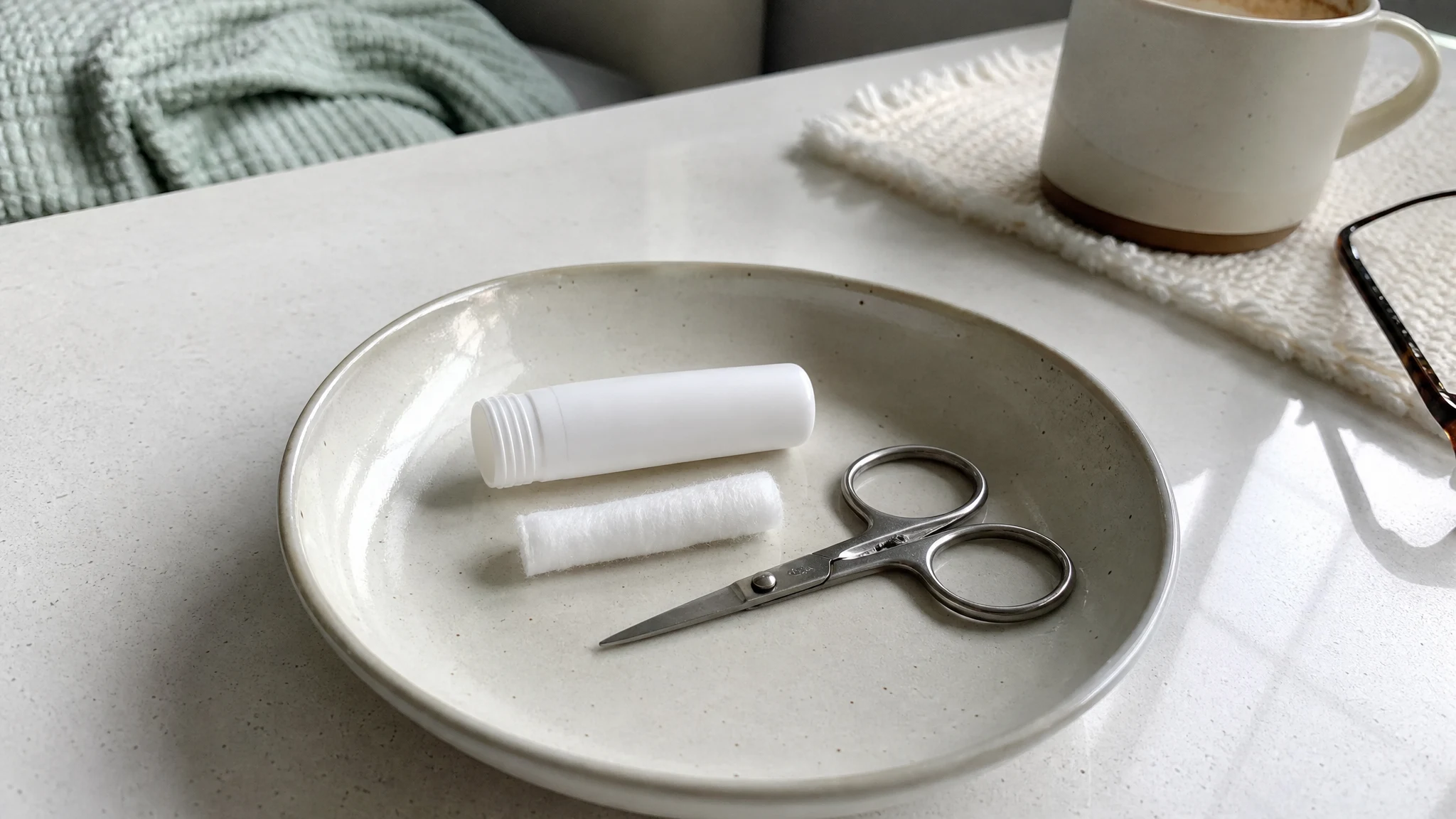
You need an empty inhaler tube with a cotton wick and an inner cap, fennel oil, clean tweezers, a small plate or tray, and a label. We do not sell inhalers, so buy the blanks from any supplier of empty tubes. The steps below are our method, reasoned from how the parts work, not a tested recipe.
- Wash your hands and dry them. Oil on your fingers ends up on the tube and then near your face.
- Put the oil on the wick, not in the tube. Lay the wick on the tray and add the drops there. Starting low is the point: we suggest two drops of fennel oil, and one more only if you cannot smell it. No published standard sets a drop count for an inhaler, so this is our judgement. Fennel is a strong, sweet oil, and a wick holds only a few drops before it is wet through.
- Insert the wick with tweezers into the inner tube, then fit the inner cap and the outer cap firmly.
- Label it with the date and the oil, and write "personal use only".
- Keep it in its own small bag, away from heat and light, out of reach of children and pets.
If you want a blend, a lavender and fennel pairing is a place to start. Our diffuser blends list pairings; scale any ratio down to a few drops in total for a wick. An inhaler has no carrier oil, so the dilution rules we publish for skin (0.5% to 2% in a carrier) do not apply, and equally do not tell you anything about safety here.
Using it without overdoing it
Hold the open tube a short way below your nose and take a few slow breaths, then cap it. Do not touch the wick or put any part of the tube in your mouth. The Children's Hospital of Philadelphia notes that the brain stops noticing a scent after about 20 minutes, which can lead people to keep adding oil (CHOP, 2022). That fits fennel particularly well, because a scent you stop noticing is not a scent that has gone, and heavier use of an anethole oil is the opposite of what we want. If the scent fades, rest for a while instead of adding drops.
How long a loaded wick keeps its scent is not something we have tested. Our sealed oil is typically stable for two to three years in the bottle, but a wick in a tube is a different case. Replace it if the scent changes or the wick looks discoloured, and do not rely on a wick that is months old.
Who should not make or use one
- Anyone pregnant or breastfeeding. Our published guidance is to avoid fennel oil entirely in these situations. An obstetrician-gynecologist or midwife can answer for your case.
- Children. Fennel oil is not appropriate for children, in our guidance. Other sources set their own lines for aromatherapy in general: St. Jude Children's Research Hospital says oils should not be used in children under 2 and not for children with asthma or other breathing problems (St. Jude, reviewed January 2024), while CHOP limits aromatherapy to children over 3 (CHOP, 2022). The two lines differ, which is a reason to ask a pediatrician and not to pick one.
- Anyone with epilepsy or an oestrogen-sensitive condition. Our guidance is to leave fennel oil alone. This is your doctor's call, not ours.
- Anyone with asthma or breathing problems. St. Jude's list for children includes asthma, and the airway sensitisation findings above are about the same compound, so we extrapolate the caution to adults. Ask your doctor first.
- Households with pets. Keep fennel oil and the tube away from them; a veterinarian can tell you more about your animal.
- Anyone sharing. St. Jude advises not to share inhalers, and not to let a child re-use one used during a cold or respiratory infection. Keep the tube yours alone, and keep its small parts away from small children, who could choke on them (St. Jude, 2024).
If you notice breathing problems, stop at once. For a reaction that does not settle, or if a child or pet has been exposed, call poison control (US: 1-800-222-1222, poison.org) or your doctor or veterinarian.
Why we say make it for the scent
An inhaler is a tidy, low-exposure way to carry a smell you like. It is not a tested way to do anything else, and for a symptom like nausea, stress or poor sleep the right person to ask is a physician. Our oil is steam-distilled sweet fennel, bottled 100% pure and undiluted, in amber glass with a plain cap; we send the anethole and estragole figures for any lot on request through the contact page. For other low-key ways to use it, return to the everyday uses guide.
Fennel Essential Oil
Fennel Essential Oil from our own shop, in sizes from 0.5 oz to bulk.
From $13.99
Shop Now →Sources & Further Reading
- Félix BP, Rodrigues A, Sousa MJ, Pereira OR, 2026. Effect of aromatherapy massage with Foeniculum vulgare Mill. seed essential oil compared to massage on anxiety, well-being, and sleep quality: an exploratory randomized study. Health Sci Rep. pubmed.ncbi.nlm.nih.gov/42147465
- European Medicines Agency (HMPC), 2024. Assessment report on Foeniculum vulgare Miller subsp. vulgare var. vulgare, fructus and var. dulce, fructus (EMA/HMPC/240553/2016). ema.europa.eu (assessment report PDF)
- EFSA FEEDAP Panel, 2023. Safety and efficacy of a feed additive consisting of an essential oil derived from the fruit of Illicium verum Hook.f. (star anise oil) for use in all animal species. EFSA Journal 21(7):e08182. pmc.ncbi.nlm.nih.gov/articles/PMC10388226
- European Medicines Agency (HMPC), 2013. Community herbal monograph on Pimpinella anisum L., aetheroleum (EMA/HMPC/321185/2012). ema.europa.eu (monograph PDF)
- Children's Hospital of Philadelphia, 2022. Aromatherapy for children: what's safe and what's not. chop.edu
- St. Jude Children's Research Hospital, reviewed January 2024. Essential oils and aromatherapy: choose and use essential oils. together.stjude.org