
Fennel Oil and Nausea: What Inhalation Studies Do and Don't Show
We could not find a single published trial in which people inhaled fennel essential oil for nausea. What exists is a body of inhaled-aromatherapy research on nausea in hospitals, where the best-supported material is isopropyl alcohol from an alcohol pad, which is not an essential oil, and where peppermint, the usual plant comparison, did not clearly beat placebo in the largest review. This page walks through that evidence, says what it does and does not transfer to a bottle of fennel oil, and explains why fennel and nausea are linked in the first place. For the wider evidence picture, our pillar is fennel essential oil benefits: what the research actually shows.
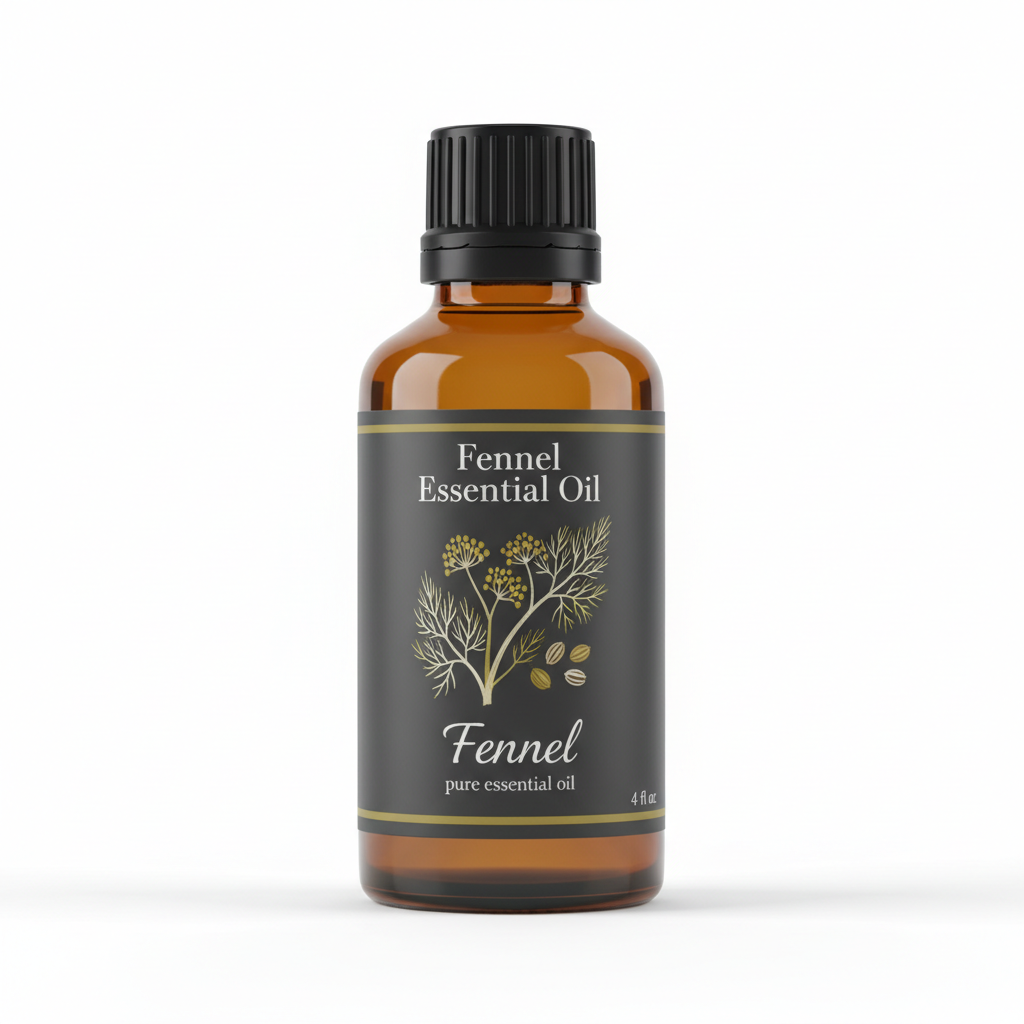
Fennel Essential Oil
Our own Fennel Essential Oil, in sizes from 0.5 oz to bulk.
From $13.99
Shop Now →Where fennel and nausea get connected, and where they do not
Fennel's recognised traditional uses in Europe are digestive spasm with bloating and flatulence, minor menstrual-period spasm, and cough with a cold. Nausea is not on the European Medicines Agency's list (EMA monograph, 2024). Those indications are for dried fruit steeped as a tea. Our reading, and it is reasoning, not a finding: the nausea link seems to travel from fennel's general association with the stomach, which is how a digestive herb ends up in lists about queasiness.
The nearest fennel-oil aromatherapy trial we found is not about nausea at all. A 2026 exploratory randomised study of 40 people compared massage with sweet almond oil alone to massage with 1.6% fennel seed essential oil in the almond oil, one session every 15 days for two months. The measured outcomes were anxiety, well-being and sleep quality. State anxiety scores were lower in the fennel group after the last session (32.47 against 41.75, p = 0.007); the authors called the work exploratory and asked for confirmation (Félix and colleagues, Health Science Reports, 2026). It was massage, not inhalation, and says nothing about nausea. We mention it because it is the closest thing to a human fennel-oil aromatherapy trial, and because it shows how easily a result gets lifted onto a neighbouring claim.
What inhaled aromatherapy has shown for nausea, and in which setting
| Setting and review | What was inhaled | What was found | Certainty and limits |
|---|---|---|---|
| After surgery; Cochrane review, 16 studies, 1,036 people (2018) | Mixed aromatherapy, including peppermint and isopropyl alcohol | Against placebo, no clear drop in nausea severity (6 studies, 241 people); fewer people needed rescue anti-nausea drugs (RR 0.60, 7 trials, 609 people) | Low to very low; study methods varied |
| Same review, peppermint only | Peppermint | No evidence of an effect on severity at five minutes (4 trials, 115 people) | Low |
| Same review, isopropyl alcohol against standard anti-nausea drugs | Alcohol pad vapour | Faster halving of nausea scores (3 trials, 176 people) | Moderate |
| Adults in emergency departments; meta-analysis (2023) | Isopropyl alcohol against saline placebo | Nausea about 2.2 points lower on a 0 to 10 scale (95% CI 1.60 to 2.76; 2 trials, 195 people) | Moderate; few trials and few patients |
| After surgery; narrative review of 12 studies, 2013 to 2023 (2024) | Mostly ginger and mint, by inhalation or by mouth | Authors report less nausea and fewer anti-nausea drugs, mainly in the first minutes after surgery | No pooled analysis; mixes routes |
| Fennel essential oil, any setting | Fennel | No trial found | Nothing to grade |
Two of those reviews disagree on tone. The Cochrane authors called their finding on nausea severity "very uncertain" while the 2024 review judged aromatherapy effective for post-surgery nausea. The difference is method: Cochrane applied formal risk-of-bias and certainty ratings and pooled only comparable trials, while the later review summarised 12 studies without pooling and included oral as well as inhaled use. Neither tested fennel. Sources: Hines and colleagues, Cochrane, 2018; Lee and Tamale, Emergency Medicine Journal, 2023; Pashaei and Akyüz, 2024.
Clinic and kitchen are different experiments
The trials above share features that a home setting lacks. They enrolled people with a defined nausea cause, post-anaesthesia or an emergency visit, with nurses scoring symptoms on a scale at fixed times. The best-supported inhaled agent is a single pad of isopropyl alcohol held under the nose, a standard and repeatable exposure. An essential oil in a diffuser is neither: the amount in the air depends on the device, the room and the drops, and nobody has measured a fennel-oil dose against a nausea score. Reasoning from that, a result from a recovery ward cannot be carried into a living room, and a result for peppermint or alcohol cannot be carried across to fennel. That is a limit on the evidence, not a verdict on the oil.
Fennel carries one further consideration: the estragole in the oil is subject to European regulatory limits (the arithmetic is in fennel oil in pregnancy and breastfeeding). Those limits are why we do not point anyone toward swallowing or heavy use in the hope of settling a stomach.
What would change this page is easy to state. A randomised trial that exposed people to fennel oil vapour at a stated, measured level, used a matched placebo scent so participants could not tell the difference, and scored nausea on a validated scale at set times would give us something to grade. Until someone runs that, the accurate sentence is "unstudied," and we would rather print that than borrow a result from peppermint, ginger or an alcohol pad.
Nausea in pregnancy is a separate question, and our answer is no
We exclude pregnancy from this page deliberately. Our own published caution is to avoid fennel oil entirely in pregnancy and while breastfeeding, and the EMA writes that safety in pregnancy and lactation has not been established. A Cochrane review of 41 trials (5,449 women) of interventions for nausea and vomiting in early pregnancy covered acupressure, acupuncture, ginger, chamomile, lemon oil, mint oil, vitamin B6 and several anti-nausea drugs. Fennel oil was not among them. It found that ginger "may be helpful" but the evidence was limited and inconsistent, and that there was "a lack of high-quality evidence to support any particular intervention," which the authors stressed is not the same as saying the interventions are ineffective (Matthews and colleagues, Cochrane, 2015). Pregnancy nausea belongs with an obstetrician-gynecologist or midwife.
When nausea is a symptom to take to someone
The NHS says to call 999 if you suddenly feel sick and also have tight or heavy chest pain, pain spreading to the arms, back, neck or jaw, or shortness of breath, because it could be a heart attack. It says to see a GP if you feel sick and do not feel better within a few days, or if the nausea keeps coming back, and to watch for dehydration if you are also vomiting (NHS, Feeling sick (nausea)). In the United States the same conversation belongs with a physician, and a pharmacist can say whether a medicine you already take could be the cause. Nausea has too many causes for an aroma to be a diagnostic or a plan.
What we would actually do
If you simply like the sweet, aniseed-like smell of fennel, that is a fine reason to keep a bottle, and it needs no health claim to justify it. If you are queasy, we would go to the person who can find the cause and use what has trial support in your situation. We would not buy an oil in the hope of a nausea effect. The digestive material, with its own caveats, is in fennel essential oil for bloating and digestion. If you make a personal inhaler despite all this, fennel oil inhaler stick covers the how and the cautions, and the inhaler is a craft project, not a nausea tool. We sell the oil only; we sell no inhalers, diffusers or carriers.
The honest summary of the research is that fennel and nausea is an open question with no trial behind it, set beside inhaled-aromatherapy evidence that is modest even for the agents that have been tested. For where fennel does and does not have evidence, see the benefits evidence overview.
Fennel Essential Oil
Fennel Essential Oil from our own shop, in sizes from 0.5 oz to bulk.
From $13.99
Shop Now →Sources & Further Reading
- European Medicines Agency (HMPC), 2024. European Union herbal monograph on Foeniculum vulgare Miller subsp. vulgare var. vulgare, fructus, final revision 1. ema.europa.eu
- Félix, Rodrigues, Sousa and colleagues, 2026. Effect of aromatherapy massage with Foeniculum vulgare Mill. seed essential oil compared to massage on anxiety, well-being, and sleep quality: an exploratory randomized study. Health Sci Rep. pubmed.ncbi.nlm.nih.gov
- Hines, Steels, Chang and colleagues, 2018. Aromatherapy for treatment of postoperative nausea and vomiting. Cochrane Database Syst Rev. pubmed.ncbi.nlm.nih.gov
- Lee, Tamale, 2023. Isopropyl alcohol inhalation for the treatment of nausea in adult emergency department patients: a systematic review and meta-analysis. Emerg Med J. pubmed.ncbi.nlm.nih.gov
- Pashaei, Akyüz, 2024. Effective role of aromatherapy in reducing postoperative nausea and vomiting: a systematic review. J Educ Health Promot. pubmed.ncbi.nlm.nih.gov
- Matthews, Haas, O'Mathúna and colleagues, 2015. Interventions for nausea and vomiting in early pregnancy. Cochrane Database Syst Rev. pubmed.ncbi.nlm.nih.gov
- NHS. Feeling sick (nausea). nhs.uk