Fennel Essential Oil for Bloating and Digestion: Does It Help?
Not shown yet. Fennel seed has a regulator-recognised traditional use for mild bloating and gas, and a few trials of fennel capsules and combination products are encouraging, but we found no trial of fennel essential oil used on skin or breathed in for bloating. This page separates what was tested from what is repeated. The wider grading is in our evidence overview.
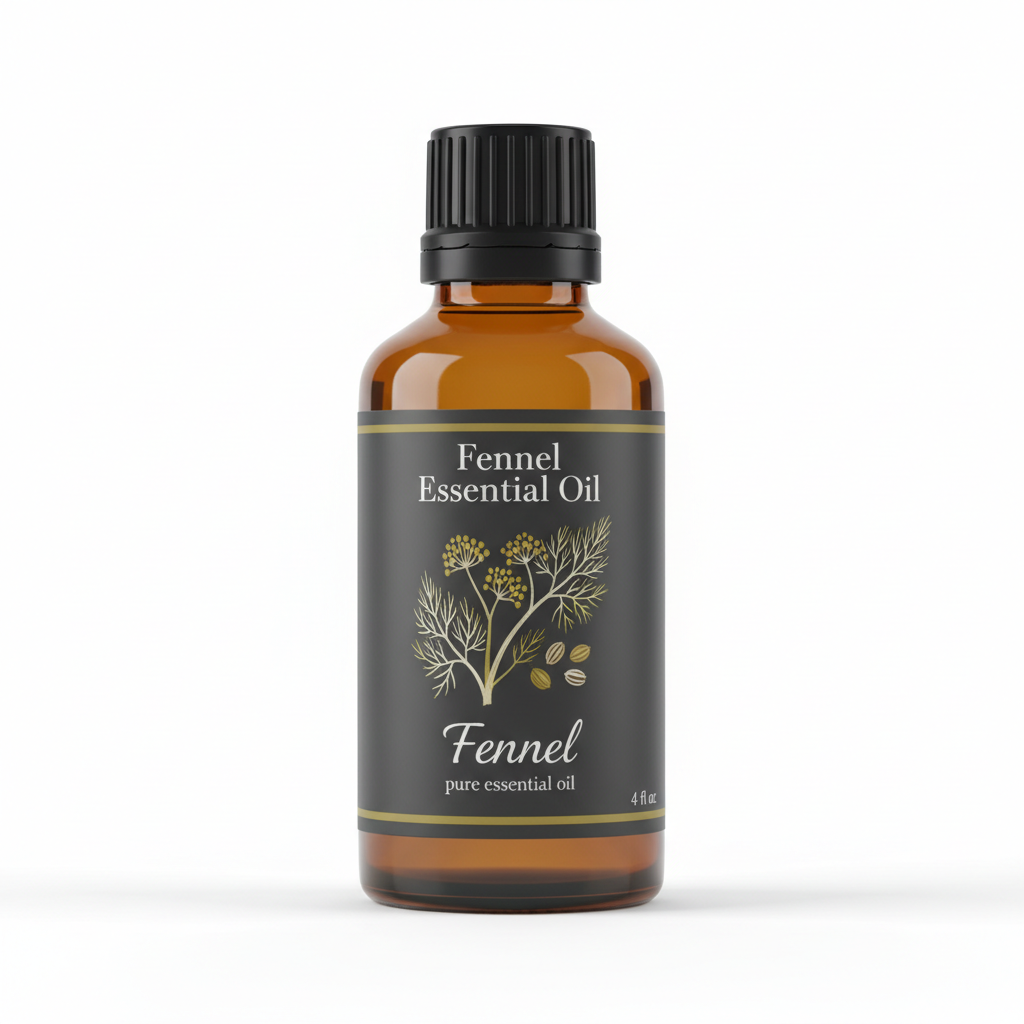
Fennel Essential Oil
Our own Fennel Essential Oil, in sizes from 0.5 oz to bulk.
From $13.99
Shop Now →Three questions that get answered as one
"Does fennel help digestion?" is really three questions, because the tradition, the trials and the bottle on your shelf involve different things.
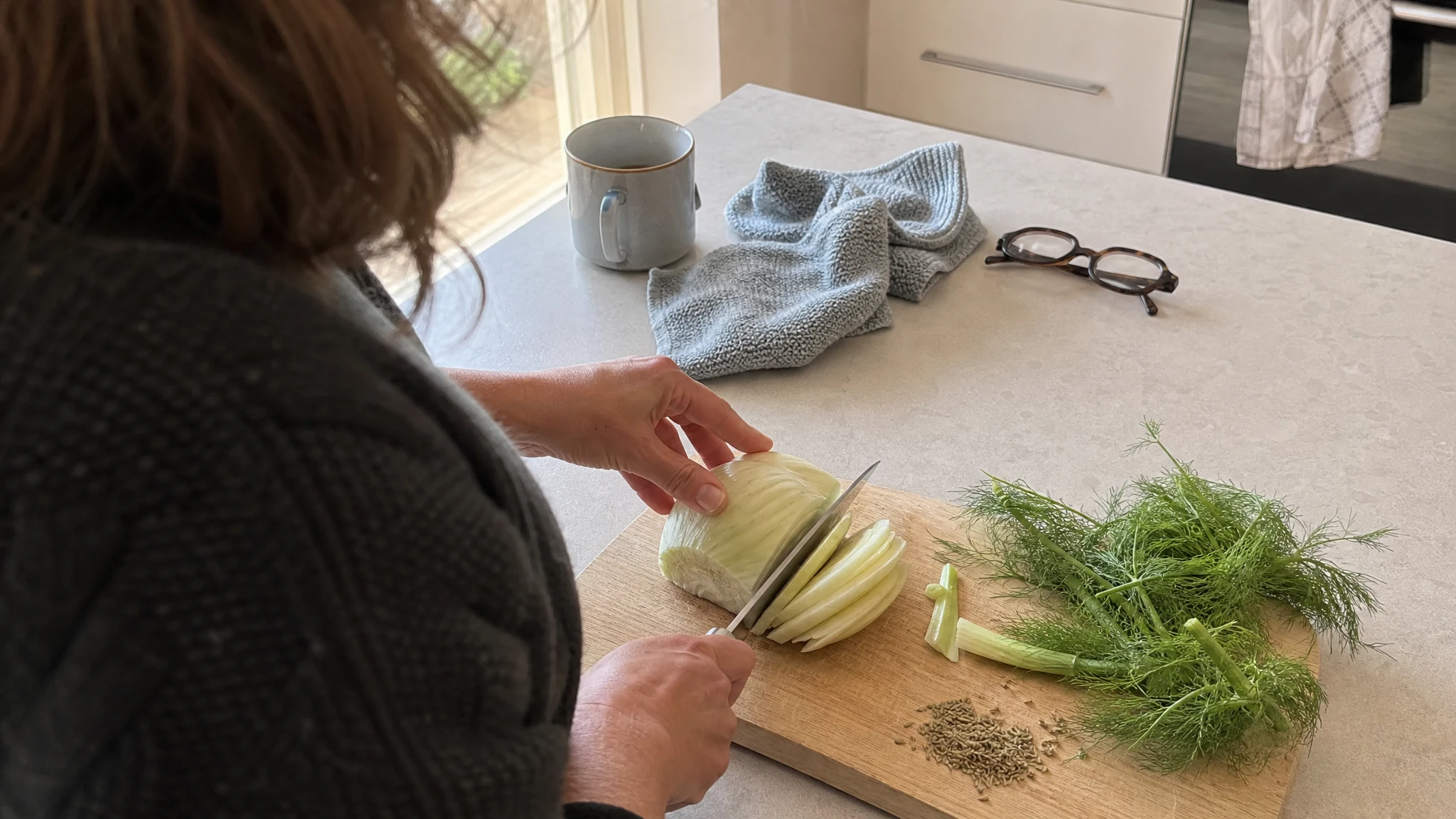
- Fennel fruit as tea. The European Medicines Agency's herbal committee lists dried sweet fennel fruit as a traditional herbal tea for mild, spasmodic digestive complaints including bloating and flatulence. Its monograph (adopted 31 January 2024) says that rests exclusively on long-standing use, caps adult use at 2 weeks, and does not recommend it under 4 years (EMA, 2024).
- Fennel capsules and combination products, swallowed, in the handful of human trials.
- Fennel essential oil, a steam-distilled concentrate of the seed, which is what we bottle, and which the monograph does not cover.
The first two are real evidence about different things. Reading them as evidence for the third is the mistake most pages on this topic make.
What the trials found, and what each one was
A 2024 double-blind trial in a teaching hospital compared fennel capsules with dimethicone, a common anti-gas medicine, in women who felt flatulent after cesarean section. Each woman took four doses six hours apart and rated flatulence on a visual analogue scale before and one hour after each dose. Scores fell in both groups, and after adjusting for baseline there was no difference between them (Jourshari et al., 2024). That reads as "about as good as dimethicone", but the trial had no placebo arm, the abstract does not say whether the capsules held seed powder or oil, and the setting was the first days after surgery. Recovery alone lowers gas scores, and a no-placebo design cannot separate the two.
A larger randomized trial of 381 people after complex abdominal surgery found that those given "heated fennel therapy" passed first flatus and first stool sooner than those given a heated rice husk pack, and had less abdominal distension (Chen et al., Surgery, 2020). The rice husk control means warmth alone was matched. The abstract does not describe the preparation, so we cannot say whether the effect came from fennel vapour, contact or something else, and surgical recovery is not everyday bloating.
In IBS, the best-known fennel oil trial gave 121 people a curcumin and fennel oil capsule for 30 days and reported a larger fall in symptom score than on placebo (Portincasa et al., 2016). Participants took two capsules twice a day. The oil there was swallowed, combined with curcumin, and the question was IBS rather than ordinary bloating. We take it apart in what the IBS trials did and did not test.
What this means for a bottle of oil
Our position: the data support curiosity about fennel, not a promise about the oil. Three conclusions are reasoning rather than trial results:
- Applied to skin, diluted, the oil reaches the abdomen very differently from a capsule. Nobody has shown that it does anything for gas, and we will not imply it does.
- If you use it anyway, the only evidence-adjacent method is light abdominal massage, and the evidence there is for the massage, not the oil. We walk through that in dilution, direction and red flags.
- Swallowing the bottle is the wrong way to copy the trials. Our oil is bottled undiluted and is not meant for internal use; the oral products in the studies were formulated and dosed as capsules or tea. See can you swallow fennel essential oil.
If your question is really which oil has stronger evidence for digestion, peppermint does for one situation: IBS. The American College of Gastroenterology's 2021 guideline suggests peppermint oil for IBS symptoms, rated conditional with low-quality evidence, and does not mention fennel (Lacy et al., 2021). We sell only fennel, so for peppermint questions see a gastroenterologist or pharmacist; the comparison is in fennel vs peppermint.
The moves with better evidence than any aromatic
If the bloating is a pattern rather than a one-off, the guideline-level steps are not oils. The ACG recommends a limited trial of a low FODMAP diet to improve global IBS symptoms, and suggests gut-directed psychotherapy, both graded above anything said about fennel (Lacy et al., 2021). Those apply to diagnosed IBS, and a "limited trial" is the guideline's phrase for a reason: restrictive diets are best run with a dietitian.
What follows is reasoning, not a protocol. If you want to know whether anything you do changes your symptoms, change one thing at a time and keep a short daily note of when the bloating arrives, what you ate and when your bowels moved. A change you cannot tie to one variable tells you nothing, and a fragrant lotion added on top of a diet change makes the picture muddier. That is also why we are reluctant to say an oil "helped": with symptoms that rise and fall by themselves, a good week is the expected outcome whatever you apply.
Bloating that should go to a doctor, not a bottle
The ACG guideline lists "alarm features" that raise concern about a bowel disease: blood in the stool (hematochezia), black stool (melena), unintentional weight loss, symptoms starting at an older age, and a family history of IBD, colon cancer or other significant gastrointestinal disease. It adds that these features have low predictive value in people with IBS, and that colon cancer screening should be up to date regardless (Lacy et al., 2021). The NICE guidance summarised in the BMJ lists unexplained weight loss, rectal bleeding, a family history of bowel or ovarian cancer, and, for people over 60, a change to looser or more frequent stools lasting over six weeks. It also says a pelvic examination should be considered if ovarian cancer is a concern (Dalrymple and Bullock, BMJ, 2008).
In practice, bloating that is new, persistent, painful, comes with vomiting, or arrives with any of those signs should be assessed by a physician or gastroenterologist before anyone tries an aromatic. A lotion is no substitute for finding out why.
Who should not use fennel oil here at all
- Pregnancy and breastfeeding. The EMA says use is not recommended for want of data and notes that trans-anethole passes into breast milk. We say avoid it entirely (see pregnancy and breastfeeding).
- Children. Our oil is not appropriate for children.
- Oestrogen-sensitive conditions or epilepsy. Leave it alone, per our own published guidance.
- Allergy to the carrot family. The monograph lists hypersensitivity to aniseed, caraway, celery, coriander, dill or anethole, and to mugwort pollen, as a contraindication for fennel fruit. For the oil that is again an extrapolation, but patch testing for 24 hours first is our rule.
That is the reasoning behind our caution, not a medical judgement; a pharmacist can check it against your medicines and history. The EMA monograph itself adds that if symptoms worsen during use, a doctor or qualified health care practitioner should be consulted, and that adults should not take the fruit tea for more than 2 weeks. Even the traditional-use label is short-term and symptom-limited; it was never an open-ended daily habit.
Fennel oil has a fine place as an aroma, and a diluted skin oil if you tolerate it, but a digestive claim is one we will not make for it. For the full table of what is graded and why, return to the evidence overview.
Fennel Essential Oil
Fennel Essential Oil from our own shop, in sizes from 0.5 oz to bulk.
From $13.99
Shop Now →Sources & Further Reading
- European Medicines Agency, HMPC, 2024. European Union herbal monograph on Foeniculum vulgare Miller subsp. vulgare var. dulce, fructus (EMEA/HMPC/372839/2016, revision 1). ema.europa.eu
- Jourshari MS et al., 2024. A comparative study of fennel and dimethicone capsule effects on flatulence rate after cesarean section: a double-blind randomized controlled trial. J Educ Health Promot. pubmed.ncbi.nlm.nih.gov
- Chen B et al., 2020. Heated fennel therapy promotes the recovery of gastrointestinal function in patients after complex abdominal surgery. Surgery. pubmed.ncbi.nlm.nih.gov
- Portincasa P et al., 2016. Curcumin and fennel essential oil improve symptoms and quality of life in patients with irritable bowel syndrome. J Gastrointestin Liver Dis 25(2):151-157. pubmed.ncbi.nlm.nih.gov
- Lacy BE et al., 2021. ACG clinical guideline: management of irritable bowel syndrome. Am J Gastroenterol 116(1):17-44. pubmed.ncbi.nlm.nih.gov
- Dalrymple J, Bullock I, 2008. Diagnosis and management of irritable bowel syndrome in adults in primary care: summary of NICE guidance. BMJ 336:556-558. pmc.ncbi.nlm.nih.gov