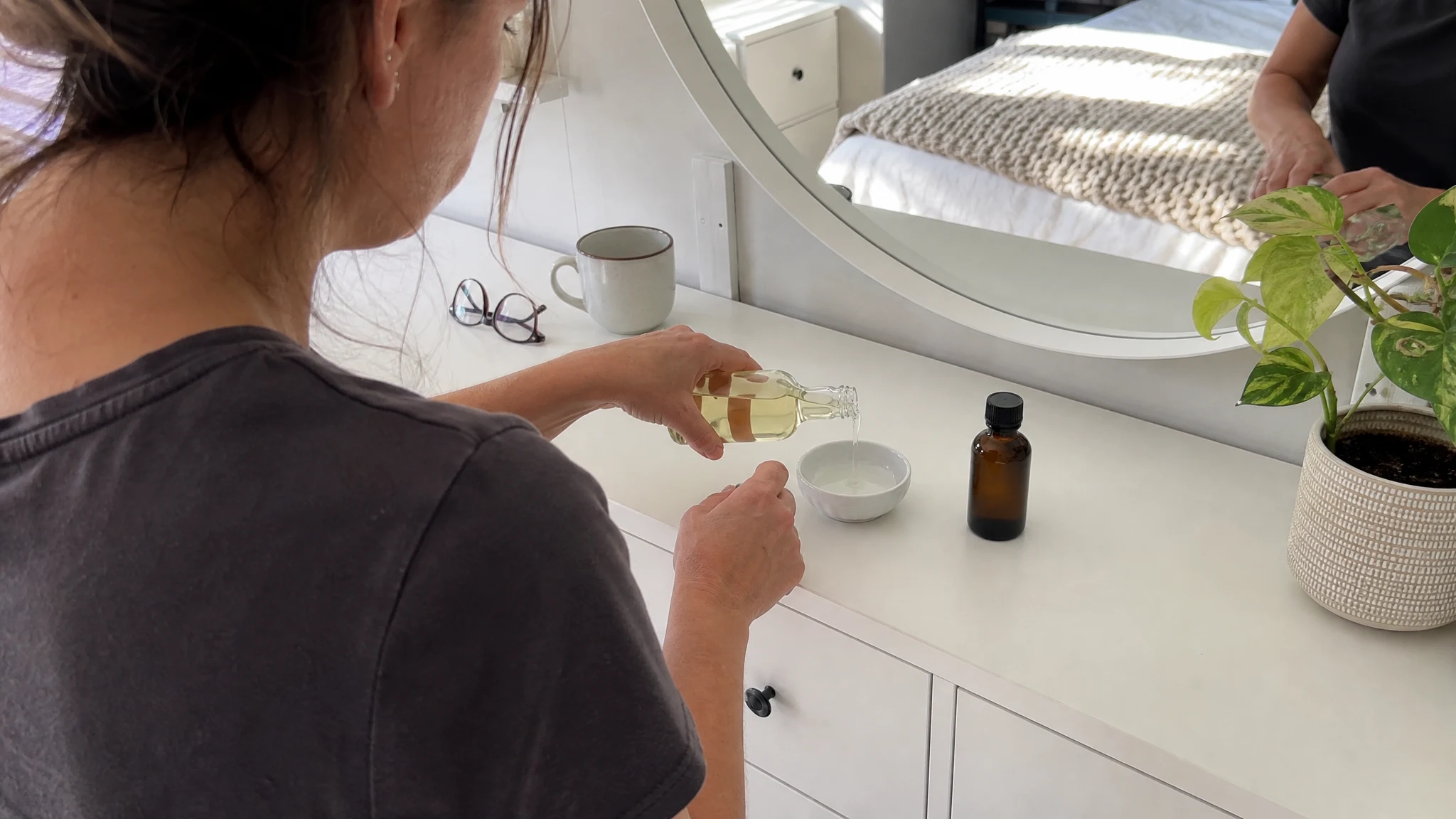
Fennel Oil Abdominal Massage: Dilution, Direction and Red Flags
Nobody has shown that adding fennel oil makes an abdominal massage work better, so treat the oil as scent, not as the active part. If you want to try it, the safe version is a low dilution, a patch test first, a clockwise direction and a short list of people and symptoms that rule it out. All of that is below, with the evidence behind each step.

Fennel Essential Oil
Our own Fennel Essential Oil, in sizes from 0.5 oz to bulk.
From $13.99
Shop Now →What is known: the massage, not the oil
The evidence is for the massage itself, and it is about constipation. A 2025 systematic review and meta-analysis pooled 23 studies with 1,431 adults with chronic constipation. Abdominal massage increased weekly bowel movements by about 1.6 on average, shortened gut transit time by about 21.5 hours and lowered constipation symptom scores, but it did not reduce laxative use, and the results varied widely between studies (I2 of 82% for frequency). Aromatherapy and acupressure massage showed a bigger effect than circular massage alone, but the authors note high heterogeneity and few articles; no adverse reactions were observed in people without neurogenic bowel dysfunction (Huang et al., 2025).
Read that carefully. It does not name fennel, it covers constipation rather than bloating, and the aromatherapy subgroup mixed many oils. We found no trial that tested fennel oil in an abdominal massage for digestion, which is why our bloating page files the oil as unproven. Our grading across all claims is in the evidence overview.
Step one: decide whether you should do this at all
An NHS community service in Leeds lists who its abdominal massage programme is not for: people with a history of malignant bowel obstruction or an abdominal growth, a history of inflammatory bowel disease, an unstable spinal injury, pregnancy, recent scarring or skin lesions, "spastic colon experienced in irritable bowel syndrome", and care is advised with any abdominal hernia (Leeds Community Healthcare NHS Trust). That is one provider's exclusion list, written for its own supervised service, so it is a cautious reference rather than a universal rule. Healthline's medically reviewed guide adds the simplest one: do not have abdominal massage after recent abdominal surgery (Healthline, updated 2024).
For fennel oil specifically, add our own published limits: avoid it if you are pregnant or breastfeeding, if you have an oestrogen-sensitive condition or epilepsy, and do not use it on children or infants. The EU herbal committee's fennel monograph also lists allergy to the carrot family (aniseed, caraway, celery, coriander, dill), to anethole and to mugwort pollen as a contraindication for fennel fruit, and lists allergic reactions of the skin and respiratory system as adverse effects (EMA, 2024). That is a monograph about the fruit, not the oil, so applying it to the oil is an extrapolation. We would still follow it.
Step two: dilution, with the arithmetic shown
Our own published guidance for fennel is 0.5% to 2% in a carrier oil, roughly 3 to 12 drops per ounce, with a 24-hour patch test first. The Tisserand Institute's general ranges are 1% to 3% for body oils and lotions, and 0.2% to 1% where skin is sensitive or its barrier is impaired (Tisserand Institute, dilution guidelines). They call these guidelines, not rules, and the figures are not specific to fennel.
Our position for the abdomen is to start at the bottom of our range, 0.5% to 1%. The reasoning, not a trial result: the abdomen is a large area, a massage covers it for minutes at a time, and the skin-allergy risk the EMA lists applies at any strength. There is no benefit evidence that a stronger dilution works better, so there is no reason to go higher.
On our guidance of about 3 drops per ounce for 0.5%, 1% is about 6 drops per ounce. An ounce is roughly 30 mL, so a 1% blend contains about one drop of oil per 5 mL (a teaspoon) of carrier. That is arithmetic from our own drop guidance, not a measurement: drop size varies with the tool you use to dispense it, so for anything you plan to repeat, mix a small batch in a clean glass container and label it with the date and dilution. We sell the oil only, not carrier oils; see the carrier oil guide for what to look for, and the skin basics page for the patch test method. A ready-made example of a fennel body oil is in the body oil post, though it is a different use.
Step three: direction and pressure
Go clockwise as you look down at your own abdomen. The NHS Leeds page describes "a clockwise massage over your abdomen" and says sessions in that service take 10 to 20 minutes. Healthline's guide, reviewed by a physical therapist, describes using the palm to massage the whole stomach clockwise and circling outward from the navel. The reason for the direction is anatomy, and it is reasoning, not a trial result: the large intestine rises on your right side, crosses under the ribs and descends on your left, and a clockwise circle follows that path.
Keep the touch light enough that you could hold a conversation. Pain is a stop sign, not a sign it is working. The Leeds page does not specify pressure and we are not clinicians, so we will not give a number. Use a small amount of the diluted oil, skip any area where the skin is broken or irritated, and wash your hands afterwards, because our guidance is to keep the oil away from the eyes.
What commonly goes wrong
These are reasoned from the cautions above, not from observed cases:
- Using the oil neat. Bottled fennel oil is undiluted by design. It goes into a carrier first, every time.
- Skipping the patch test because the dose is "only a few drops". The test is about your skin, not the amount.
- Massaging through pain or a hard, swollen belly. Both are on the stop list below, not reasons to press harder.
- Reading a good or bad week as an answer. If it seems to help one week and not the next, that tells you nothing about the cause; a physician can find it.
- Carrying on for weeks without a plan. No trial we opened tells you how long to continue with fennel oil, so set yourself a review date, and if the symptom is still there, book the appointment.
Red flags: stop and get assessed
Stop massage and contact a physician if any of these appear. They come from three sources: the intestinal obstruction entry from MedlinePlus (US National Library of Medicine, reviewed 27 April 2026), the American College of Gastroenterology's IBS guideline and our own cautions on skin reactions.
- Cannot pass stool or gas, a swollen abdomen that does not go down, repeated vomiting, or unexplained abdominal pain that persists. MedlinePlus lists these as reasons to contact a provider about possible intestinal obstruction (MedlinePlus).
- Blood in the stool, black stool, unintentional weight loss, symptoms that started later in life, or a family history of bowel disease. The ACG guideline names these as alarm features that raise concern about a pathologic cause (Lacy et al., 2021).
- Redness, itching, swelling or a rash on the skin, or wheezing or a cough after using it: wash the area, stop, and contact a physician. The EMA lists skin and respiratory allergy as the adverse effects of fennel.
A massage that "does nothing" is not a red flag. A massage that makes pain worse is.
Where this stops being our territory
We distil and sell one oil, and a massage technique is not our product. If constipation or bloating is persistent, a gastroenterologist or your own physician can find out why, and a pelvic-floor physical therapist or registered dietitian can teach an abdominal technique appropriate to your situation. A fennel-scented oil is a comfort, and the massage is what the evidence looks at.
If you do go ahead, patch test, dilute low, go clockwise, and keep the red-flag list handy; the full picture of what is and is not shown is in our evidence overview.
Fennel Essential Oil
Fennel Essential Oil from our own shop, in sizes from 0.5 oz to bulk.
From $13.99
Shop Now →Sources & Further Reading
- Huang SY, Chiao CY, Chien LY, 2025. Effectiveness of abdominal massage on chronic constipation in adults: a systematic review and meta-analysis. Int J Nurs Stud. pubmed.ncbi.nlm.nih.gov
- Leeds Community Healthcare NHS Trust. Abdominal massage (CUCS): information page. leedscommunityhealthcare.nhs.uk
- Healthline, 2024 (medically reviewed). Abdomen massage: what it is, benefits, and safety. healthline.com
- Tisserand Institute. Dilution guidelines for essential oils. tisserandinstitute.org
- European Medicines Agency, HMPC, 2024. European Union herbal monograph on Foeniculum vulgare Miller subsp. vulgare var. dulce, fructus (EMEA/HMPC/372839/2016, revision 1). ema.europa.eu
- MedlinePlus Medical Encyclopedia. Intestinal obstruction and ileus. US National Library of Medicine, reviewed 27 April 2026. medlineplus.gov
- Lacy BE et al., 2021. ACG clinical guideline: management of irritable bowel syndrome. Am J Gastroenterol 116(1):17-44. pubmed.ncbi.nlm.nih.gov