
Fennel Essential Oil Benefits: What the Research Actually Shows
No benefit of fennel essential oil is backed by strong evidence. The best human data come from capsules, tea and mixed products, and where trials did use the oil, it was swallowed, which we do not advise. Below, each claimed benefit gets a grade, a reason and the exact form that was tested, so you can see how far each one reaches.
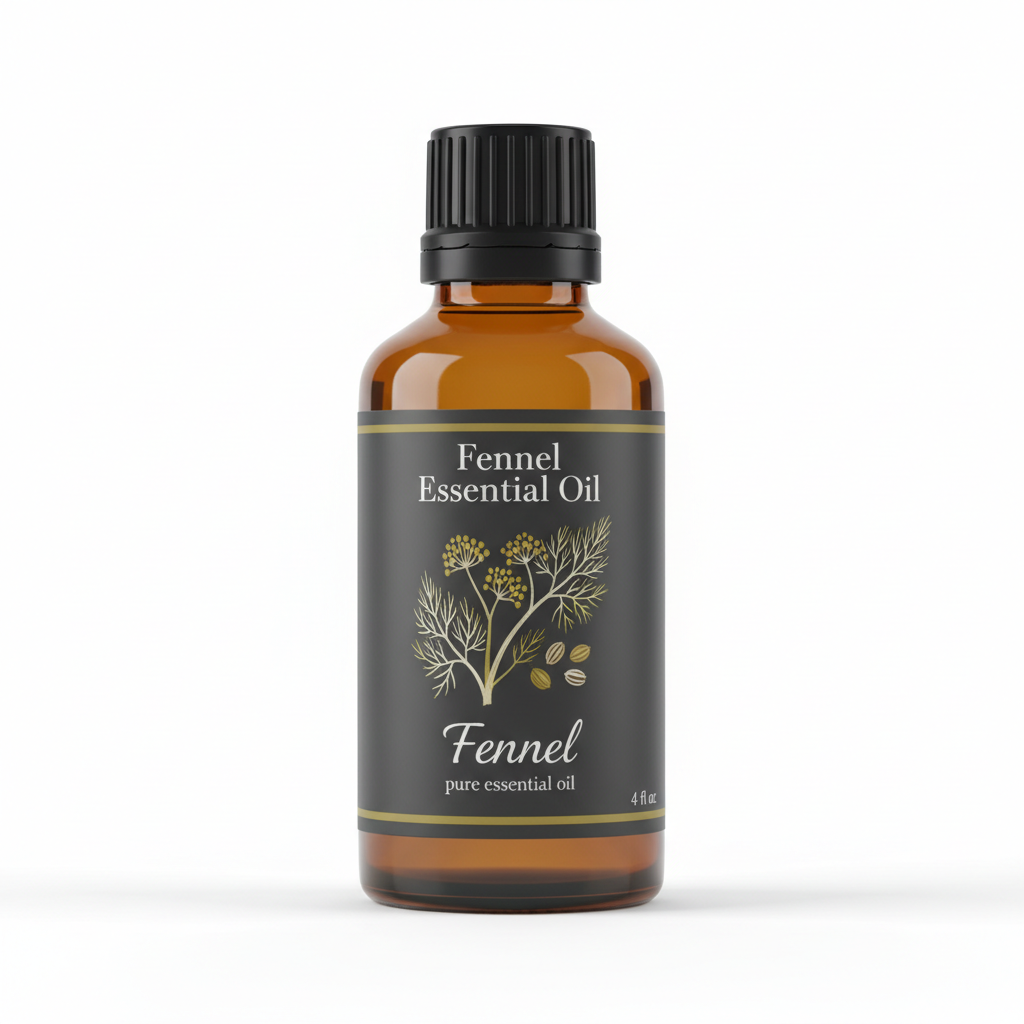
Fennel Essential Oil
Our own Fennel Essential Oil, in sizes from 0.5 oz to bulk.
From $13.99
Shop Now →Why most benefit lists describe a different product
Search results blur four things that behave differently: the dried seed (botanically the fruit), tea made from it, standardised capsules, and the steam-distilled oil. A trial of one does not carry over to another. Fennel tea is a water extract, while the oil is a distillate: one 2026 analysis found a fennel seed oil that was 79.7% (E)-anethole (Drioiche et al., 2026), a profile no cup of tea reproduces. Our own bottle is sweet fennel (Foeniculum vulgare, sweet variety), distilled from crushed seed, and it is sold for aroma and for diluted skin use, not for swallowing. Advice that says "fennel" without naming the form is incomplete, and the same goes for advice that does not say sweet or bitter (see sweet vs bitter fennel oil).
The clearest example is period cramps. A 2020 systematic review of 12 randomized trials of fennel in primary dysmenorrhea found that nine tested oral fennel oil and three tested capsules, that all came from Iran, and that the authors deliberately excluded massage with fennel oil (Lee et al., Nutrients, 2020). So the one condition with a pile of trials on the oil is a condition where the oil was swallowed. Nothing in that review tests rubbing diluted oil on skin, which is how most readers will use a bottle like ours.
How the grades work
Four grades, assigned by us from what we opened and read, not taken from any outside rating:
- Strong: several well-run randomized trials of the same form, consistent results, and a guideline body that endorses it. Nothing about fennel oil reaches this.
- Limited: at least one randomized trial in people, but small, short, a different form, or with results that conflict.
- Lab only: measured in a dish or in animals. It shows a mechanism is plausible and nothing about what happens in a person.
- Traditional only: accepted on long-standing use, with no trial behind the claim.
The grades, claim by claim
| Claim | Grade | What was actually tested |
|---|---|---|
| Mild bloating and gas | Traditional only for the oil; limited for other fennel products | The EU herbal committee lists fennel fruit as a traditional herbal tea for mild, spasmodic digestive complaints including bloating and flatulence (EMA, 2024). A 2024 trial in women after cesarean section found fennel capsules and dimethicone both lowered flatulence scores with no difference between them. |
| IBS symptoms | Limited | One placebo-controlled trial of 121 people on a curcumin plus fennel oil capsule for 30 days (Portincasa, 2016). One uncontrolled study of 211 people (Di Ciaula, 2018). Neither isolates fennel. |
| Period cramps | Limited | Twelve trials, all Iranian, mostly oral fennel oil; large unexplained differences between studies and signs of publication bias (Lee, 2020). |
| Relaxing uterine muscle | Lab only | Fennel oil lowered oxytocin and prostaglandin E2 contractions in isolated rat uterus (Ostad, 2001). |
| Appetite and weight | Limited for appetite; no support for weight loss | Nine women, tea, subjective ratings (Bae, 2015). Forty-seven women, capsules, 12 weeks, no change in weight (Saghafi, 2017). |
| Growth inhibition of microbes | Lab only | A 2026 dish study reported that fennel oil stopped Candida parapsilosis growing at 1,200 micrograms per mL (Drioiche). |
| Cough with a cold | Traditional only | Listed as a traditional use of fennel fruit tea, "based exclusively on long-standing use" (EMA, 2024). |
| Infant colic | Limited, one trial | An oral seed-oil emulsion in 125 infants (Alexandrovich, 2003). Not guidance: the EMA does not recommend fennel fruit products under 4 years. |
Nausea, oral health, skin and hair are not graded here because each deserves its own reading of the evidence: see nausea, oral health, acne, anti-aging claims and hair.
Digestion: the strongest-sounding claim, and its gap
This is where the tradition is oldest and the trial data thinnest for oil. The IBS capsule trial reported a drop in the symptom score of 50.05% against 26.12% on placebo, and 25.9% symptom-free against 6.8% (Portincasa et al., 2016). It is a real result. It is also a curcumin and fennel oil combination swallowed in capsules, and the follow-up open study (Di Ciaula et al., 2018) had no comparison group. The details are in what the IBS trials did and did not test, and the wider picture is in fennel oil for bloating and digestion. For IBS specifically, the American College of Gastroenterology's 2021 guideline suggests peppermint oil (conditional, low-quality evidence); the document does not discuss fennel (Lacy et al., 2021). That asymmetry is why we wrote fennel vs peppermint.
Cramps, menopause and hormones
Dysmenorrhea has the most trials and the most baggage. Pooled against placebo, one review reported a standardized mean difference of -3.27 with heterogeneity (I2) of 98%, and pooled against drugs such as mefenamic acid it found no meaningful difference across seven trials, but flagged publication bias because small favourable studies were over-represented (Lee et al., 2020). A second meta-analysis of 12 studies pooled seven articles against placebo and reported a much smaller standardized mean difference of -0.632 (Shahrahmani et al., 2021). When two reviews of the same trials disagree on size, "works" is too strong a word. Our pages on the cramp trials and menopause go through the detail before you draw a conclusion. Anyone with an oestrogen-sensitive condition or epilepsy should leave fennel oil alone, per our own published guidance.
Weight, cough and the lab
The appetite claim rests on nine women drinking tea (Bae et al., 2015), and a later trial of fennel capsules found no effect on weight or fat distribution (Saghafi et al., 2017). See where the weight-loss claim comes from. Cough is a tradition with a regulator's wording but no trial; see tradition vs evidence. Lab figures such as the 1,200 micrograms per mL one are measurements of growth inhibition in a dish; why lab results are not home use explains the gap.
What a trial would need to change a grade
To move any row up, a trial would have to test the thing people actually buy: sweet fennel oil, diluted in a carrier, applied to skin or inhaled, against a placebo carrier with the same smell masked or matched, in a stated number of people over a stated number of weeks, with the oil's anethole and estragole content reported. For the digestive, IBS and cramp rows we did not find a trial of that kind. That is a statement about the evidence we opened, not proof that nobody has run one, and it is why those grades stay at limited, lab only or traditional only.
Safety comes before benefit
The EU herbal committee's 2024 monograph says safety in pregnancy and breastfeeding has not been established, does not recommend use then, notes that trans-anethole is excreted in breast milk, and sets an estragole limit of 0.05 mg per person per day for pregnant and breastfeeding women (EMA, 2024). That monograph covers fruit tea, not oil, so applying it to oil is an extrapolation, but we draw the same line: avoid it in pregnancy and while breastfeeding, and it is not for children. Skin and respiratory allergy are the listed adverse effects. Full detail is in is fennel essential oil safe.
Where we are not the answer
We sell one product: sweet fennel essential oil, from a 0.5 oz bottle up to 400 lb drums. If your goal is help with recurring digestive symptoms, period pain or weight management, the right person is a gastroenterologist, obstetrician-gynecologist or registered dietitian, not a bottle. If you want to know what the oil is, start with the complete guide.
That is the whole honest list: a distinctive oil, studied in some forms of fennel, and not yet shown to do any of the jobs on this page. Our safety page and the IBS review are the two to read before you decide.
Fennel Essential Oil
Fennel Essential Oil from our own shop, in sizes from 0.5 oz to bulk.
From $13.99
Shop Now →Sources & Further Reading
- European Medicines Agency, HMPC, 2024. European Union herbal monograph on Foeniculum vulgare Miller subsp. vulgare var. dulce, fructus (EMEA/HMPC/372839/2016, revision 1). ema.europa.eu
- Lee HW, Ang L, Lee MS, Alimoradi Z, Kim E, 2020. Fennel for reducing pain in primary dysmenorrhea: a systematic review and meta-analysis of randomized controlled trials. Nutrients 12(11). pmc.ncbi.nlm.nih.gov
- Shahrahmani H et al., 2021. Effect of fennel on primary dysmenorrhea: a systematic review and meta-analysis. J Complement Integr Med. pubmed.ncbi.nlm.nih.gov
- Portincasa P et al., 2016. Curcumin and fennel essential oil improve symptoms and quality of life in patients with irritable bowel syndrome. J Gastrointestin Liver Dis 25(2):151-157. pubmed.ncbi.nlm.nih.gov
- Di Ciaula A, Portincasa P, Maes N, Albert A, 2018. Efficacy of bio-optimized extracts of turmeric and essential fennel oil on the quality of life in patients with irritable bowel syndrome. Ann Gastroenterol. pubmed.ncbi.nlm.nih.gov
- Lacy BE et al., 2021. ACG clinical guideline: management of irritable bowel syndrome. Am J Gastroenterol 116(1):17-44. pubmed.ncbi.nlm.nih.gov
- Jourshari MS et al., 2024. Fennel and dimethicone capsule effects on flatulence after cesarean section. J Educ Health Promot. pubmed.ncbi.nlm.nih.gov
- Ostad SN et al., 2001. The effect of fennel essential oil on uterine contraction as a model for dysmenorrhea. J Ethnopharmacol. pubmed.ncbi.nlm.nih.gov
- Bae J et al., 2015. Fennel and fenugreek tea drinking suppresses subjective short-term appetite in overweight women. Clin Nutr Res. pubmed.ncbi.nlm.nih.gov
- Saghafi N et al., 2017. The effect of Foeniculum vulgare (fennel) on body composition in postmenopausal women with excess weight. J Menopausal Med. pmc.ncbi.nlm.nih.gov
- Drioiche A et al., 2026. In vitro and in silico evaluation of Foeniculum vulgare seeds. Chem Biodivers. pubmed.ncbi.nlm.nih.gov
- Alexandrovich I et al., 2003. The effect of fennel seed oil emulsion in infantile colic. Altern Ther Health Med. pubmed.ncbi.nlm.nih.gov