Fennel vs Peppermint Oil for Digestion: Which Evidence Holds Up?
Peppermint, for IBS. A US gastroenterology guideline suggests peppermint oil (conditional, low-quality evidence) and never mentions fennel, whose best IBS data come from a capsule that also held turmeric. Both bodies of evidence are about swallowed products, not oils on skin. We sell only fennel, and on the evidence this page favours peppermint.
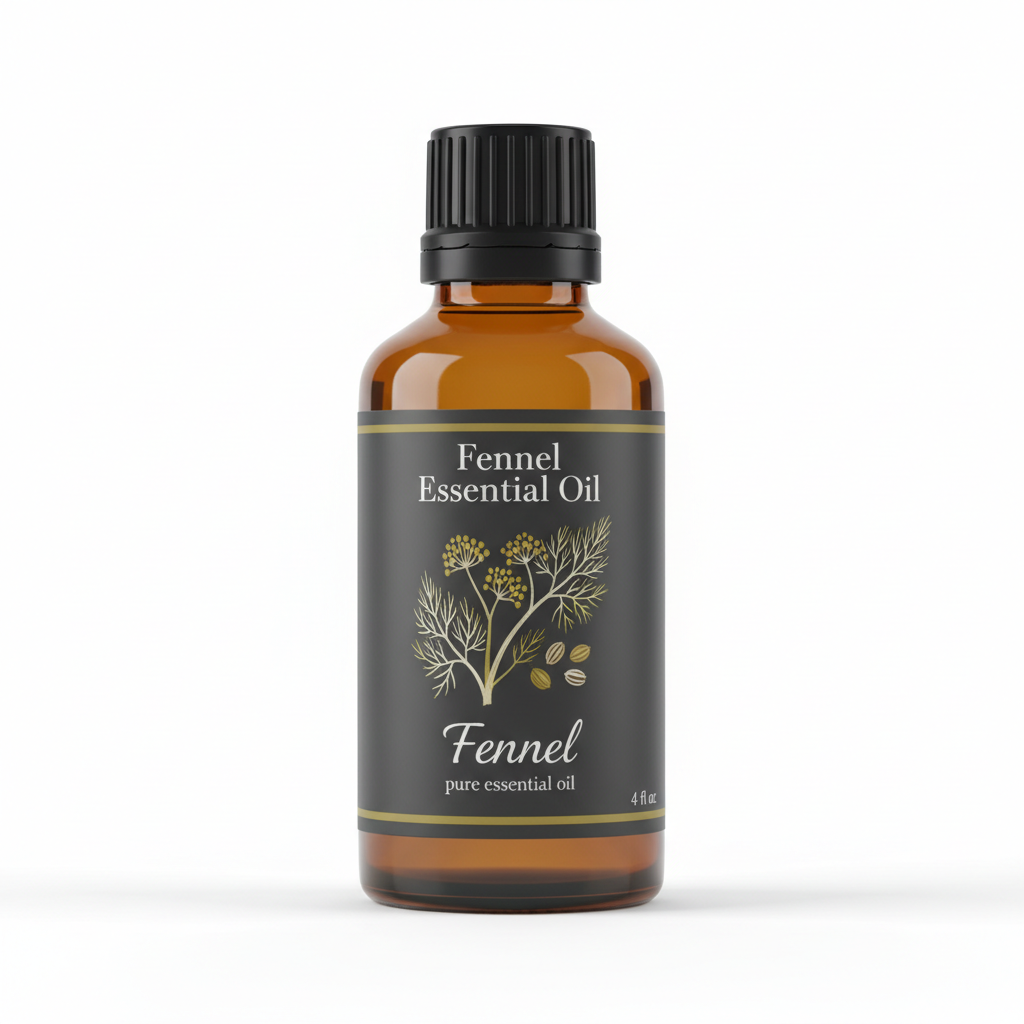
Fennel Essential Oil
Our own Fennel Essential Oil, in sizes from 0.5 oz to bulk.
From $13.99
Shop Now →The comparison at a glance
| Fennel essential oil | Peppermint oil | |
|---|---|---|
| Main compound | trans-anethole (79.7% in one 2026 analysis of a fennel seed oil) | L-menthol, the compound the ACG guideline links to calcium-channel blockade and muscle relaxation |
| What the best trials tested | One 30-day capsule of curcumin plus fennel oil in 121 people with IBS; one uncontrolled study of 211 | Mainly oral peppermint oil in capsules; 12 randomized trials with 835 people in the latest meta-analysis the ACG cited |
| Guideline status | Not mentioned in the ACG 2021 IBS guideline | "We suggest": conditional recommendation, low-quality evidence |
| Our reading of the evidence | Limited | Limited, but stronger than fennel's: pooled randomized trials and a guideline mention, for swallowed capsules; nothing for oil on skin that we opened |
| Main cautions | Skin and respiratory allergy; not recommended in pregnancy or breastfeeding; oestrogen-sensitive conditions and epilepsy (our guidance) | Heartburn when swallowed; not for the face of infants or young children (NCCIH) |
| Who should skip it | Pregnant or breastfeeding people, children, anyone with an oestrogen-sensitive condition or epilepsy | People prone to reflux (our inference from the heartburn finding), and anyone with an infant or young child it might be applied near |
Sources are given below; the cautions in the left column that say "our guidance" are our own published limits, not a regulator's finding. How the grades are set is in the evidence overview.
Peppermint's case, and where it stops
The American College of Gastroenterology's 2021 guideline suggests peppermint oil to relieve global IBS symptoms and rates it conditional with low-quality evidence. The guideline reserves "we recommend" for strong recommendations (for example, chloride channel activators in IBS with constipation) and uses "we suggest" for conditional ones, which is where peppermint sits. It reports a meta-analysis of 12 randomized trials and 835 patients; for overall improvement across 7 trials the relative risk was 2.39 (95% CI 1.93 to 2.97), and the guideline's number-needed figure was 3 for overall symptoms and 4 for abdominal pain. It also flags the limits: trials were small (18 to 178 people) and short (2 to 12 weeks), and a newer 190-person Dutch trial, with capsules releasing 182 mg of peppermint oil in the small bowel or ileocolonic region, missed its primary endpoint at week 4 (Lacy et al., 2021).
That is a mixed picture, but it comes from randomized trials, pooled and graded by a guideline panel. Fennel has nothing equivalent. The guideline also notes that only a small number of commercial peppermint products have had rigorous efficacy and safety testing, and that the oil's effect on the lower esophageal sphincter can cause heartburn in some people, which is why enteric-coated formulations are discussed.
Everything above is oral. The National Center for Complementary and Integrative Health says enteric-coated peppermint oil capsules may improve IBS symptoms in adults, and that evidence for peppermint oil applied to the skin is limited, with possible benefit for tension headaches, not digestion (NCCIH, updated May 2025). So the capsule evidence does not transfer to a rub or a diffuser, for peppermint or for fennel. That is the most useful sentence on this page.
Fennel's case, and the missing head-to-head
The fennel evidence is the capsule trial (Portincasa et al., 2016): symptom score fell 50.05% vs 26.12% on placebo over 30 days, in a product that also contained curcumin and was swallowed. It is a real signal, with industry links and no fennel-only arm; we set it out in what the IBS trials did and did not test. Outside IBS, the EU herbal committee lists fennel fruit tea as a traditional use for mild, spasmodic digestive complaints including bloating, resting on long-standing use rather than trials (EMA, 2024).
No trial we found compares fennel oil with peppermint oil. A PubMed search run for this article in October 2026 for the two together returned no randomized comparison. So anyone declaring a winner is comparing two different bodies of evidence, which is what the table does, honestly labelled.
The one place the two meet in a trial is a 1996 randomized, double-blind study in which drops made from caraway, fennel, peppermint and wormwood extracts were compared with metoclopramide drops for upper abdominal complaints over two weeks, with the herbal mixture reported as better (Westphal et al., 1996). It was a four-plant extract product, so it cannot say which ingredient mattered, and it says nothing about essential oil.
Using both, or either, as an aroma
Nobody has studied fennel and peppermint oils together as aromatics or massage oils for digestion, so there is no evidence either way. That is a reasoned position, not a finding. If you like both as scents, there is no reason to treat them as competitors, but there is no basis either for stacking them in the hope of a bigger effect. Two oils in the same carrier are simply two oils on the same patch of skin: patch test each separately for 24 hours and keep each at the low end of its range. Our own guidance for fennel is 0.5% to 2% in a carrier oil. For where this fits in a routine, see bloating and digestion and the abdominal massage guide.
The safety difference that matters most
The cautions are different in kind. For peppermint, NCCIH says little is known about larger-than-food amounts in pregnancy and breastfeeding, that skin use can cause rashes and irritation, and that the oil should not be applied to the face of infants or young children because inhaling the menthol can cause serious side effects (NCCIH, 2025). For fennel, the EU committee goes a step further: use in pregnancy and breastfeeding is not recommended, trans-anethole is excreted in breast milk, and skin and respiratory allergy are the listed adverse effects. Its contraindications include allergy to the carrot family (aniseed, caraway, celery, coriander, dill) and to mugwort pollen (EMA, 2024). That monograph is for fennel fruit tea, so for the oil it is an extrapolation, but it is the closest regulator wording there is.
How to choose, in the order we would ask
- Do you have a diagnosis? If not, that comes first. Blood in the stool, black stool, unintentional weight loss, symptoms starting later in life or a family history of bowel disease are reasons to see a physician before choosing any aromatic or capsule (ACG alarm features).
- Is it IBS, and are you open to a capsule? Then peppermint is the one the guideline mentions, and the person to ask about product, enteric coating and reflux is a gastroenterologist or pharmacist. We do not sell it and will not pretend to advise on it.
- Do you want an aroma or a diluted skin oil, with no health expectation? Then either can fit, subject to each oil's cautions. If you want fennel, our buying guide covers what to check before you order.
- Are you pregnant, breastfeeding, buying for a child, or living with epilepsy or an oestrogen-sensitive condition? Leave fennel oil alone. Review the full list in contraindications and interactions, and ask a pharmacist or obstetrician-gynecologist before anything else.
Fennel and peppermint are not rivals in the way the question implies: one has a guideline's tentative backing for a swallowed product in IBS, and the other has an early signal in a mixed capsule, and neither has been tested as the oil on your shelf. Our evidence overview keeps that grade table in one place.
Fennel Essential Oil
Fennel Essential Oil from our own shop, in sizes from 0.5 oz to bulk.
From $13.99
Shop Now →Sources & Further Reading
- Lacy BE, Pimentel M, Brenner DM, Chey WD, Keefer LA, Long MD, et al., 2021. ACG clinical guideline: management of irritable bowel syndrome. Am J Gastroenterol 116(1):17-44. pubmed.ncbi.nlm.nih.gov
- National Center for Complementary and Integrative Health, 2025. Peppermint oil: usefulness and safety. nccih.nih.gov
- Portincasa P et al., 2016. Curcumin and fennel essential oil improve symptoms and quality of life in patients with irritable bowel syndrome. J Gastrointestin Liver Dis 25(2):151-157. pubmed.ncbi.nlm.nih.gov
- European Medicines Agency, HMPC, 2024. European Union herbal monograph on Foeniculum vulgare Miller subsp. vulgare var. dulce, fructus (EMEA/HMPC/372839/2016, revision 1). ema.europa.eu
- Westphal J, Hörning M, Leonhardt K, 1996. Phytotherapy in functional upper abdominal complaints: results of a clinical study with a preparation of several plants. Phytomedicine. pubmed.ncbi.nlm.nih.gov
- Drioiche A et al., 2026. Comprehensive in vitro and in silico evaluation of Foeniculum vulgare seeds. Chem Biodivers. pubmed.ncbi.nlm.nih.gov