
Fennel Oil and IBS: What the Trials Did and Did Not Test
Two studies sit behind almost every claim that fennel oil helps irritable bowel syndrome. Both gave people a swallowed capsule that combined fennel oil with turmeric extract, both share authors, and neither can tell you what fennel alone did. This page sets them side by side and says what they leave open. For the wider grading, see our evidence overview.
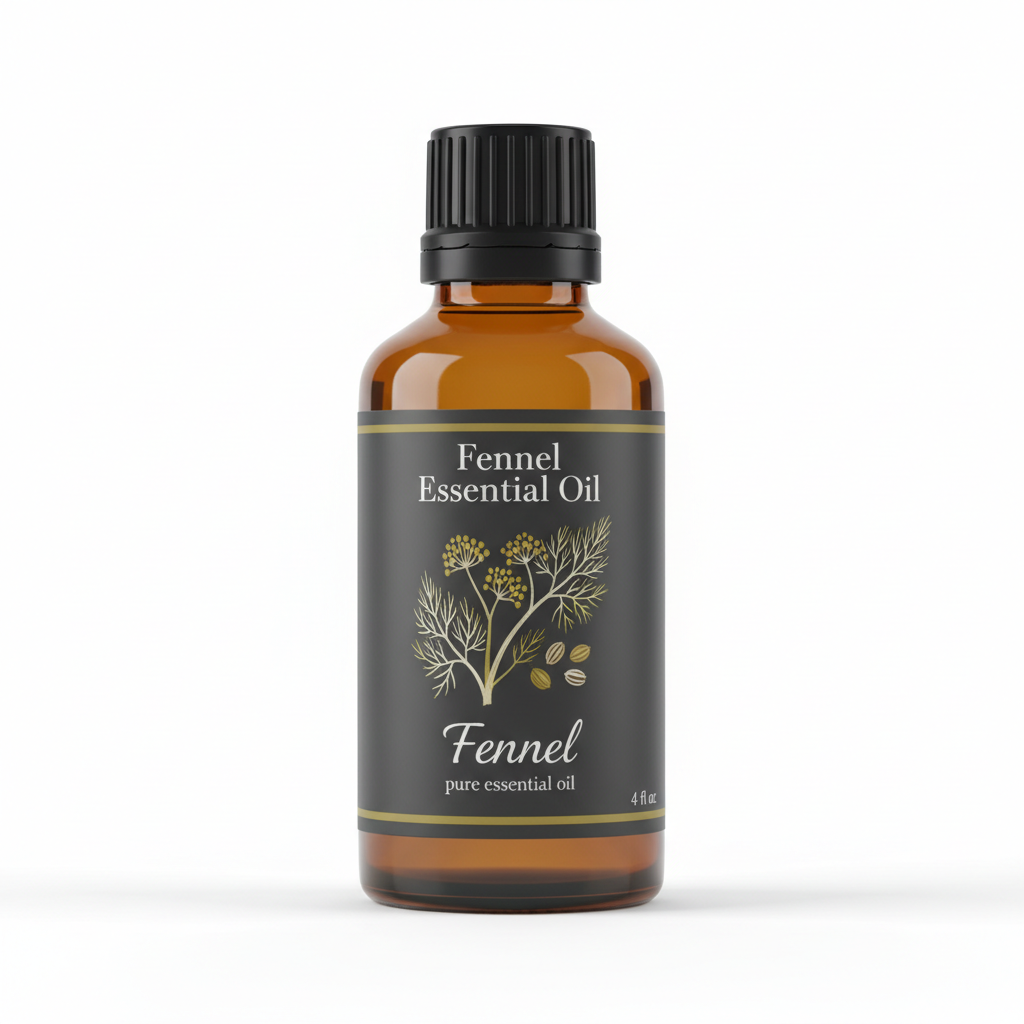
Fennel Essential Oil
Our own Fennel Essential Oil, in sizes from 0.5 oz to bulk.
From $13.99
Shop Now →The two studies in one table
| Portincasa et al., 2016 | Di Ciaula et al., 2018 | |
|---|---|---|
| Design | Randomized, double-blind, placebo-controlled, five Italian centers | Open pilot study, no control group, enrolled by 70 general practitioners |
| People | 121 randomized, 116 analysed; Rome III IBS, mild to moderate, aged 18 to 60; diarrhea-predominant or constipation-predominant | 211 with Rome III IBS; 14% diarrhea-predominant, 24% constipation-predominant, 62% mixed |
| Product | Curcumin plus fennel essential oil capsule, 2 capsules twice a day | A branded product of turmeric extract and fennel oil, 2 capsules twice a day for a month, then 2 once a day |
| Length | 30 days | 2 months |
| Main result | Relative fall in symptom score 50.05% vs 26.12% on placebo; symptom-free 25.9% vs 6.8% | Symptom severity and quality of life improved in every subgroup; no adverse events reported |
| Limits stated | Small sample, short course | No placebo group, in a condition where remission comes and goes |
Sources: Portincasa et al., 2016; Di Ciaula et al., 2018. The details in the table come from the open full texts.
What neither study can tell you
It is not a fennel result. The capsule in the randomized trial was curcumin plus fennel oil. With both in the capsule, any improvement belongs to the pair. A trial that gave curcumin alone, fennel oil alone and the combination would answer the question; this one did not.
It was swallowed. This is the part that readers meeting these papers on a fennel oil shop's page miss. The trials tested a formulated oral capsule. They say nothing about an oil on skin or in a diffuser, and our bottle is not intended for internal use. A capsule's dose and composition are set by its maker, which a dropper of undiluted oil is not.
There are industry ties. The randomized trial's conflict-of-interest statement says three authors served as speakers for, and received research funding from, Alfa Wassermann, and the clinical research department of Alfa Wassermann SpA is one of the listed author affiliations. The open study declares no conflicts. That does not make either result wrong. It does mean the better-controlled trial has links to a company in this field, and we did not find an independent replication.
The control matters. IBS symptoms drift on their own. The open study's own discussion calls the lack of a placebo group a limitation, because patients may enter remission by themselves and placebo response in IBS trials is reported at 40 to 50%. That is why the randomized trial's comparison, 50.05% vs 26.12%, is the more useful number: even placebo improved by about a quarter.
The subtypes are uneven. The randomized trial enrolled diarrhea-predominant and constipation-predominant IBS, with no mixed type; the open study's population was mostly mixed. The authors of the first call for larger trials in each subtype. It also enrolled only people scoring 100 to 300 on the symptom severity scale, which the authors describe as mild to moderate, so severe IBS was not studied. Over the 30 days, one adverse event was reported in the capsule group, and one placebo participant withdrew after 10 days because of worsening reflux.
The dose is small and specific. The open study describes its product as containing turmeric extract standardized to 42 mg of curcumin and 25 mg of fennel essential oil (trans-anethole). If those figures are per capsule, four capsules a day carried about 100 mg of fennel oil. That is arithmetic on the paper's description, not something the paper states, and it is a measured, encapsulated amount: not a reason to improvise with a bottle.
What guideline writers did with it
The American College of Gastroenterology's 2021 IBS guideline does not mention fennel. It does suggest peppermint oil for global IBS symptoms (conditional recommendation, low-quality evidence), after weighing a meta-analysis of 12 randomized trials with 835 patients, and it recommends a limited low FODMAP diet trial (Lacy et al., 2021). A 2025 review of herbal therapies for IBS reaches a similar ordering: peppermint oil and one herbal combination "demonstrated efficacy in randomized controlled trials", while fennel oil appears in the group with promising findings from preclinical studies (Abalo et al., 2025). That is a reviewers' reading of the same evidence, and it puts the two oils in different places. The side-by-side is in fennel vs peppermint.
Five questions for the next fennel-and-IBS headline
These are a reader's checklist we would apply, reasoned from the table above:
- Was there a placebo group? Without one, a 2-month improvement in IBS is hard to interpret.
- What exactly was swallowed: a capsule, a tea, an extract or the oil, and what else was in it?
- Which IBS types, how severe, and was alarm-feature screening done first?
- How long did it last, and did anyone check whether the benefit held after stopping?
- Who paid, and has anyone else repeated it?
Run the 2016 trial through that list and it scores well on the first and weakly on the second, fourth and fifth. Run the 2018 study through it and it fails the first. Both are fair as early signals; neither is a basis for a purchase decision.
Our reading
These are our conclusions from the papers above, not a clinician's advice:
- Fennel oil in a curcumin capsule has early, funder-linked, short-term evidence in two IBS subtypes. That earns a grade of limited.
- Nothing here supports using a bottle of undiluted oil for IBS, by mouth or otherwise.
- Whether abdominal massage with diluted oil helps IBS has not been tested with fennel. One NHS community service lists "spastic colon experienced in irritable bowel syndrome" among the people its abdominal massage programme is not for (Leeds Community Healthcare NHS Trust). If you have IBS, ask your gastroenterologist before trying the technique in our massage guide.
If you think you have IBS, start somewhere else
IBS is a diagnosis, and the symptoms overlap with conditions that need a different response. The ACG guideline suggests a positive diagnostic strategy rather than ruling everything out, and a blood test for celiac disease and a stool calprotectin test in people with diarrhea symptoms. Its alarm features are blood in the stool, black stool, unintentional weight loss, older age at onset, and a family history of IBD or colon cancer. The open study above excluded people with alarm features such as symptom onset after age 50, rectal bleeding or unexplained weight loss, so even those trials say nothing about someone who has them. The guideline also suggests gut-directed psychotherapy for global IBS symptoms and recommends chloride channel and guanylate cyclase activators for IBS with constipation and rifaximin for IBS with diarrhea. None of those is a bottle of oil, and each is a conversation to have with a gastroenterologist or physician first, with a dietitian for the FODMAP step.
If you do use fennel oil on skin for scent, our published limits apply: dilute to 0.5% to 2% in a carrier oil, patch test for 24 hours, and avoid it if you are pregnant or breastfeeding, have an oestrogen-sensitive condition or epilepsy, or are using it on a child. We sell sweet fennel only. For peppermint capsules, interactions or dosing, the person to ask is a pharmacist or gastroenterologist.
The honest line on IBS and fennel: promising enough to study properly, not yet proven, and nothing the bottle can promise. Our evidence overview and bloating and digestion page carry the same grading.
Fennel Essential Oil
Fennel Essential Oil from our own shop, in sizes from 0.5 oz to bulk.
From $13.99
Shop Now →Sources & Further Reading
- Portincasa P, Bonfrate L, Scribano ML, Kohn A, Caporaso N, Festi D, et al., 2016. Curcumin and fennel essential oil improve symptoms and quality of life in patients with irritable bowel syndrome. J Gastrointestin Liver Dis 25(2):151-157. pubmed.ncbi.nlm.nih.gov
- Di Ciaula A, Portincasa P, Maes N, Albert A, 2018. Efficacy of bio-optimized extracts of turmeric and essential fennel oil on the quality of life in patients with irritable bowel syndrome. Ann Gastroenterol. pubmed.ncbi.nlm.nih.gov
- Lacy BE, Pimentel M, Brenner DM, Chey WD, Keefer LA, Long MD, et al., 2021. ACG clinical guideline: management of irritable bowel syndrome. Am J Gastroenterol 116(1):17-44. pubmed.ncbi.nlm.nih.gov
- Abalo R, Gallego-Barceló P, Gabbia D, et al., 2025. Natural remedies for irritable bowel syndrome: a comprehensive review of herbal-based therapies. Int J Mol Sci. pubmed.ncbi.nlm.nih.gov
- Leeds Community Healthcare NHS Trust. Abdominal massage (CUCS): information page. leedscommunityhealthcare.nhs.uk