
Fennel Oil for Weight Loss: Where the Claim Comes From
The claim has a small real seed and a lot of stretch around it. One tiny study found that fennel tea lowered subjective appetite for a few hours. A later trial of fennel capsules found no change in weight or fat over 12 weeks. Nothing we opened shows that fennel essential oil, applied or inhaled, reduces body weight. This page traces the claim to its sources.
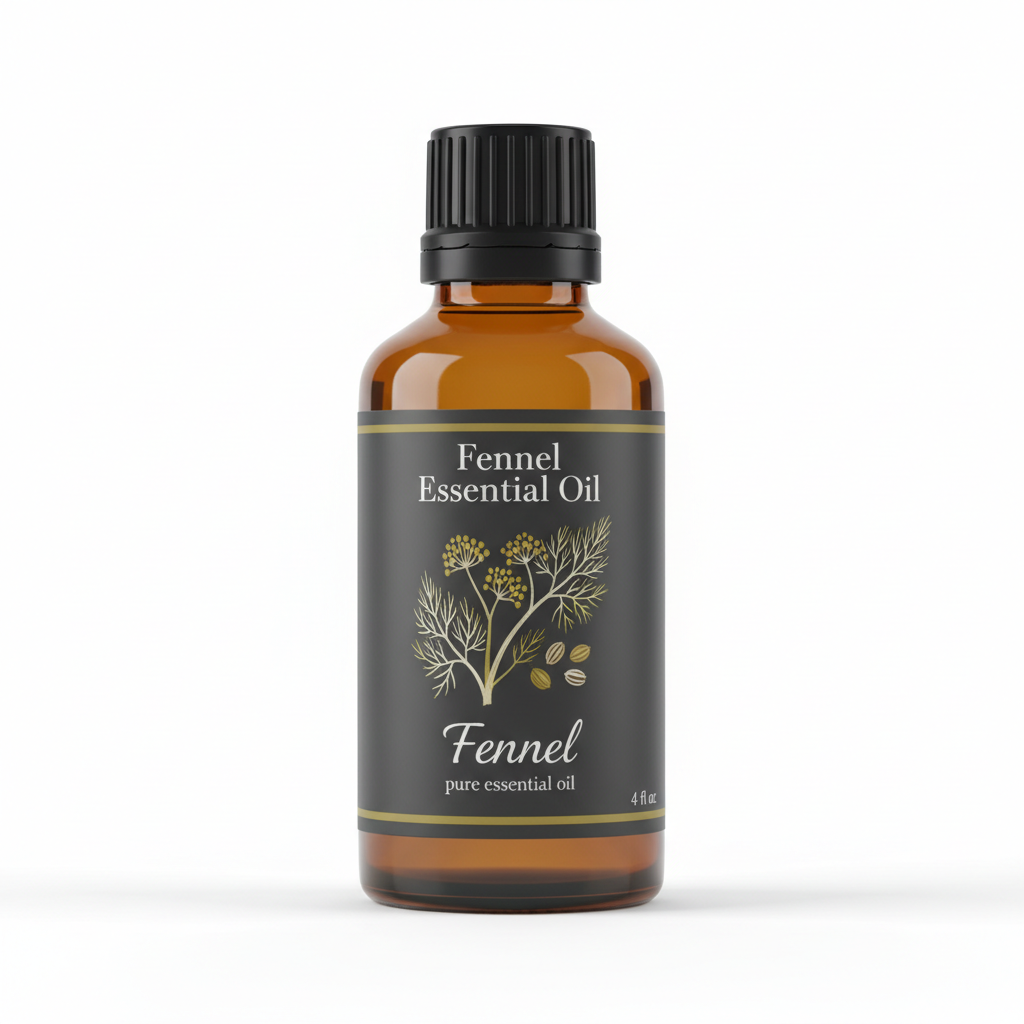
Fennel Essential Oil
Our own Fennel Essential Oil, in sizes from 0.5 oz to bulk.
From $13.99
Shop Now →The one result that started it: nine women and a cup of tea
The study people point to is a 2015 Korean trial published in Clinical Nutrition Research. Nine women (mean age 49.7, mean BMI 24.6) took part in a single-blinded, three-way crossover: fennel tea, fenugreek tea or placebo tea, each followed by a lunch buffet. Food eaten at the buffet did not differ between teas. On visual analogue scales, though, fennel tea lowered hunger, lowered the amount people expected to eat and raised fullness compared with placebo tea (Bae et al., 2015).
That is a real finding, with real limits: nine people, one session per tea, self-reported feelings, and no change in what they ate. It was also tea, a water infusion, not essential oil. A cup of tea cannot stand in for a distilled oil, so no claim about the bottle follows from it. Our evidence overview grades this as limited for appetite and unsupported for weight loss.
The trial that tested weight directly
A 2017 randomized, double-blind, placebo-controlled trial in postmenopausal women with excess weight measured body weight, BMI, waist and hip circumference and fat distribution. In the analysis of 47 women (22 on fennel, 25 on placebo), the fennel group did not differ from placebo on any of them over a 12-week period (the paper's methods text also mentions capsules supplied for 30 days, an inconsistency we cannot resolve). The authors wrote that the fennel group "experienced a slight increase in body weight and fat distribution, which was not significant", and that the result rejected their hypothesis, which had been built on the tea study (Saghafi et al., 2017).
The product was 100 mg soft capsules standardized to 71 to 90 mg of anethole, taken three times a day. It was a secondary analysis, small, and again oral, but it is the more direct test of the thing the claim is about, and it came out flat. The authors suggest fennel "may suppress appetite" yet also slightly raise weight and fat distribution, and ask for further work on both. We read that as: unresolved, and not a basis for a weight claim.
Claim by claim
| Claim you will see | What the sources support | Our reading |
|---|---|---|
| "Fennel oil melts belly fat" | No trial we opened measured fat loss from fennel oil. The capsule trial found no change in fat distribution (Saghafi, 2017). | Unsupported |
| "Fennel suppresses appetite" | Tea, 9 women, subjective ratings, no change in buffet intake (Bae, 2015). | Limited, for tea only |
| "Smelling fennel oil curbs cravings" | The Saghafi authors cite a 2005 Korean study of fennel oil aromatherapy (2 to 4 drops on dried cotton) in obese women, and a rat study in which inhaled essential oils did not change body weight. We could not retrieve either paper. | Unverified by us; do not rely on it |
| "Rubbing it on your stomach shrinks it" | The US Federal Trade Commission: "Nothing you can wear or apply to your skin will cause you to lose weight. Period." (FTC, February 2025) | Contradicted by the regulator's guidance |
| "It balances hormones so menopause weight comes off" | The capsule trial was in postmenopausal women and found no change in weight or fat distribution (Saghafi, 2017). | Not supported |
What would change our reading is simple to state: a randomized, placebo-controlled trial of the oil itself, by the route people actually use, measuring body weight and waist over at least 12 weeks in a few dozen people or more, with the oil's composition reported. We did not find one, and until one exists, "weight loss" belongs in the myth column.
Where the stretch happens
A few steps turn a nine-person tea study into "fennel oil for weight loss", and each one is a leap.
- From appetite ratings to weight. Feeling a bit fuller for hours is not eating less, as the buffet in the first study showed, and eating less is not losing weight over months.
- From tea to oil. The Saghafi paper says the appetite effect in the tea work was attributed to trans-anethole. That is a proposed explanation, and the studies we opened did not test it by giving anethole or oil alone. The oil is also a different concentration and a different route.
- From swallowing to skin or air. The oral trials say nothing about oil on skin or in a diffuser.
- From small studies to marketing. The FTC lists "lose weight without dieting or exercising", "to lose weight, all you have to do is take this pill" and "lose weight with this patch or cream" among the false promises it tells consumers to watch for, and warns that some weight-loss supplements contain drugs or chemicals not on the label (FTC, 2025). A fennel oil that is said to do the same is making the same sort of promise.
Why the swallowing version is the risky one
Anyone wanting fennel's appetite effect is steered toward drinking it, and that is where the cautions sit. The EU herbal committee's monograph covers fennel fruit as a tea, caps adult use at 2 weeks, and says that in the general population exposure to estragole should be kept as low as practically achievable. It sets a limit of 0.05 mg of estragole per person per day for pregnant and breastfeeding women and 1.0 microgram per kg of body weight per day for children under 12 (EMA, 2024). Those are limits for a herbal tea, not for the oil, and applying them to a concentrate is an extrapolation. The direction is clear, though: a tea trial's modest signal does not justify moving to the stronger, less studied form.
What we say about our own bottle
We sell sweet fennel essential oil, steam-distilled from crushed seed, bottled undiluted, in amber glass. It is for aroma and for diluted skin use, and it is not meant for internal use, which is why we do not recommend adding it to water or tea (see can you swallow fennel essential oil). We make no weight claim for it. If you enjoy a belly rub with a fennel-scented oil, that is a pleasant thing to do and it is not a weight-loss method; the practical side, with dilution and cautions, is in the abdominal massage guide.
Safety limits apply regardless of purpose. Dilute to 0.5% to 2% in a carrier oil and patch test for 24 hours. Avoid it if you are pregnant or breastfeeding, have an oestrogen-sensitive condition or epilepsy, and keep it from children and pets. Anyone aiming for weight loss for medical reasons should talk to a physician or a registered dietitian, who can look at the whole picture including medicines; we are neither.
If the real question is "what works"
The FTC calls "lose weight without dieting or exercising" a false promise, which is as plain an answer as a regulator gives. A registered dietitian can build a plan around your history and a physician can check for medical causes or medicines that affect weight; those are the right people, and neither involves an essential oil. For the other folklore that gathers around this oil, our post on fennel oil myths and facts covers it.
So the answer to "where does the claim come from" is a tea trial with nine participants, a capsule trial that found nothing, and marketing that outran both. The evidence overview keeps the full grade table in one place.
Fennel Essential Oil
Fennel Essential Oil from our own shop, in sizes from 0.5 oz to bulk.
From $13.99
Shop Now →Sources & Further Reading
- Bae J, Kim J, Choue R, Lim H, 2015. Fennel (Foeniculum vulgare) and fenugreek (Trigonella foenum-graecum) tea drinking suppresses subjective short-term appetite in overweight women. Clin Nutr Res 4(3):168-174. pubmed.ncbi.nlm.nih.gov
- Saghafi N, Ghazanfarpour M, Khadivzadeh T, Babakhanian M, Afiat M, 2017. The effect of Foeniculum vulgare (fennel) on body composition in postmenopausal women with excess weight: a double-blind randomized placebo-controlled trial. J Menopausal Med. pmc.ncbi.nlm.nih.gov
- European Medicines Agency, HMPC, 2024. European Union herbal monograph on Foeniculum vulgare Miller subsp. vulgare var. dulce, fructus (EMEA/HMPC/372839/2016, revision 1). ema.europa.eu
- US Federal Trade Commission, Consumer Advice, February 2025. The truth behind weight loss ads. consumer.ftc.gov