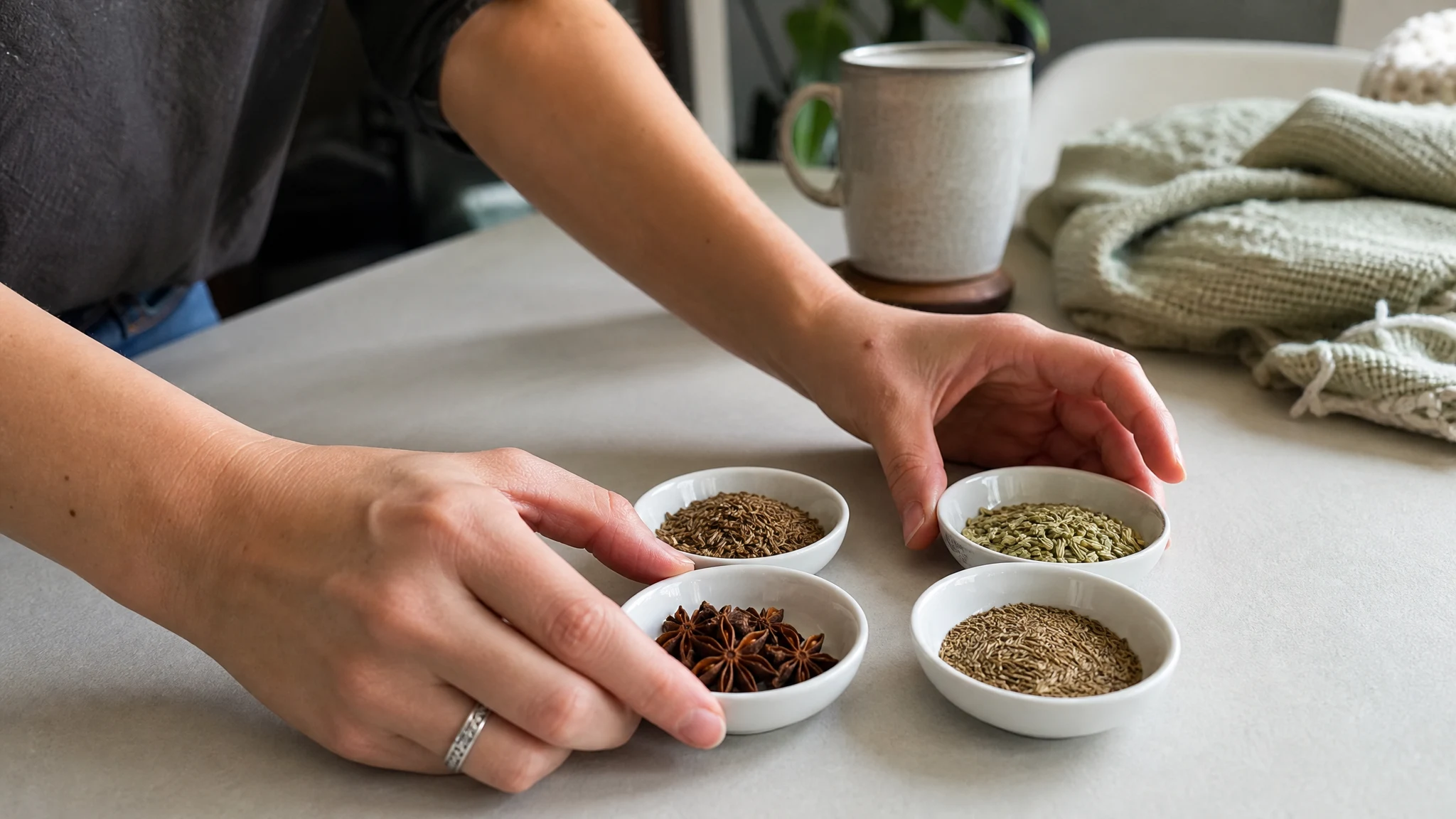
Fennel Essential Oil Substitutes: What Works and What Shares Its Risks
The oils that smell most like fennel are the ones that share the most of its risks. That is the main thing to know before swapping one for another. If you are leaving fennel out because of a safety concern, the closest aroma match is usually the wrong replacement, and the best substitute depends on which job fennel was doing. We sell only fennel, so for every other oil below we are describing published composition and regulator findings, not recommending a product. Our quality guide to buying fennel essential oil covers the case where fennel is still the right oil and you want to choose well.
Fennel Essential Oil
Our own Fennel Essential Oil, in sizes from 0.5 oz to bulk.
From $13.99
Shop Now →First decide why you want a substitute
There are three common reasons, and each points somewhere different.
- You want the scent and cannot get or do not like fennel. You are looking for sweet, anise-like and herbaceous. Anethole is the molecule that does that, and it is the one to understand.
- You are avoiding fennel for safety. Pregnancy, breastfeeding, a child in the house, an oestrogen-sensitive condition, epilepsy, or an allergy. Here the question is not "what smells similar" but "what is different in a way that matters", and the answer is often "less than you hope".
- You want something for a digestion-tradition purpose. Fennel is associated with that in folk use. We have not graded that evidence on this page, and the people to ask about it are a pharmacist or gastroenterologist, not a retailer.
The anethole family: close in smell, close in concerns
Two oils are close chemical relatives of sweet fennel. The European food-safety authority's feed-additive opinion on star anise oil gives a specification of 85 to 93% trans-anethole and 0.5 to 6.0% estragole, with batch means of 88.6% anethole and 3.41% estragole in the four batches it analysed. Because estragole was at 1% or more, the panel classified the oil as suspected of causing genetic defects and cancer, and as a skin and eye irritant and a dermal and respiratory sensitiser (EFSA FEEDAP Panel, 2023). That is a statement about a feed additive, and it still tells you the oil's hazard classification. It does not describe a safer sibling of fennel.
Aniseed oil is the other relative. The fragrance industry's estragole standard lists indicative natural estragole levels of 0.3% for anise seed oil, 3% for sweet fennel oil and 3.3% for star anise oil (IFRA, Amendment 49, 2020, hosted copy). So by that table anise seed oil carries roughly a tenth of fennel's estragole. Do not read that as a green light. The European Medicines Agency's monograph on anise oil, a traditional oral product, contraindicates it for children and adolescents under 18 "because of the lack of data and the presence of estragole". It states that safety in pregnancy and lactation has not been established and that use then is not recommended, and it lists allergic reactions of the skin and respiratory system among undesirable effects (EMA, 2013). The same document reports that ingestion of 1 to 5 mL of anise oil has been associated with nausea, vomiting, seizures and pulmonary oedema. We have a full side-by-side in fennel oil vs anise oil.
The practical consequence is blunt. If you are pregnant or breastfeeding, anise and star anise are not an escape from fennel's cautions, and our fennel oil pregnancy and breastfeeding article sets out why we say leave it out. Your obstetrician-gynecologist or midwife can say what applies to you. Two other oils that appear in the same IFRA table are worse on this one measure: basil oil of the estragole chemotype and tarragon oil are listed at about 80% estragole, so they are not substitutes for anyone worried about it.
Allergy runs across the family, not just the oil
If you are avoiding fennel because of a reaction, the substitute list shrinks further. The EMA monograph's contraindication reads hypersensitivity to "the active substance and to other plants of the Apiaceae (Umbelliferae) family (fennel, caraway, celery, coriander and dill) or to anethole" (EMA, 2013). That wording comes from a medicinal-product monograph, and it is not a rule for aromatherapy, but it is the closest regulator statement on cross-reactivity we found. In plain terms: caraway and dill are botanical relatives of fennel, so a past reaction to fennel is a reason to ask an allergist before trying them. A patch test does not replace that conversation.
Lower in anethole: caraway and dill
If the aim is a spicy, seed-like scent without the anise note, caraway is the nearest. EFSA's 2024 opinion on caraway oil reports a specification of 45 to 65% d-carvone and 30 to 50% d-limonene, with batch means of 52.2% carvone and 44.6% limonene across three batches. It listed anethole at a mean of 0.29% and did not report estragole in the applicant's analyses, although the panel noted the literature gives traces up to 0.1%. It still classed the oil as an irritant to skin and eyes and as a skin and respiratory sensitiser (EFSA FEEDAP Panel, 2024). Our comparison of fennel and caraway seed oils covers the aroma side.
Dill is more tangled, and the type matters. EFSA's 2022 opinion concerns oil from the aerial parts, dill herb oil, not dill seed oil, so it should not be read across to a bottle labelled dill seed. For that herb oil the specification was 28 to 45% carvone, with a mean of 42.2% carvone and 21.5% limonene in five batches. Estragole, myristicin, dillapiole and apiole were not detected, and the oil was classed as an irritant and a dermal and respiratory sensitiser (EFSA FEEDAP Panel, 2022). We did not find an equivalent analysis for dill seed oil, so we cannot say what it contains from a source we opened.
Lower in anethole does not mean low in risk: both opinions above classed the oil as a sensitiser. Dilute, patch test, and follow the seller's own guidance for these oils, which we cannot supply because we do not sell them.
A purpose table
| If you want | Oil to look at | What the sources say | Shares fennel's concerns? |
|---|---|---|---|
| Closest aroma | Star anise oil | Anethole 88.6%, estragole 3.41% (EFSA, 2023) | Yes: same compound, same estragole question, classed as a sensitiser |
| Anise-like, lower estragole | Anise seed oil | IFRA indicative estragole 0.3%; EMA 2013 contraindicates it under 18 and advises against it in pregnancy | Yes, on the regulators' wording |
| Spicy seed note, little anethole | Caraway seed oil | Carvone 52.2%, limonene 44.6%, anethole 0.29% (EFSA, 2024) | Partly: same plant family, still a sensitiser |
| Fresh herbaceous note | Dill herb oil (not seed) | Carvone 42.2%, limonene 21.5%, estragole not detected (EFSA, 2022) | Partly: same plant family, still a sensitiser |
| Anise note from a different plant | Basil or tarragon, estragole type | IFRA lists about 80% estragole for both | Worse on estragole |
| A digestion tradition | See our peppermint comparison, or ask a pharmacist | Not assessed on this page; see the linked post | Different compounds, different cautions |
When the answer is not another oil
For digestion, bloating or cramps, a swap of essential oils is the wrong frame, because the question is whether an aromatic oil is the right tool. We compare fennel with peppermint on that ground in our fennel vs peppermint oil post, and the person to ask about persistent symptoms is a doctor or gastroenterologist. If you want the taste of fennel in food, use the culinary spice, not the oil. If the job is simply a pleasant room scent, any oil you tolerate will do, and a diffuser blend need not include a substitute at all.
If you are replacing fennel because you cannot use it, the safe move is usually to leave the whole anethole group out and choose a scent that does not depend on it. Whether to use any essential oil at all in pregnancy, around infants, or with a medical condition is a clinician's call.
Where fennel itself still fits
Our oil is sweet fennel, steam-distilled from crushed seed, with anethole and estragole quantified by an independent laboratory for each lot and both figures sent on request through the contact page. Our guidance is 0.5% to 2% in a carrier with a 24-hour patch test, no internal use, away from eyes, children and pets. We do not claim it is a better or safer choice than the oils above for any person or condition. We claim only that you can see what is in the lot. For the shopping side, the buying guide lists the documents to ask any seller for.
Fennel Essential Oil
Fennel Essential Oil from our own shop, in sizes from 0.5 oz to bulk.
From $13.99
Shop Now →Sources & Further Reading
- EFSA Panel on Additives and Products or Substances used in Animal Feed (FEEDAP), 2023. Safety and efficacy of a feed additive consisting of an essential oil derived from the fruit of Illicium verum Hook.f. (star anise oil) for use in all animal species. EFSA Journal 21(7):e08182. pmc.ncbi.nlm.nih.gov/articles/PMC10388226
- EFSA FEEDAP Panel, 2024. Safety and efficacy of a feed additive consisting of an essential oil obtained from the fruit of Carum carvi L. (caraway oil) for all animal species. EFSA Journal 22(7):e8906. pmc.ncbi.nlm.nih.gov/articles/PMC11289620
- EFSA FEEDAP Panel, 2022. Safety and efficacy of a feed additive consisting of an essential oil from the aerial parts of Anethum graveolens L. (dill herb oil) for use in dogs and cats. EFSA Journal 20(12):e07689. pmc.ncbi.nlm.nih.gov/articles/PMC9768842
- European Medicines Agency (HMPC), 2013. Community herbal monograph on Pimpinella anisum L., aetheroleum (EMA/HMPC/321185/2012). ema.europa.eu (monograph PDF)
- IFRA, 2020. IFRA Standard: Estragole (Amendment 49). perfumersworld.com (hosted copy)