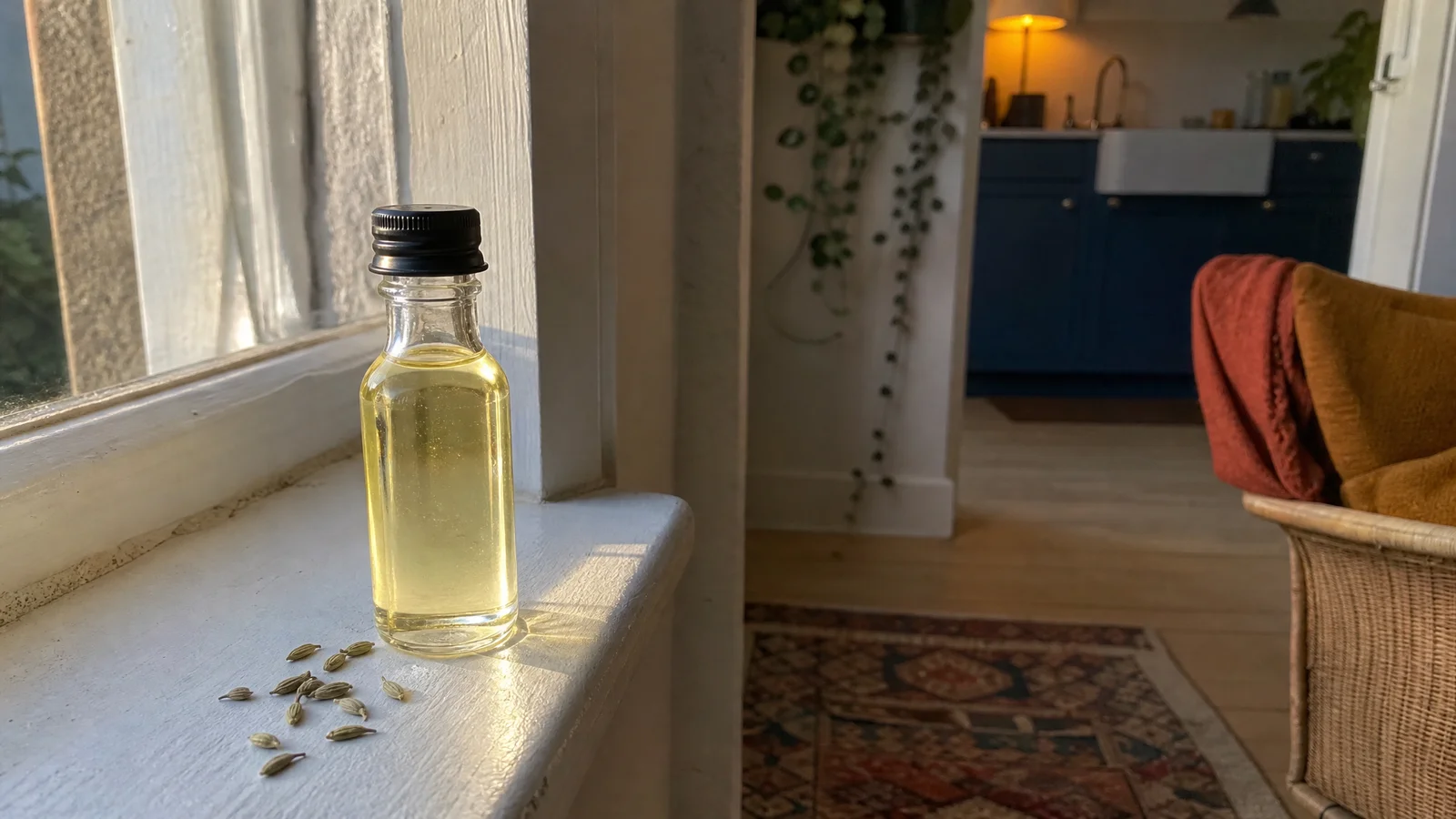
What Does Fennel Oil Smell Like? Sniff to Dry-Down
Open a bottle of fennel oil and the first thing you meet is sweetness, close to licorice, with a brightness that makes you think of a spice drawer or a Mediterranean hillside. Give it a few minutes and it changes: the sugar falls back, and something earthy, grassy and a little peppery takes over.
Fennel Essential Oil
Our own Fennel Essential Oil, in sizes from 0.5 oz to bulk.
From $13.99
Shop Now →Three stages on a paper strip
We describe our fennel oil as sweet and licorice-like at first, then settling into earthy, peppery, herbaceous layers, a top to middle note in perfumery terms. The easiest way to watch that happen is to put a drop on a paper blotter instead of sniffing the bottle neck. A strip lets the oil evaporate gradually, so the stages separate.
- The first minute: the anise sweetness, clean and slightly cool.
- Around fifteen minutes: the herbal and grassy side comes forward, with that faint pepper.
- After an hour: a softer, drier, earthy trace remains.
Treat those timings as a guide to try, since every nose and every room is a little different.
Who is responsible for which note
The science lines up nicely with what the nose reports. In one study, researchers sniffed a commercial fennel oil as it came off a gas chromatography column. Trans-anethole, the main component, scored highest for odour intensity and is the backbone of that fennel sweetness. Fenchone was described as "herb, fragrance" and alpha-pinene as "herb" (Hong et al., 2022). A study of six fennel oils from different regions named ten key odorants and found a panel using words such as spicy, woody, grassy, floral, musty, sweet and green (Xiao et al., 2017).
In plain terms, anethole is the sweetness, and the pinenes, fenchone and estragole are the herbal, grassy backing. For a deeper look, the supporting aroma compounds sorts them out one by one.
Why two fennel oils rarely smell identical
Fennel is a plant, and plants vary. Three things matter most.
The plant part and the distillation. In a study that distilled fennel herb at eight different run times, anethole ranged from about 33 to 59 percent of the oil, with the shortest runs lowest in anethole and highest in fenchone (Zheljazkov et al., 2013). Our oil is steam-distilled from crushed seed, which that study did not test, but it shows how much the method can steer the balance.
Origin and variety. Five authentic fennel distillates from Europe, Sicily and Tasmania averaged 52 percent anethole, 17 percent estragole and 18.5 percent fenchone, while a sweet fennel specification looks for 60 to 82 percent anethole (Murphy et al., 2024; EFSA FEEDAP Panel, 2023). More anethole generally reads sweeter, more fenchone and estragole reads more herbal and camphor-edged. That is our reasoning from the composition, but it matches what the descriptors above suggest.
Age. The Tisserand Institute notes that oxidation can alter an oil's odour (Tisserand Institute, oxidized oils FAQ). For fennel, a stability review reports trans-anethole converting into anisaldehyde or cis-anethole within two months at room temperature under light (Turek and Stintzing, 2013). A fresh bottle kept dark and capped will smell closest to how it began.
A little tasting-room routine for your nose
You do not need training to describe a scent well, only a calm moment and a few habits. Use fresh paper strips and label each one in pencil. Sniff something neutral between attempts, like the crook of your own sleeve, so your nose resets. Open a window, because a stuffy room makes everything smell heavy.
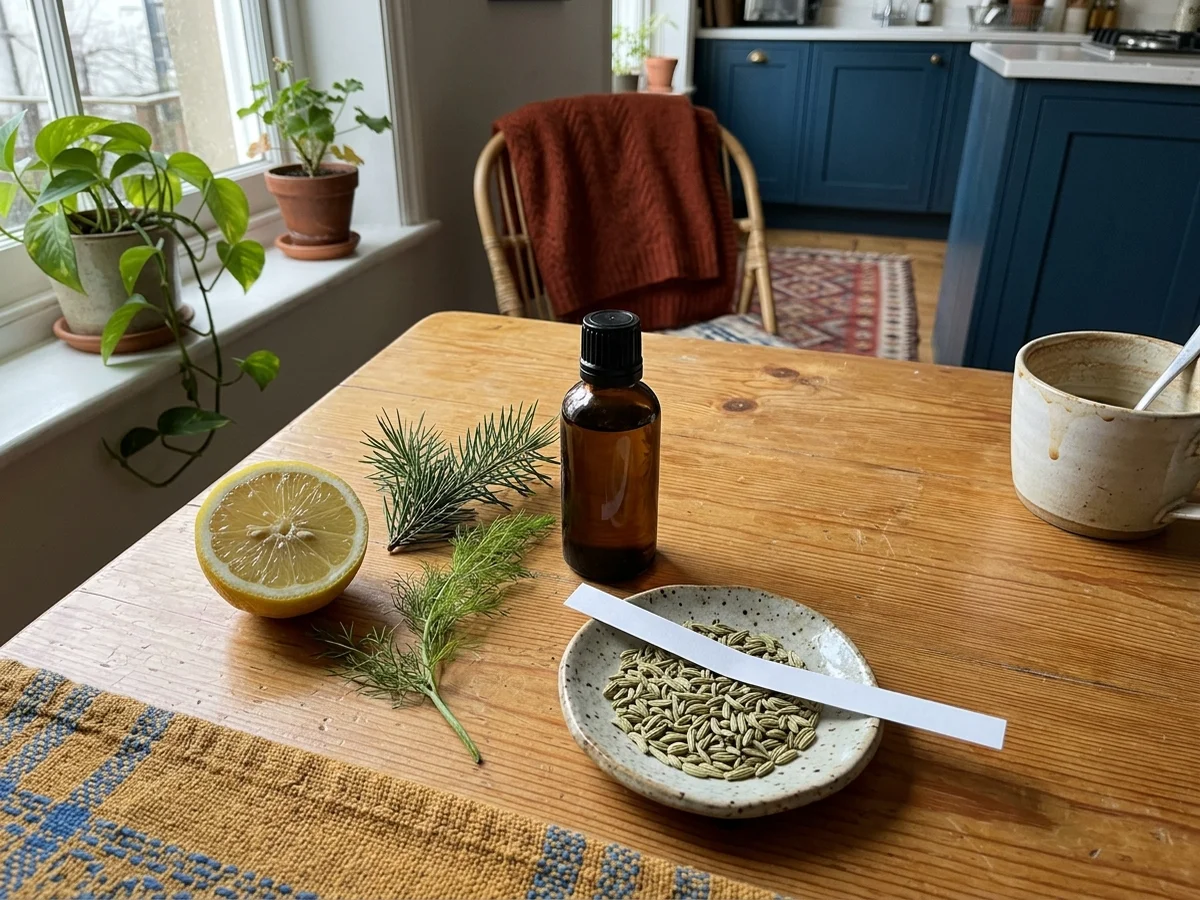
Then borrow words. Sweet, cool, green, grassy, peppery, dry, earthy and spiced are all fair descriptions of fennel at different moments. Jotting three words at the start, the middle and the end gives you a little map of the oil that is yours alone. Return to the strip an hour later and see whether your words still fit.
Using your nose well
Smell is a wonderful guide to what you like and a good freshness check, so use it for those. Compare a new bottle with an older one of the same oil, because a slow drift is easy to miss from memory. Keep sessions short, since strong oils can irritate the nose if you inhale from an open bottle at length.
Smell cannot tell you the variety or the exact composition. A study of 30 commercial anise, star anise and fennel oils found fennel samples flagged as adulterated, and one of them still carried all the expected fennel markers (Murphy et al.). Our nose cannot see what a gas chromatograph can. The Certificate of Analysis we publish covers one batch's density, refractive index, appearance and smell. If you want anethole and estragole for a particular lot, ask us in writing through the contact page.
Where the scent belongs
Fennel is sweet without being sugary, which is why it sits well with citrus, lavender and black pepper, all on our own list of good partners. If you are comparing it with its cousins, fennel oil versus anise oil lays out how they differ, and what blends well with fennel covers pairings. This is an external cosmetic oil: our How It's Made page says to avoid it entirely in pregnancy and breastfeeding, and it is not appropriate for children.
Describe fennel to a friend as sweet first, herbal second, with a peppery whisper, and you will have it about right. Describe it as exactly the same every time, and you will have missed half its charm.
Fennel Essential Oil
Fennel Essential Oil from our own shop, in sizes from 0.5 oz to bulk.
From $13.99
Shop Now →Sources & Further Reading
- Hong SJ et al., 2022. Olfactory stimulation by fennel essential oil improves lipid metabolism and metabolic disorders in high fat-induced obese rats. Nutrients 14(4):741
- Xiao Z, Chen J, Niu Y, Chen F, 2017. Characterization of the key odorants of fennel essential oils of different regions using GC-MS and GC-O combined with partial least squares regression. J Chromatogr B 1063:226-234
- Zheljazkov VD et al., 2013. Fennel essential oil distilled from herb at eight distillation times. J Oleo Sci 62(9):665-672
- Murphy BJ et al., 2024. Authentication of Fennel, Star Anise, and Anise Essential Oils by GC/MS and GC/IRMS. Plants 13(2):214
- EFSA FEEDAP Panel, 2023. Safety and efficacy of feed additives from Foeniculum vulgare (bitter and sweet fennel oil)
- Tisserand Institute. Oxidized oils FAQ
- Turek C, Stintzing FC, 2013. Stability of essential oils: a review. Compr Rev Food Sci Food Saf 12