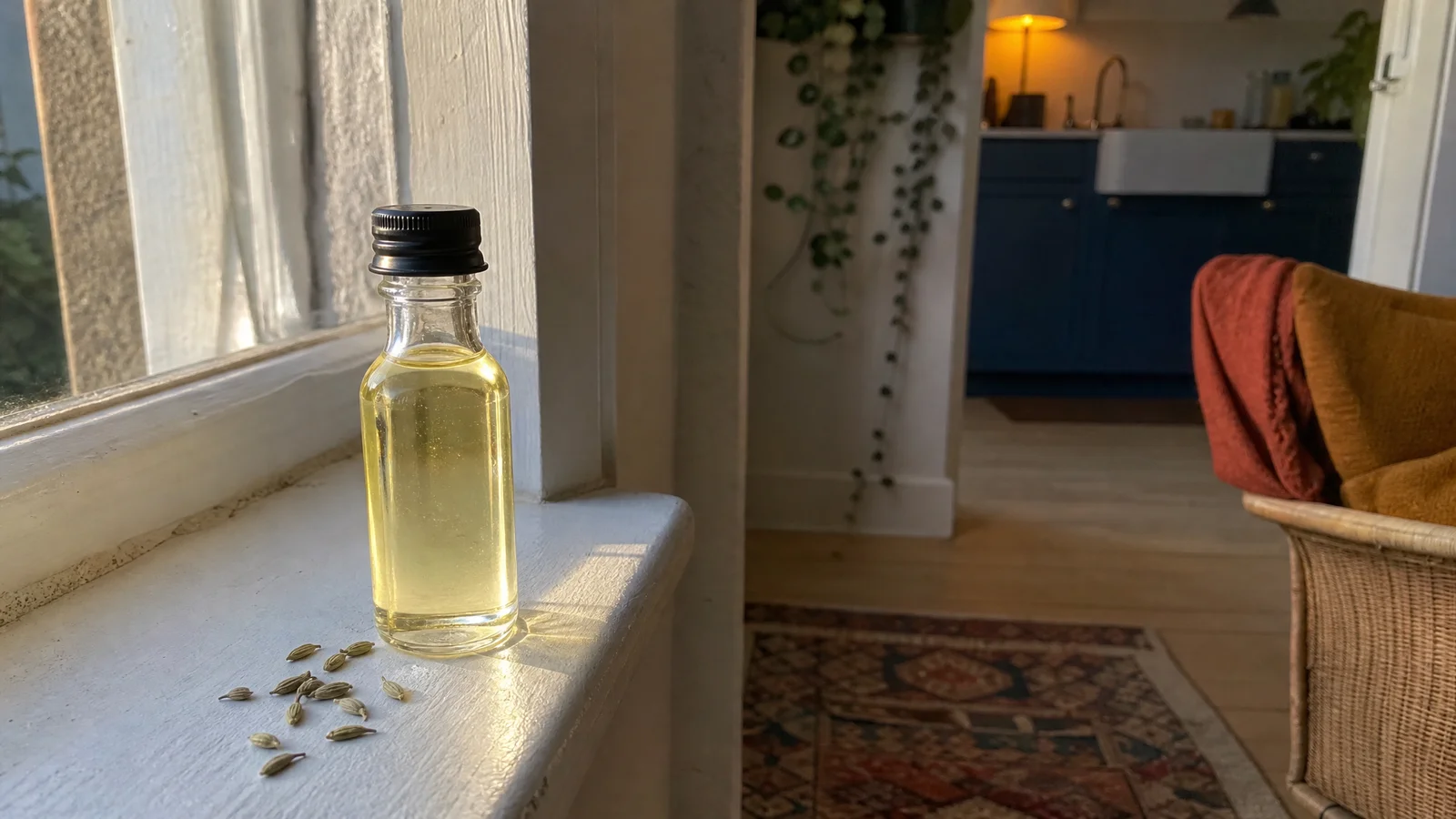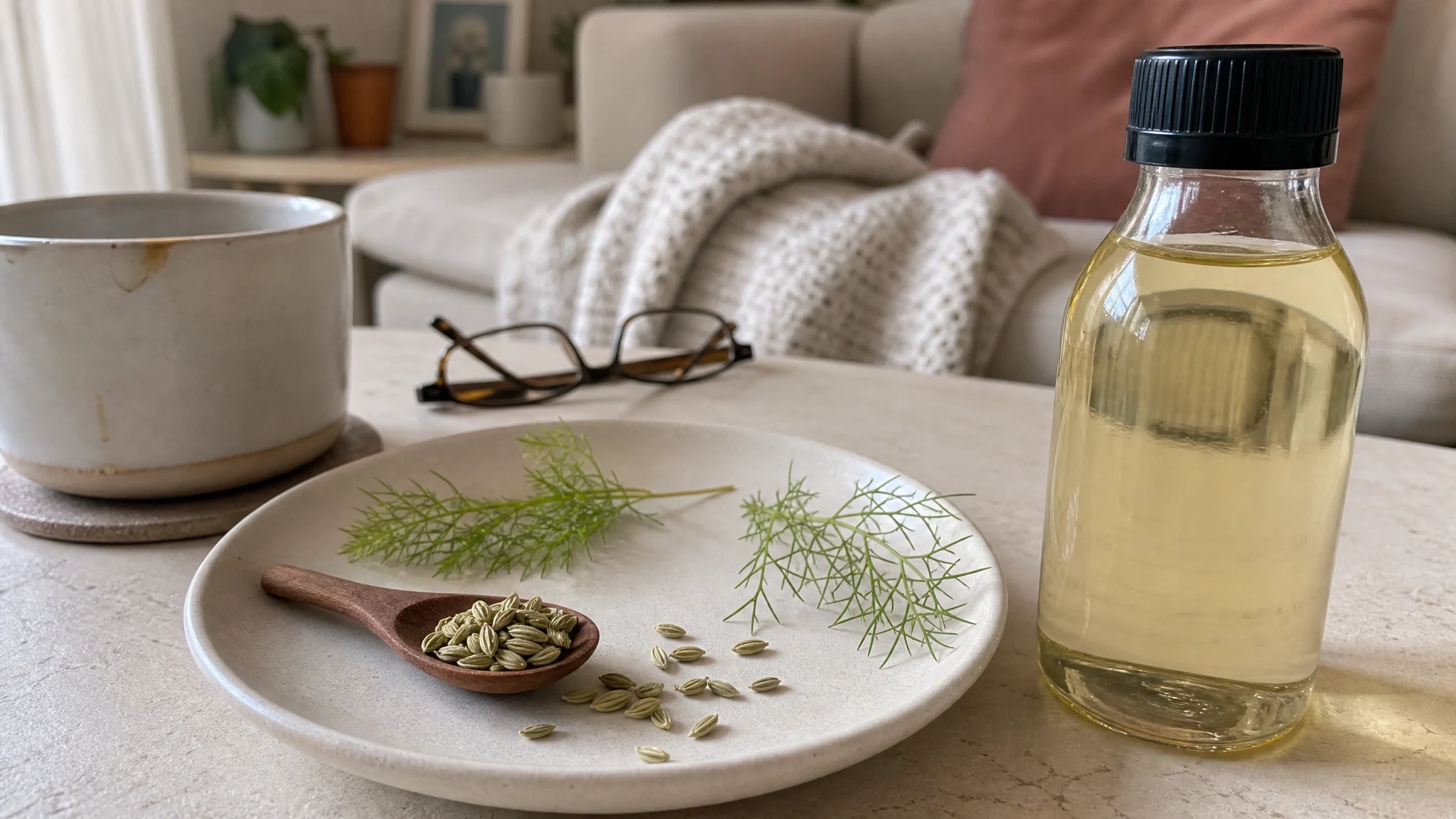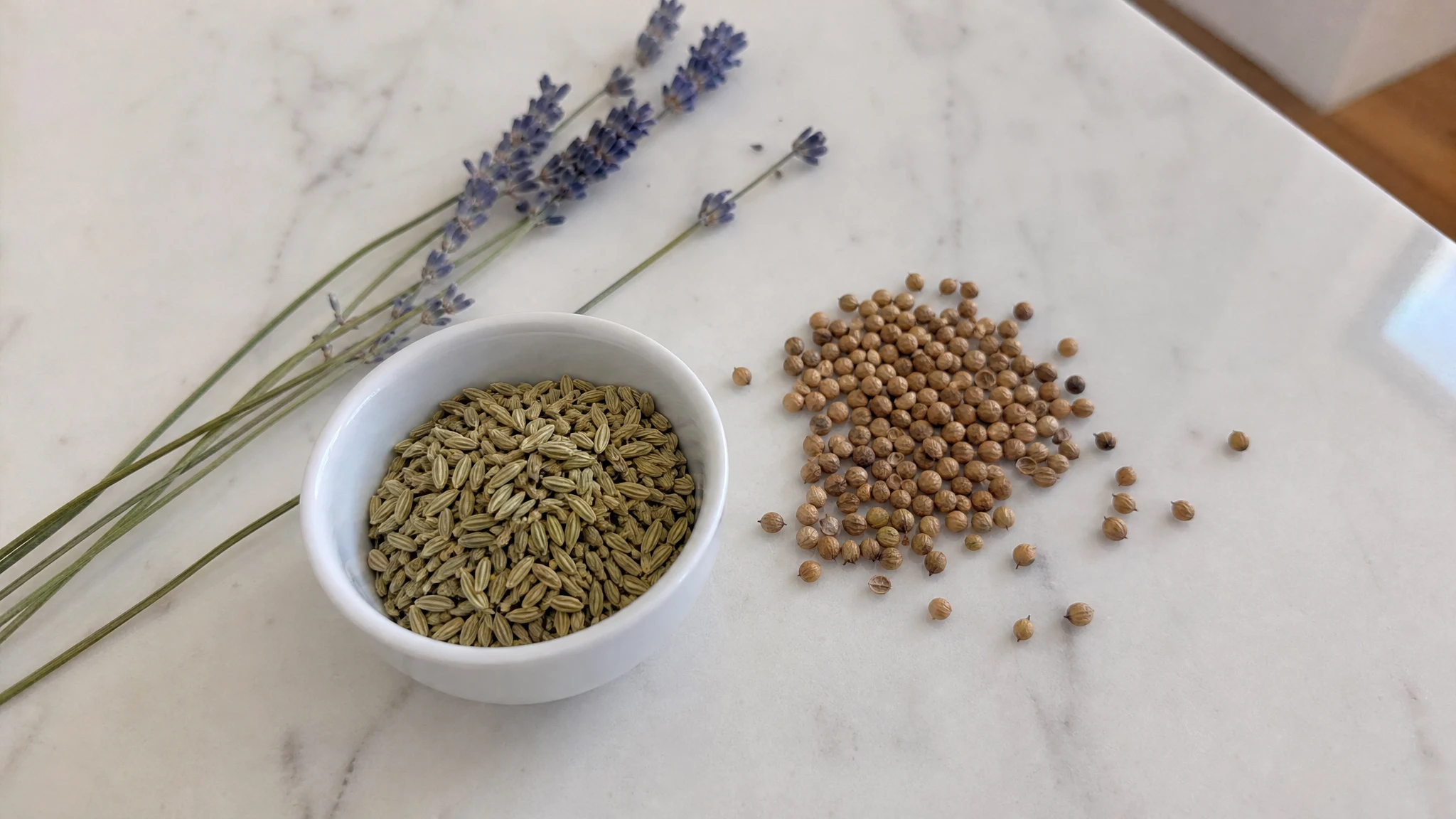
What Gives Fennel Oil Its Smell? Beyond Anethole
If you have ever smelled lavender, bergamot or rose oil and then fennel, you may have wondered where fennel's sweet, faintly floral edge comes from. Linalool, the molecule behind those floral oils, is the obvious guess. It turns out to be the wrong one, and the real supporting cast is more interesting.
Fennel Essential Oil
Our own Fennel Essential Oil, in sizes from 0.5 oz to bulk.
From $13.99
Shop Now →One loud molecule and a herbal chorus
Sweet fennel oil is mostly trans-anethole, the compound that gives anise, star anise and licorice their sweetness. The European Food Safety Authority's specification for sweet fennel oil asks for 60 to 82 percent anethole, and five batches it examined averaged about 78 percent (EFSA FEEDAP Panel, 2023). Behind it stand fenchone, which has a camphor-like, herbal quality, along with limonene, alpha-pinene, alpha-phellandrene and a little estragole. Linalool does not appear in the specification or in the list of minor components, which include anisaldehyde, myrcene, camphor and a few others.
So the sweet, anise-like opening and the herbal, slightly peppery dry-down are built from molecules that have little to do with lavender. That is good news for blending, because it means fennel and lavender come at the nose from different directions instead of repeating each other.
How the supporting notes read to a nose
Researchers have actually asked people to smell fennel oil one compound at a time. In one study, a commercial oil was run through a gas chromatograph with a person sniffing each peak as it came out. Fenchone was described as "herb, fragrance" and alpha-pinene as "herb", while the two anethole forms, estragole, limonene and p-anisaldehyde were all simply called "fennel" (Hong et al., 2022). Anethole scored strongest.
A second study took six fennel oils from different regions, found 30 odour-active compounds, and named ten as the key ones, including alpha-pinene, limonene, estragole, trans-anethole and p-anisaldehyde. A tasting panel used seven words for the oils: spicy, woody, grassy, floral, musty, sweet and green (Xiao et al., 2017). The paper does not tie "floral" to a single molecule, so we will not either. What we can say is that fennel oils are not all identical, and that its range runs wider than just licorice.
When linalool does show up in a fennel report
In the fennel literature, linalool mostly appears as a flag. A 2024 authenticity study of 30 commercial anise, star anise and fennel oils treated linalool as one marker of star anise. The authentic fennel samples had none, and one commercial fennel sample carrying 0.9 percent linalool also lacked fenchone and held a large share of a non-fennel ester (Murphy et al., 2024). That study says nothing about our oil, and a trace of linalool alone proves nothing. It simply gives you a good question to ask whoever sends you a report: does it show anethole and fenchone as well?
That is also why we suggest asking for numbers when they matter to you. The Certificate of Analysis we publish for one batch lists density, refractive index, appearance and smell. If you want anethole, fenchone and estragole for a specific lot, ask us in writing through the contact page before ordering.
Smelling it for yourself
Open the bottle and hold it a hand's width from your nose rather than right under it. The first thing you'll notice is the sweetness, quick and candy-like, and a moment later something drier and greener comes up behind it. That second layer is what keeps fennel from smelling like a licorice stick. Breathe normally, give it a minute, and the peppery edge arrives last.
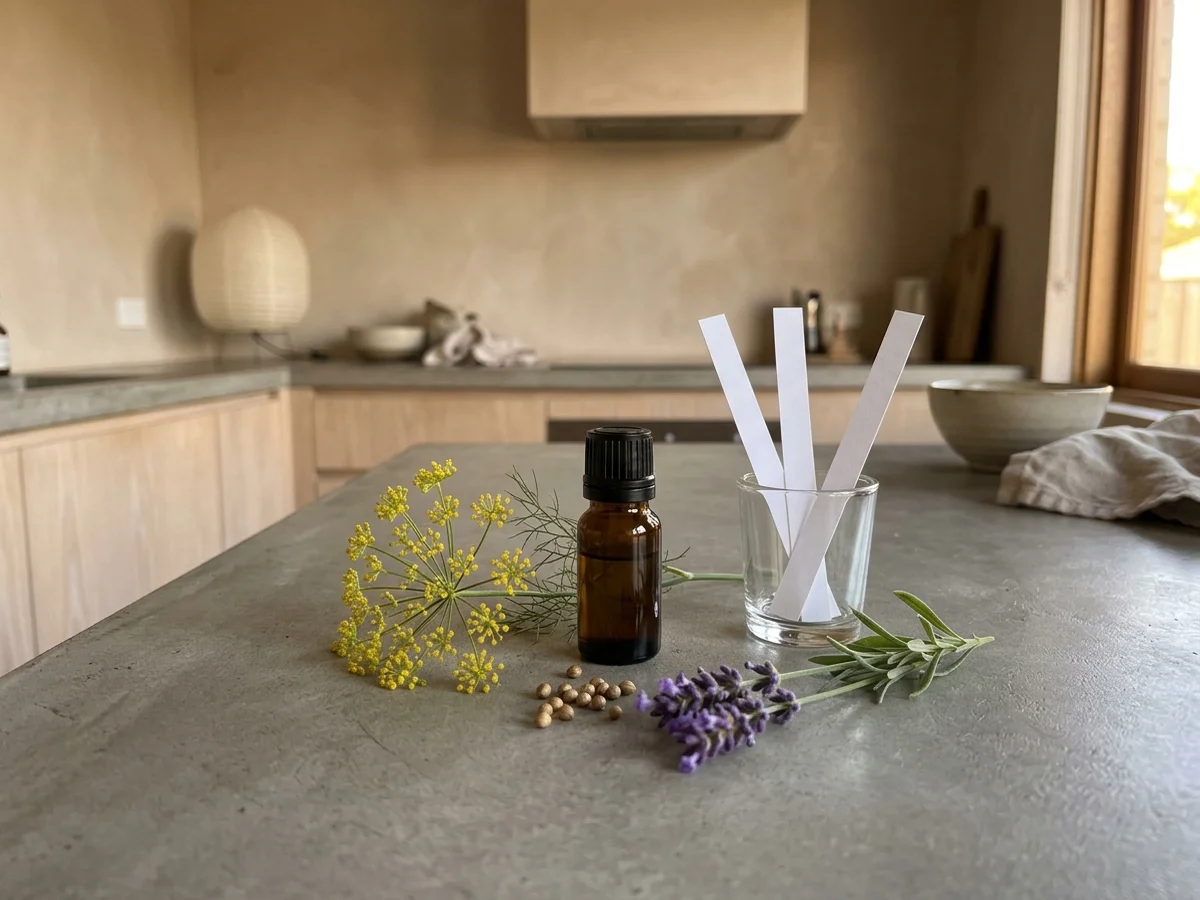
A strip of clean paper makes it easier to follow. Put one drop on it, wave it gently, and smell again every few minutes. The sweet opening fades first and the earthy, herbal part lingers, which is why we describe our oil as a top to middle note. It is a small exercise, and it is the quickest way to learn what all that chemistry sounds like in practice.
Linalool arrives when you blend
You are more likely to meet linalool by blending than by finding it in fennel. Lavender, bergamot and rose-type oils all carry it, and it is a lovely partner. The one thing worth knowing is that linalool and limonene oxidise in air into hydroperoxides that can sensitise skin. In a Danish clinic that patch-tested 6,719 patients over eleven years, 3.1 percent reacted to linalool hydroperoxide (Botvid et al., 2026). Those are dermatology patients, not the general public, so it is not a personal risk figure. It does make a practical point: fresh bottles, kept closed and cool, make better partners than half-empty ones that have sat open on a warm shelf.
Fennel has its own ageing story. A stability review reports that in sweet fennel oil, trans-anethole converted into anisaldehyde or cis-anethole within two months at room temperature in light (Turek and Stintzing, 2013), which is a strong argument for dark glass and a tight cap. Our storage thoughts are in how to store fennel essential oil.
Putting it to use
If you want to follow the nose through all these layers yourself, what fennel oil smells like walks through it, and what blends well with fennel turns the chemistry into pairings. As always, our oil is for external, diluted cosmetic use only, and our How It's Made page asks that it be avoided entirely in pregnancy and breastfeeding and is not appropriate for children.
Fennel's sweetness comes from anethole, its herbal depth from the compounds behind it, and the floral note people wonder about is better credited to the partners you choose than to fennel itself.
Fennel Essential Oil
Fennel Essential Oil from our own shop, in sizes from 0.5 oz to bulk.
From $13.99
Shop Now →Sources & Further Reading
- EFSA FEEDAP Panel, 2023. Safety and efficacy of feed additives from Foeniculum vulgare (bitter and sweet fennel oil)
- Hong SJ et al., 2022. Olfactory stimulation by fennel essential oil improves lipid metabolism and metabolic disorders in high fat-induced obese rats. Nutrients 14(4):741
- Xiao Z, Chen J, Niu Y, Chen F, 2017. Characterization of the key odorants of fennel essential oils of different regions using GC-MS and GC-O combined with partial least squares regression. J Chromatogr B 1063:226-234
- Murphy BJ et al., 2024. Authentication of Fennel, Star Anise, and Anise Essential Oils by GC/MS and GC/IRMS. Plants 13(2):214
- Botvid S, Sogaard R, Schwensen JFB, Johansen JD, 2026. Ten years of patch testing to hydroperoxides of limonene and linalool. Contact Dermatitis 94(5):504-514
- Turek C, Stintzing FC, 2013. Stability of essential oils: a review. Compr Rev Food Sci Food Saf 12