Fennel Oil Color: Why It Looks Pale or Cloudy
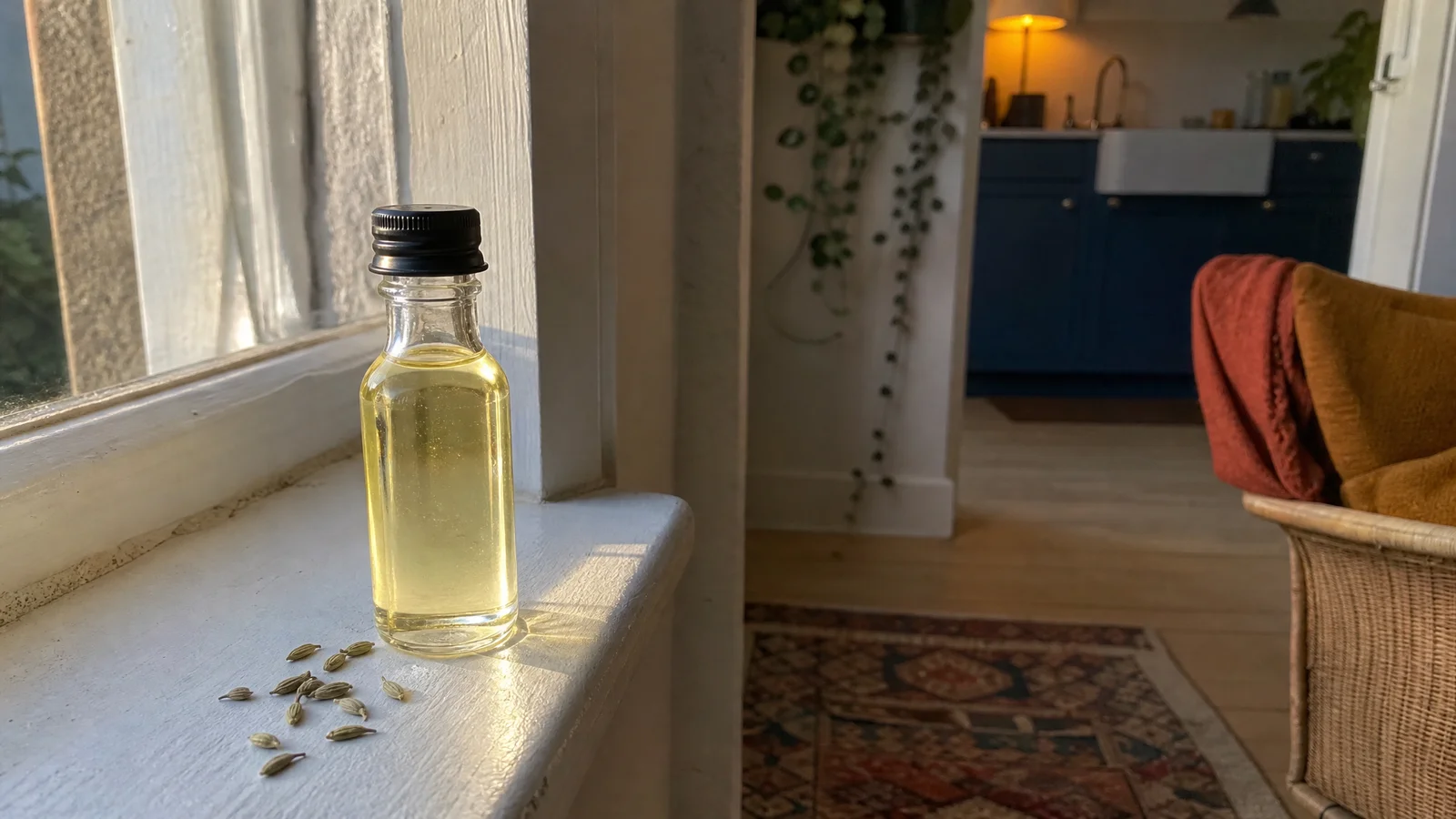
Leave a bottle of fennel oil near a cold window overnight and you may find it hazy, or even streaked with tiny crystals, by morning. It looks alarming and it usually is not. The explanation comes down to the oil's main aroma molecule, and once you know it, a lot of worry about color and clarity goes away.
Fennel Essential Oil
Our own Fennel Essential Oil, in sizes from 0.5 oz to bulk.
From $13.99
Shop Now →What normal looks like
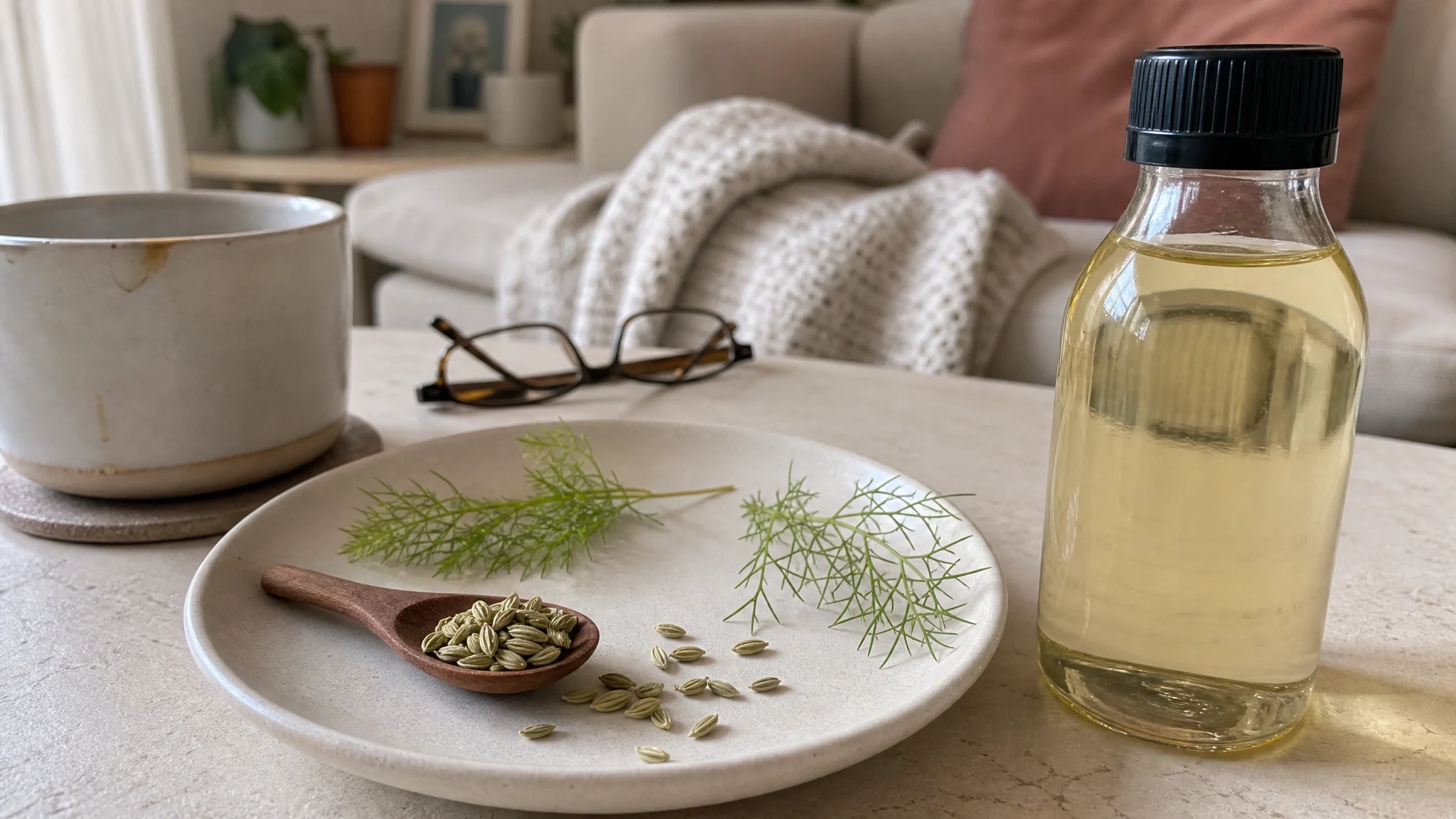
The European Food Safety Authority describes sweet fennel oil as a pale yellow to yellow, clear, mobile liquid with a characteristic aroma (EFSA FEEDAP Panel, 2023). A US dispensatory from 1898 quotes the pharmacopoeia of its day in nearly the same words, "colorless or pale-yellowish" (King's American Dispensatory). So a range of shades from almost clear to light yellow is ordinary.
The Certificate of Analysis we hold for one of our batches lists the color standard as "Yellow liquid" and records that the batch complies, alongside a relative density of 0.975 and a refractive index of 1.546. Those are the numbers we can point to. Two bottles that both comply can still sit a shade apart, and that is normal for a natural material.
The cloudy bottle: it is mostly about anethole
Trans-anethole, the sweet, licorice-like molecule that makes up most of a sweet fennel oil, melts at about 21 degrees C, or roughly 70 degrees F, according to the PubChem entry for anethole. That is only a little below a comfortable room. The 1898 dispensatory adds that fennel oil usually sets to a crystalline mass at 5 to 10 degrees C, and that it is the anethole that crystallizes as the oil cools.
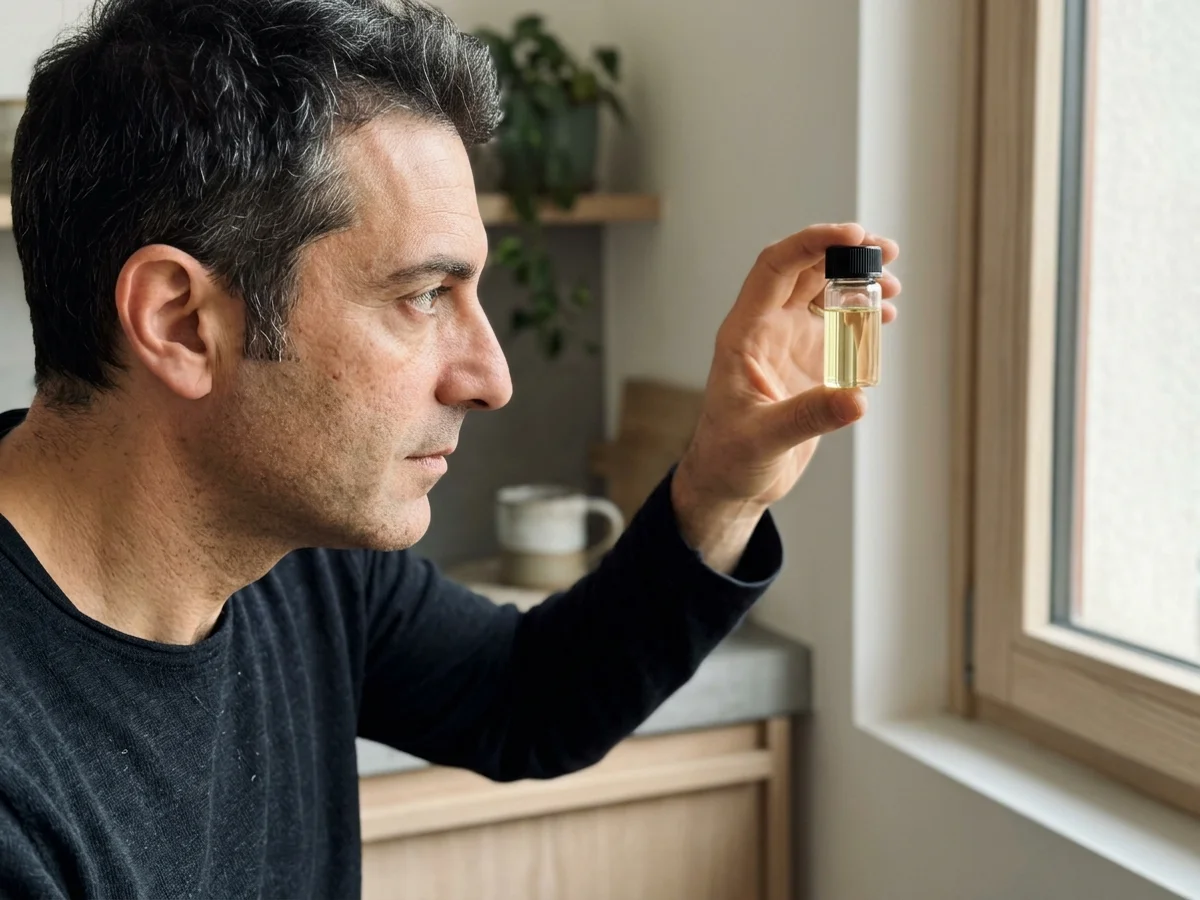
Put those together and the cloudy bottle has a simple reading: a cool room, a cold delivery truck or a drafty shelf nudged some of the anethole toward solid. That is our reasoning from the references rather than a measured result for our oil, but it matches what the old and new sources describe.
What to do with it:
- Let the capped bottle come back to room temperature and wait. It should clear on its own.
- Skip hot water and heaters. Heat, light and moisture all encourage oxidation, according to the Tisserand Institute, so gentle and slow is better.
- Give it a swirl once it is clear, because crystals and liquid may not have the same makeup and you want an even mix before you measure.
The darker bottle
Fennel oil does change with age. A well-known review of essential oil stability describes sweet fennel oil in which trans-anethole had oxidized to anisaldehyde, or flipped to its cis form, after two months at room temperature under light (Turek and Stintzing, 2013). That is the practical reason we bottle in amber glass and why a tight cap and a cool, dark cupboard are worth the small effort.
What none of these sources do is link a particular shade to a particular degree of aging. The Tisserand Institute lists an altered smell as the sign to watch for, not color. So we would not call a darker bottle spoiled on looks alone, and we would not call an unchanged one fresh on looks alone. A dull, flat or sharp aroma is a better clue than a shade. Our guide to storing fennel oil covers the habits that keep the scent bright.
Why color cannot vouch for what is inside
A 2024 laboratory study of commercial anise, star anise and fennel oils found fennel samples carrying 43.2% triethyl citrate and 35.4% capryl palmitate, and caught them with gas chromatography and isotope analysis rather than by eye (Murphy et al., Plants, 2024). The paper reports no color for any sample. The takeaway is a friendly one: the shade of the bottle is a nice thing to notice, but the lot report is where the answers are. If you want to go deeper, see how to check fennel oil before you buy and how to read a GC-MS report. If you would like the report for a lot of ours, ask us in writing through the contact page before ordering.
Keeping your own record
Because amber glass hides the oil, it is worth making your own small habit of looking at it. Write the date you opened the bottle on the label, and now and then note how the oil looks on a white dish and how it smells. After a few months you have a personal reference that no description online can give you, and you'll spot a change in aroma long before a change in shade would tell you anything.
We bottle in amber glass for a reason, and the price of that choice is that you can't admire the color through the bottle. Pour out a drop and look, now and then, just to keep your eye in.
A simple way to compare shades
Because amber glass hides the oil's color, put a single drop on a clean white dish in daylight if you want to compare one bottle with the next. That is just a convenient way to look at two samples side by side, not a standard method. The oil is undiluted, so keep it away from your eyes and wash your hands afterward.

Pale yellow is what we expect, a hazy bottle in winter is a cue to wait for room temperature, and the nose will tell you more about age than the eye will.
Fennel Essential Oil
Fennel Essential Oil from our own shop, in sizes from 0.5 oz to bulk.
From $13.99
Shop Now →Sources & Further Reading
- EFSA FEEDAP Panel, 2023. Safety and efficacy of fennel oils (sweet and bitter) as feed additives
- Felter HW, Lloyd JU, 1898. King's American Dispensatory, Foeniculum oil entry
- PubChem. Anethole, melting point section
- Tisserand Institute. Oxidized oils FAQ
- Turek C, Stintzing FC, 2013. Stability of essential oils: a review. Comprehensive Reviews in Food Science and Food Safety 12
- Murphy et al., 2024. Authentication of fennel, star anise, and anise essential oils by GC/MS and GC/IRMS. Plants 13(2)