Fennel vs Caraway Oil: Two Spice Seeds, Two Scents
Fennel and caraway sit side by side in the spice drawer, so it is natural to assume their oils are near twins. Open the chemistry and they turn out to be built on entirely different foundations. That difference is the whole story of how to choose between them.
Fennel Essential Oil
Our own Fennel Essential Oil, in sizes from 0.5 oz to bulk.
From $13.99
Shop Now →Two oils, two lead molecules
Fennel oil is organized around anethole. Sweet fennel oil is cited at 60% to 80% (E)-anethole, with a few percent of estragole and a camphor-like note from fenchone. Caraway is another matter. In a Serbian study of annual caraway from three growing areas, carvone and limonene together made up between 97.7% and 98.6% of the oil, which leaves almost no room for anything else. EFSA's 2024 opinion backs the same picture: a specification of 45% to 65% carvone and 30% to 50% limonene, with anethole present at only about 0.3%.
So the shared "spice seed" reputation is real, but it describes the plant family and the kitchen, not the bottle. We sell fennel only, and if you want the sweet, anise-like opening that settles into earthy and peppery depths, that is the oil to look at. Caraway answers a different brief, and you would find it at another supplier.
Picture the spice drawer
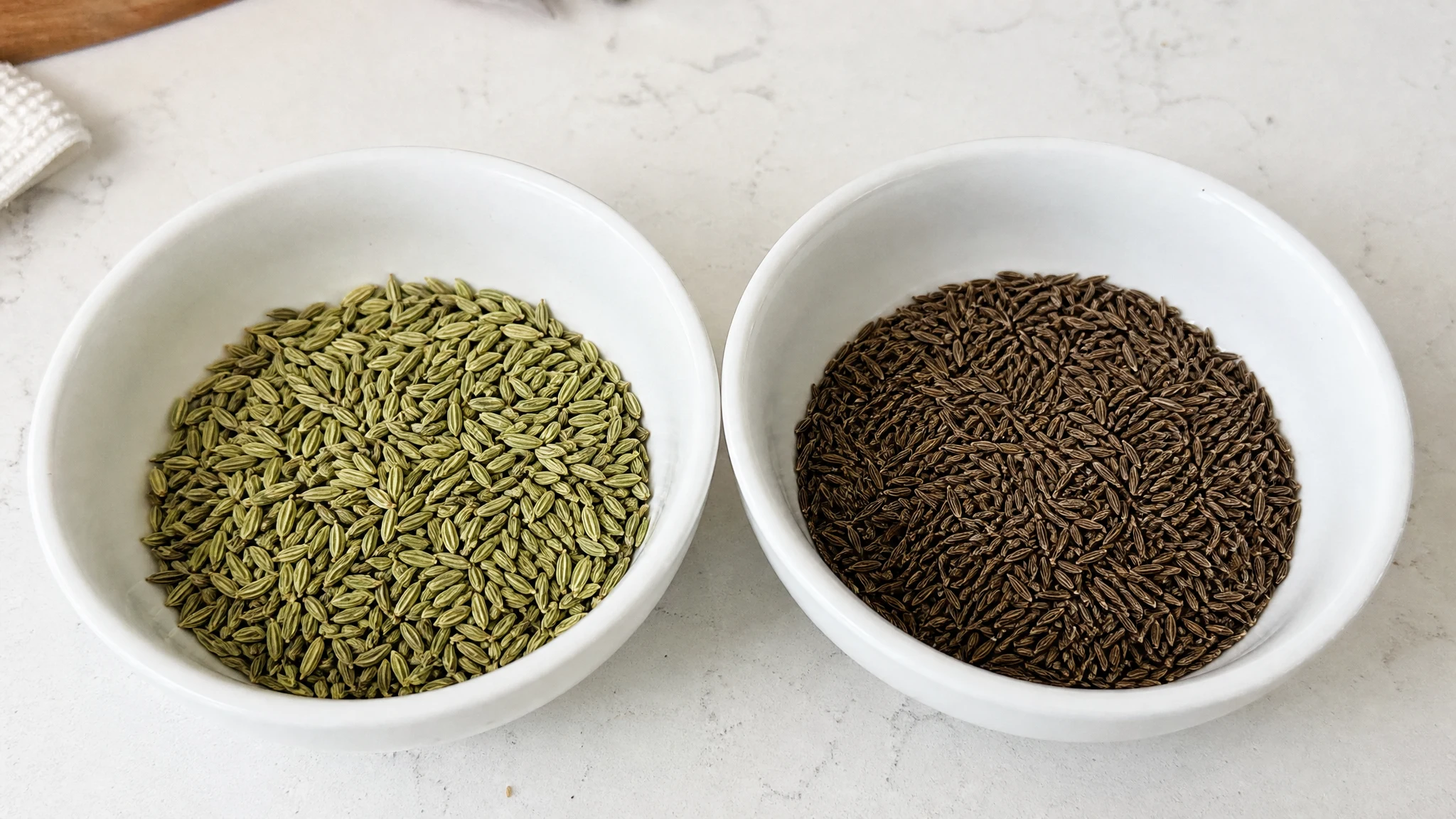
Think about how you meet these two seeds in real life. Caraway is the savory one: rye bread, sauerkraut, a stew in cold weather. Fennel is the sweeter one: the licorice-scented curls that turn up in sausage, in breads, and in the little bowl by the door at some restaurants. Both are seeds, both smell like a kitchen, and yet nobody confuses them once they are in their jars.
The oils carry that same split. Our fennel oil opens sweet and anise-like before it settles into earthy, peppery layers. If your idea of a perfect spice blend is bread and rye and savory warmth, you may be looking for something other than fennel, and that is worth knowing before you plan a recipe around it.
Why it matters if you are making something
Each oil has one component that sets how much of it a finished product can hold. For fennel it is estragole. For caraway it is carvone. IFRA publishes a limit for each by product category, and a little division turns those limits into a ceiling for the oil itself.
Take a body oil or lotion, IFRA category 5A. The estragole limit there is 0.075%. If a sweet fennel oil carries estragole at the 3.76% EFSA measured as a batch mean, the oil can make up about 2% of the product. Caraway is governed by a carvone limit of 0.20% for the same category; at IFRA's indicative figure of about 59% carvone in caraway seed oil, that works out to roughly 0.34%. In other words, on this one measure caraway has a tighter ceiling than fennel in a leave-on product.
Two honest notes on that arithmetic. It is our own division, it counts a single component, and your lot's real figures replace the indicative ones. And it says nothing about scent or about which oil is better, only about how much of each fits.
Caraway is not one thing either
The Serbian study's average carvone-to-limonene ratio of 0.58 means that caraway grown there leaned toward limonene, not carvone, which surprises people who assume carvone leads. Other crops and origins will differ. The takeaway applies to fennel just as much: the plant name on a label leaves room for a lot of variation, so ask for the lot's figures. We say more about that in sweet vs bitter fennel oil and in our guide to reading a fennel oil label and GC-MS report.
A smell test worth doing
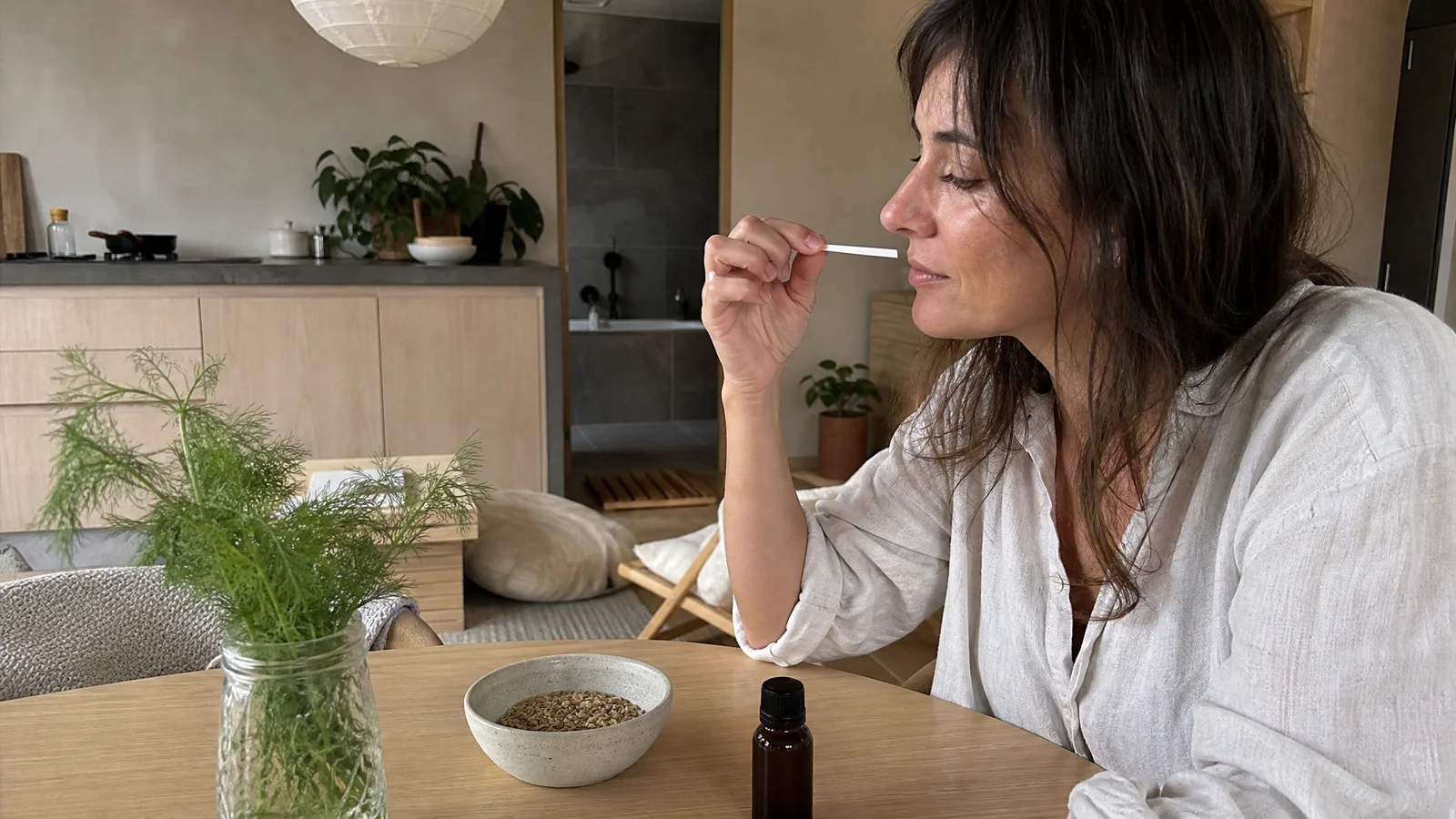
If you can get a sample of each, smell them on separate paper strips and write what you notice in plain words, not trade words. "Sweet candy", "bread crust", "grass", "pepper". Do it twice, once fresh and once after ten minutes. You will end up with your own vocabulary for each oil, which is more helpful than any listing.
Choosing between them
Start with the scent, and smell before you decide, because adjectives in listings are not standardized. Then match the use: for leave-on products the tables above give fennel more room, and for a diffuser your device guidance governs. If the question is who should avoid fennel, we say plainly to leave it out in pregnancy and breastfeeding, around children, and with an oestrogen-sensitive condition or epilepsy, and to ask a physician or pharmacist about any other oil in those situations.
For our own oil, the Certificate of Analysis we publish for one batch lists density and refractive index. If you need the variety, anethole or estragole for a lot, ask us in writing through the contact page. For the oil closest to fennel in chemistry, see fennel and anise oil, and for the wider field of alternatives, finding a stand-in for fennel oil.
The short version: fennel and caraway share a spice rack and very little else, and the better oil is simply the one built around the molecule your project needs.
Fennel Essential Oil
Fennel Essential Oil from our own shop, in sizes from 0.5 oz to bulk.
From $13.99
Shop Now →Sources & Further Reading
- Hort. Sci. (Prague) 41(3):122-130, 2014. Evaluation of caraway essential oil from different production areas of Serbia. https://hortsci.agriculturejournals.cz/artkey/hor-201403-0004_evaluation-of-caraway-essential-oil-from-different-production-areas-of-serbia.php
- EFSA FEEDAP Panel, 2024. Safety and efficacy of a feed additive consisting of an essential oil obtained from the fruit of Carum carvi L. (caraway oil). EFSA Journal 22(7):e8906. https://pmc.ncbi.nlm.nih.gov/articles/PMC11289620/
- Murphy BJ et al., 2024. Authentication of Fennel, Star Anise, and Anise Essential Oils by GC/MS and GC/IRMS. Plants 13(2). https://pmc.ncbi.nlm.nih.gov/articles/PMC10818908/
- EFSA FEEDAP Panel, 2023. Safety and efficacy of feed additives from Foeniculum vulgare Mill. ssp. vulgare: bitter fennel oil and sweet fennel oil. https://pmc.ncbi.nlm.nih.gov/articles/PMC10613937/
- IFRA, 2020. IFRA Standard: Estragole (Amendment 49). https://www.perfumersworld.com/documents/Project-Templates/IFRA-Standards/Estragole.pdf
- IFRA, 2020. IFRA Standard: Carvone (Amendment 49). https://www.perfumersworld.com/documents/Project-Templates/IFRA-Standards/Carvone.pdf