Fennel Oil Substitutes: What to Use Instead
Ask ten people what to use instead of fennel oil and you will get ten answers, because they are really answering ten different questions. Some want the sweet, licorice-like scent. Some want a seed-spice note without the licorice. Some are leaving fennel out for a personal reason and want something that behaves differently. The best stand-in depends entirely on which of those you are.
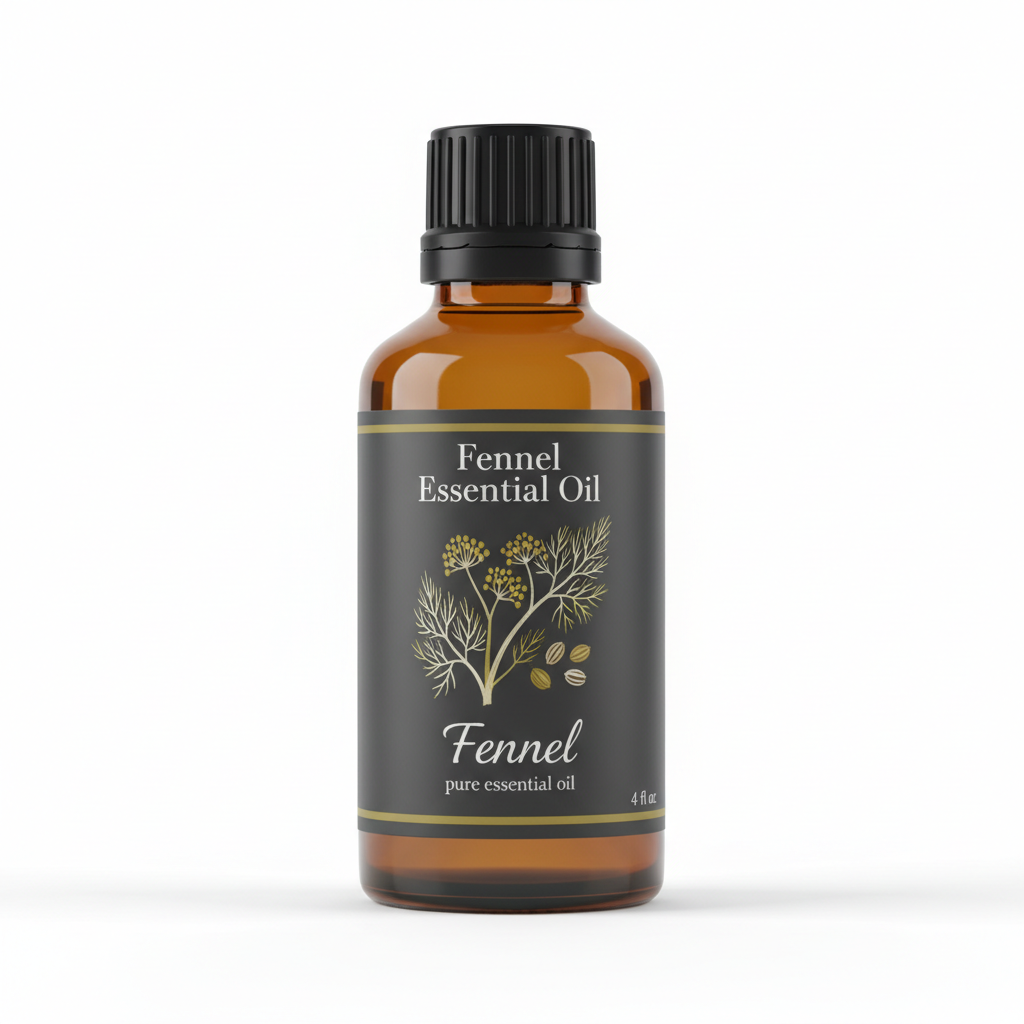
Fennel Essential Oil
Our own Fennel Essential Oil, in sizes from 0.5 oz to bulk.
From $13.99
Shop Now →If it is the scent you are after
Fennel smells the way it does largely because of one molecule, trans-anethole. Sweet fennel oil is specified at 60% to 80% anethole in the French standard, and anise and star anise oils are built on the same molecule at even higher shares. That is why they are the closest match to the nose: they are chemical cousins, not just look-alikes.
Anise oil is the purest expression of that sweet, licorice note. In the five Spanish batches EFSA reported in 2023, anethole averaged 90.0%, while estragole averaged just 0.82%. Star anise oil sits close by; in the 2024 authentication study, authentic star anise distillates from China and Vietnam averaged 86.1% anethole and 3.1% estragole. If you want the scent, either is a natural stand-in, and our side-by-side in fennel and anise oil shows where the two diverge. We do not sell either, so you would find them at another supplier.
The one thing to know is that these oils share more than a scent. Both are anethole oils with an estragole component, so whatever reasons you have for leaving fennel out usually apply to them too. A swap within the family changes the aroma slightly and the underlying chemistry hardly at all.
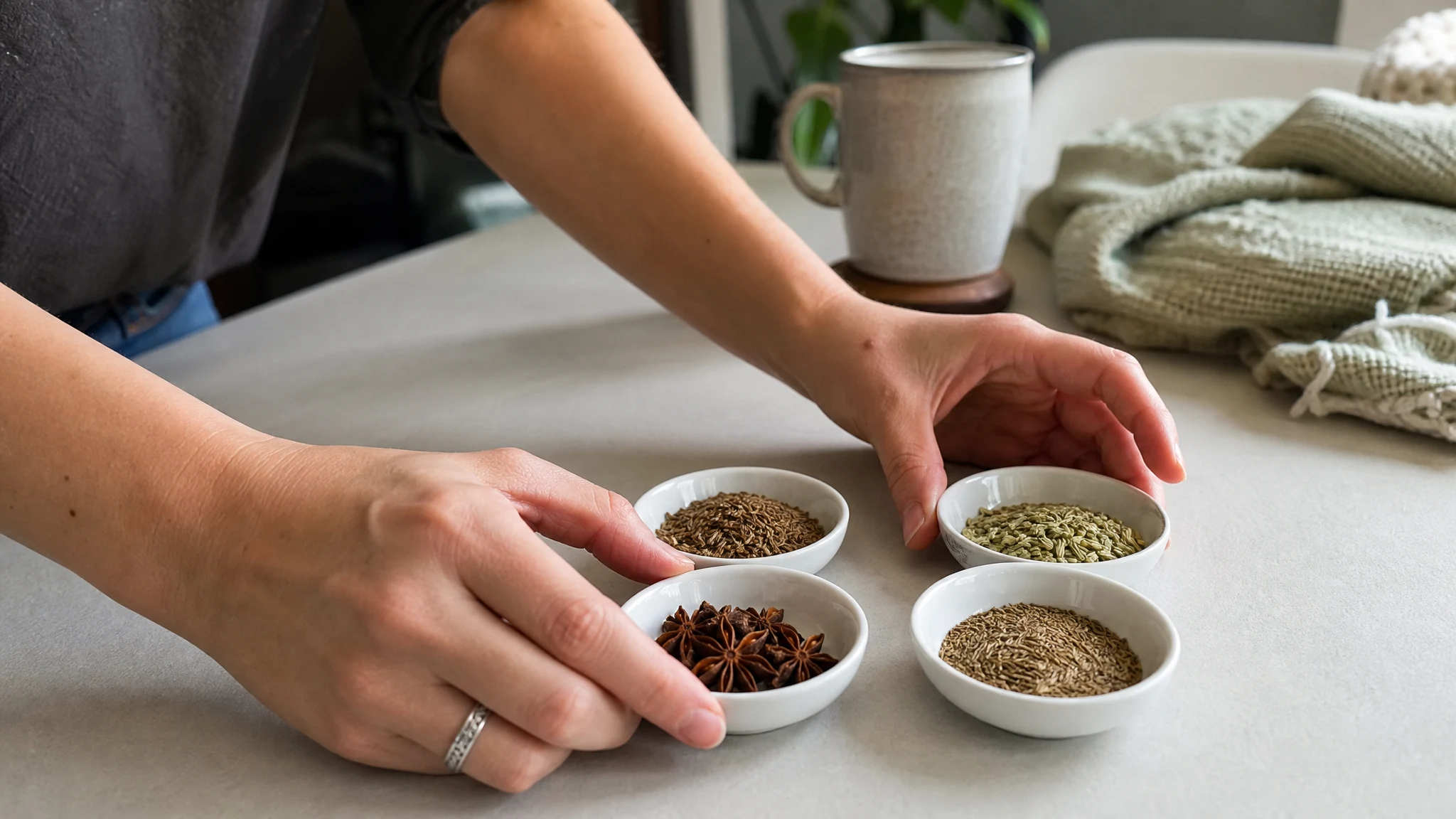
If you want a seed-spice note without the anise
Caraway oil is the more interesting alternative, because it is a different animal. EFSA's 2024 opinion gives a specification of 45% to 65% carvone and 30% to 50% limonene, with anethole showing up at a mean of only 0.29% across six batches. So it sits in the same spice-rack neighborhood while being built on entirely different compounds. We walk through that contrast in fennel vs caraway oil.
It is worth knowing that caraway and fennel belong to the same plant family, Apiaceae, along with celery, coriander and dill. The European Medicines Agency lists hypersensitivity to plants of that family, or to anethole, as a contraindication for fennel preparations. That is a statement about medicinal products, not about scenting a room, but the practical reading is simple: if a past reaction to fennel is the reason you are looking elsewhere, a close botanical relative is not an obvious fix, and an allergist is the person to ask.
If fennel is out for personal reasons
Pregnancy, breastfeeding, young children, epilepsy and oestrogen-sensitive conditions are the situations where we say plainly to leave fennel oil on the shelf. In those cases the better question is whether an aromatic oil is needed at all, rather than which one replaces fennel. A midwife, pharmacist or physician is the right person to talk it through with, and they will know your circumstances in a way no article can.
For a room, a different scent family altogether, such as a citrus or a woody note, simply avoids the question. If it is the flavor of fennel you miss, the kitchen spice does that job far better than any bottle of oil. And if the real goal was digestion, we put fennel next to peppermint in fennel vs peppermint oil, which is a better frame than swapping one aromatic for another.
How to try a stand-in sensibly
Do not swap oils one for one by drops. Different oils have different strengths on the nose, so begin with less of the substitute than the recipe asks for fennel and work up. Put a drop on a paper strip, smell it at the start and again after a few minutes, and write down what you notice.
It also helps to ask yourself a few questions before you shop:
- Is it the sweet licorice note I miss, or the herbal, peppery depth underneath?
- Is this for a diffuser, a soap or a skin product? Each use has its own limits, and a supplier should be able to share them.
- Does anyone in the household need me to leave a whole family of oils out?
Answer those first and the shortlist usually writes itself. When in doubt, buy the smallest size and smell before you commit to more.
When fennel is still the right oil
Our oil is steam-distilled from crushed Foeniculum vulgare seed, and our shop describes it as sweet fennel with an anise-like opening that settles into earthy, peppery, herbaceous layers. If that profile is what you want and nothing in your situation rules it out, nothing else quite reproduces it. For skin use our general guidance is 0.5% to 2% in a carrier oil with a patch test first, and it is for external use only. If you want the anethole, estragole and variety figures for a particular lot, ask us in writing through the contact page before ordering. Our buying guide covers what else to ask any seller.
Whatever you end up choosing, let the job decide the oil. A scent twin, a spice cousin and an honest "no oil needed" are three different answers to three different questions.
Fennel Essential Oil
Fennel Essential Oil from our own shop, in sizes from 0.5 oz to bulk.
From $13.99
Shop Now →Sources & Further Reading
- Murphy BJ et al., 2024. Authentication of Fennel, Star Anise, and Anise Essential Oils by GC/MS and GC/IRMS. Plants 13(2). https://pmc.ncbi.nlm.nih.gov/articles/PMC10818908/
- EFSA FEEDAP Panel, 2023. Safety and efficacy of feed additives obtained from the fruit of Pimpinella anisum L. (anise oil). EFSA Journal 21(4):e07976. https://pmc.ncbi.nlm.nih.gov/articles/PMC10117170/
- EFSA FEEDAP Panel, 2024. Safety and efficacy of a feed additive consisting of an essential oil obtained from the fruit of Carum carvi L. (caraway oil). EFSA Journal 22(7):e8906. https://pmc.ncbi.nlm.nih.gov/articles/PMC11289620/
- European Medicines Agency (HMPC), 2024. Assessment report on Foeniculum vulgare subsp. vulgare var. vulgare and var. dulce, fructus (EMA/HMPC/240553/2016). https://www.ema.europa.eu/en/documents/herbal-report/final-assessment-report-foeniculum-vulgare-miller-subsp-vulgare-var-vulgare-foeniculum-vulgare-miller-subsp-vulgare-var-dulce-mill-batt-trab-fructus-revision-1_en.pdf-0
- IFRA, 2020. IFRA Standard: Estragole (Amendment 49). https://www.perfumersworld.com/documents/Project-Templates/IFRA-Standards/Estragole.pdf